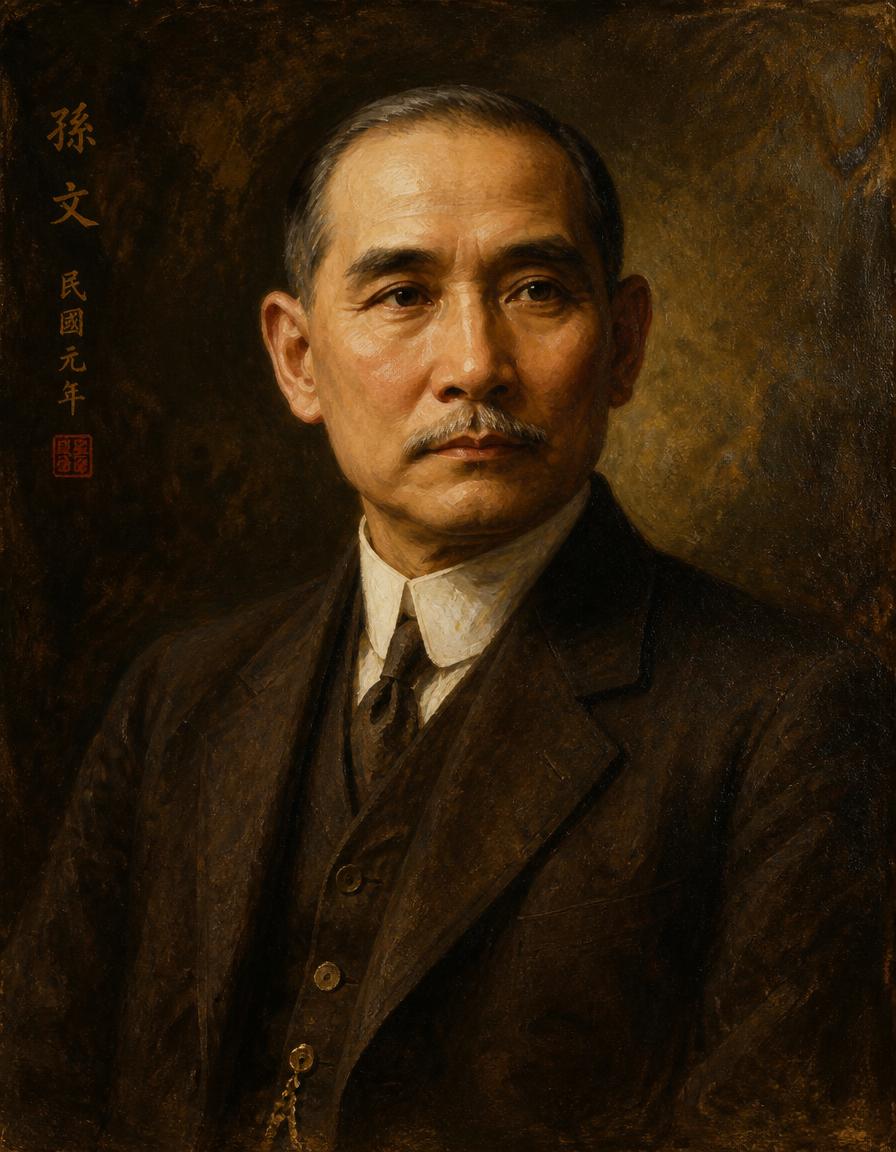
Quick Facts
- Years
- 1866 – 1925
- Category
- World Leaders & Revolutionaries
- Nationality
- Chinese
- Occupation
- Revolutionary & Statesman
Sun Yat-sen
1866 – 1925 · Chinese · Revolutionary & Statesman
Audiobook

Life Lessons from Sun Yat-sen
Marcus Alden · 57 min
Sun Yat-sen (1866–1925) was a Chinese revolutionary, political thinker, physician, and statesman whose career connected the fall of the Qing dynasty with the difficult creation of a modern Chinese republic. He helped organize revolutionary movements abroad, raised money among overseas Chinese communities, and became provisional president of the Republic of China after the 1911 Revolution. Although he did not command the uprising that began at Wuchang, decades of organizing made him its most internationally recognized political representative.
Sun’s greatest achievements were ideological and institutional as much as governmental. He helped establish organizations that eventually developed into the Chinese Nationalist Party, or Kuomintang (KMT), and articulated the Three Principles of the People: nationalism, democracy, and people’s livelihood. He also attempted to reunify a country divided by military strongmen and foreign spheres of influence.
Sun exercised less power than later admirers sometimes claimed, and several of his governments were fragile or short-lived. Nevertheless, both the Republic of China on Taiwan and the People’s Republic of China commemorate him, although they interpret his program differently. He remains important because his life illuminates anti-imperialism, nationalism, constitutionalism, political organization, and the recurring tension between democratic goals and centralized revolutionary leadership.
Quick Facts
| Field | Information |
|---|---|
| Full Name | Sun Wen (孫文); genealogical name Sun Deming; courtesy name Zaizhi |
| Common Name(s) | Sun Yat-sen; Sun Zhongshan; Sun Wen |
| Born | 12 November 1866 |
| Died | 12 March 1925 |
| Age at Death | 58 |
| Birthplace | Cuiheng village, Xiangshan County, Guangdong, Qing China; now Zhongshan, Guangdong |
| Nationality | Chinese |
| Occupation | Revolutionary, statesman, political theorist, physician |
| Historical Era | Late Qing dynasty and early Republic of China |
| Famous For | Revolutionary organizing, provisional presidency, founding the KMT tradition, Three Principles of the People |
| Political Affiliation | Revive China Society; Tongmenghui; Kuomintang/Chinese Nationalist Party |
| Religion | Baptized Christian; his later religious convictions remain debated |
| Education | Iolani School; Oahu College; Government Central School and Queen’s College; Hong Kong College of Medicine for Chinese |
| Parents | Sun Dacheng and Lady Yang |
| Spouse(s) | Lu Muzhen; Soong Ching-ling; a marriage or concubinage involving Kaoru Otsuki is documented but interpreted differently by sources |
| Children | Sun Fo, Sun Jinyuan, Sun Jinwan; Fumiko Miyagawa is generally identified as his daughter by Kaoru Otsuki |
| Major Works | The International Development of China; The Three Principles of the People; political manifestos and lectures |
| Major Achievements | Helped overthrow Qing rule; served as provisional president; developed the Three Principles; reorganized the KMT; built a revolutionary base in Guangzhou |
Early Life
Sun was born into a Hakka-speaking farming family in Cuiheng, near the Portuguese colony of Macao. His father, Sun Dacheng, had worked away from home before returning to agriculture. Rural inequality, local traditions, migration, and the presence of European colonial settlements formed part of Sun’s early environment.
In 1879 he joined his older brother Sun Mei in the Hawaiian Kingdom. He studied at Iolani School, where instruction was in English, and later attended Oahu College. Hawaii exposed him to Christianity, modern science, commercial society, and constitutional government. He earned academic recognition but was eventually sent back to China, reportedly because his brother feared his growing Christian commitment.
Back in Cuiheng, Sun and his friend Lu Haodong damaged a village religious image in 1883, provoking local hostility. Sun then studied in Hong Kong, where he was baptized by the American missionary Charles Robert Hager. He attended Government Central School—later Queen’s College—and trained at the Hong Kong College of Medicine for Chinese under the influential physician James Cantlie.
Sun completed his medical studies in 1892. Because the college’s qualification did not provide unrestricted legal practice throughout colonial Hong Kong, he worked principally in Macao and Guangzhou. Medicine gave him professional standing, but China’s military defeats, corruption, foreign encroachment, and limited reform increasingly directed him toward politics.
Rise to Prominence
Sun initially sought reform rather than immediate revolution. In 1894 he submitted a long proposal to the senior official Li Hongzhang advocating economic and administrative modernization. Receiving no meaningful response reinforced his belief that the Qing system could not reform itself sufficiently.
Later that year, in Honolulu, he founded the Revive China Society. Its members pledged to expel Qing rulers and establish a renewed Chinese state. Sun and his associates planned an uprising in Guangzhou in 1895, but the authorities discovered the plot. Lu Haodong and other participants were executed, while Sun escaped abroad.
Exile transformed him into an international revolutionary. In London in 1896, Qing diplomatic personnel detained him inside the Chinese legation. James Cantlie and British publicity helped secure his release. The episode attracted international attention, and Sun published an account titled Kidnapped in London.
Sun traveled through Europe, North America, Japan, and Southeast Asia, collecting funds and recruiting supporters among students, merchants, secret societies, and emigrant communities. Numerous uprisings failed, including the Huizhou rising of 1900. Yet each effort expanded revolutionary networks.
In Tokyo in 1905, Sun and other activists created the Tongmenghui, or Revolutionary Alliance. Its program called for overthrowing Qing rule, establishing a republic, and addressing land inequality. Sun’s reputation grew as the movement’s chief fundraiser, organizer, and spokesman, even though other revolutionaries often challenged his authority.
Major Achievements
Building an International Revolutionary Movement
Sun recognized that revolution required support beyond China’s borders. He mobilized overseas Chinese communities, cultivated Japanese sympathizers, and used modern newspapers, lectures, and political associations to connect scattered activists.
This mattered because Qing surveillance and repression made sustained organization inside China dangerous. Diaspora money helped finance propaganda and attempted uprisings. In the long term, Sun demonstrated how transnational communities could influence political change in their homeland.
Helping Create the Republic of China
On 10 October 1911, revolutionary soldiers rose in Wuchang. Sun was in the United States and learned of events through the press. Provincial declarations of independence followed, and delegates elected him provisional president in Nanjing.
Sun took office on 1 January 1912. To secure the Qing emperor’s abdication and reduce the danger of civil war, he agreed to yield the presidency to Yuan Shikai, the commander best positioned to compel the northern court. The Qing abdicated in February, ending more than two millennia of imperial monarchy.
Sun did not single-handedly cause the revolution, but his movement supplied republican language, symbols, and networks. The republic’s survival was troubled, yet the rejection of hereditary imperial rule proved durable.
Formulating the Three Principles of the People
Sun’s most influential doctrine consisted of minzu—nationalism or national solidarity; minquan—people’s political rights; and minsheng—people’s livelihood. He developed these ideas over many years and presented extensive lectures in Guangzhou in 1924.
Nationalism meant restoring Chinese sovereignty and building unity among the country’s peoples. Democracy included elections, constitutional government, and Sun’s proposed five-branch constitution. People’s livelihood involved land policy, economic development, regulation of capital, and social welfare; scholars debate whether it should be described as socialism.
The principles became the KMT’s official ideology and remain constitutionally important in the Republic of China. Competing Chinese political traditions have also selectively adopted Sun’s nationalist and developmental language.
Reorganizing the Kuomintang
After Yuan Shikai’s consolidation of power and the suppression of parliamentary politics, Sun repeatedly rebuilt his organization. In 1919 he reconstituted it as the Chinese Kuomintang. By the early 1920s, earlier organizational methods had failed to overcome warlord power.
With Comintern advisers and Soviet assistance, Sun reorganized the KMT in 1924 as a disciplined, membership-based party. Chinese Communists were admitted as individuals under the First United Front. The Whampoa Military Academy was established near Guangzhou, with Chiang Kai-shek as commandant and Soviet aid supporting its development.
This structure outlived Sun. It supplied the party, military, and alliance framework used in the later Northern Expedition and shaped both Nationalist and Communist political organization.
Promoting National Development
In The International Development of China, Sun proposed an ambitious network of railways, ports, waterways, industries, and planned urban centers, financed partly through international cooperation.
Many proposals were unrealistic under the political and financial conditions of his lifetime. Nonetheless, the work showed that Sun saw revolution not merely as regime change but as economic reconstruction. His emphasis on transport, industrialization, and national planning anticipated central concerns of later Chinese governments.
Leadership and Work
Sun’s principal strengths were persistence, communication, and coalition building. He could translate broad aspirations into memorable formulas and persuade emigrants to contribute money to a distant political struggle. Repeated defeat rarely ended his organizing.
His leadership was mobile and network-based. Exile forced him to work through correspondence, newspapers, personal envoys, and fundraising tours. He cooperated with Christians, secret-society members, students, military officers, merchants, Japanese supporters, Soviet advisers, and eventually Chinese Communists.
Sun was also pragmatic. He resigned in Yuan Shikai’s favor, worked with regional military leaders, and accepted Soviet assistance after Western governments declined substantial support. Such flexibility kept his movement alive but sometimes produced unstable partnerships.
His weaknesses were equally significant. Plans were sometimes optimistic, secrecy could be poor, and several uprisings ended disastrously. He lacked a dependable national army and often depended on commanders whose loyalty was uncertain. Critics also identify a growing preference for centralized party discipline and political tutelage over immediate parliamentary competition.
Relationships with Huang Xing, Song Jiaoren, Chen Jiongming, Chiang Kai-shek, and Communist leaders reveal both his ability to attract talent and his difficulty controlling allies. Sun’s authority rested heavily on symbolic legitimacy rather than administrative control.
Personal Life
Sun married Lu Muzhen in 1885 in a family-arranged union. They had three children: Sun Fo, Sun Jinyuan, and Sun Jinwan. His prolonged absences and revolutionary activity made conventional family life difficult. Lu later agreed to a divorce.
In 1915 Sun married Soong Ching-ling, the American-educated daughter of publisher and supporter Charlie Soong. The marriage caused family controversy because Sun was much older and Soong’s parents objected. She became his political partner, secretary, and later a prominent public figure in her own right.
Japanese records document Sun’s relationship with Kaoru Otsuki. Sources differ over whether to characterize it as marriage, concubinage, or a relationship shaped by contemporary custom. Their daughter, Fumiko, was raised in Japan and later used the surname Miyagawa.
Sun formed close friendships with James Cantlie, Lu Haodong, Charlie Soong, Huang Xing, and numerous overseas supporters. He traveled incessantly and worked under aliases because Qing agents pursued him. “Yat-sen” derives from a Cantonese rendering of a Christian-school name; “Zhongshan,” associated with a Japanese alias, later became his most familiar name in Chinese.
Diagnosed with liver cancer, Sun underwent surgery in Beijing in January 1925. He died there on 12 March. His remains were later placed in the Sun Yat-sen Mausoleum in Nanjing.
Philosophy and Beliefs
Sun combined Chinese reform traditions, Western constitutional ideas, Christian moral language, nationalism, and developmental economics. His thought evolved in response to circumstances and does not fit neatly into a single European category.
His nationalism began as an anti-Qing revolutionary doctrine but broadened into a program of national unity and resistance to imperialism. He increasingly emphasized cooperation among China’s recognized ethnic groups rather than simple ethnic revenge against Manchus.
Sun’s democratic model included four popular rights—election, recall, initiative, and referendum—and five governmental branches, adding examination and control institutions to the executive, legislative, and judicial branches. He proposed three stages of revolution: military government, political tutelage, and constitutional government.
That sequence reflected his fear that immediate electoral politics could be captured by entrenched interests or military power. Supporters regarded tutelage as preparation for democracy; critics saw it as a justification for one-party rule.
His principle of livelihood drew partly on Henry George’s land-value ideas and on broader socialist and welfare debates. He favored equalization of land rights, regulation of capital, infrastructure, and public responsibility for development.
Sun was baptized and often used Christian ethical concepts, but his mature religious position is disputed. Some accounts stress continued faith; others describe a more eclectic or politically framed spirituality. His final statements employed both revolutionary and moral language.
Challenges and Controversies
Sun’s revolutionary attempts before 1911 repeatedly failed and cost lives. Admirers argue that these sacrifices weakened Qing legitimacy and trained activists. Critics contend that poorly prepared plots exposed followers to execution without producing proportional gains.
His role in the 1911 Revolution is sometimes exaggerated. The Wuchang Uprising was initiated by revolutionary soldiers and local organizations while Sun was abroad. His importance lay less in operational command than in long-term advocacy, fundraising, coalition building, and post-uprising legitimacy.
The decision to surrender the provisional presidency to Yuan Shikai remains debated. Sun hoped to achieve abdication and prevent division. Yuan subsequently dismantled parliamentary politics and attempted to become emperor. Some historians view Sun’s compromise as unavoidable; others believe it surrendered the revolution to an authoritarian military leader.
Sun supported armed resistance during the 1913 Second Revolution after Song Jiaoren’s assassination and Yuan’s repression. The revolt failed. His later governments in Guangzhou claimed national legitimacy but depended on regional military alliances and controlled limited territory.
His 1922 break with Chen Jiongming exposed strategic divisions. Sun prioritized a Northern Expedition to reunify China; Chen favored provincial autonomy and consolidation in Guangdong. Chen’s forces attacked the presidential residence, driving Sun from Guangzhou. Interpretations differ over whether Chen betrayed the national cause or resisted Sun’s militarized centralism.
The Soviet alliance and First United Front were also controversial. Sun considered Soviet aid necessary and believed Communists could strengthen national revolution. KMT conservatives feared ideological infiltration, while Communists had reservations about entering a larger nationalist party. The alliance later collapsed violently under Sun’s successors.
Finally, Sun’s democratic reputation coexists with his advocacy of party discipline and tutelage. He desired constitutional government, but his later institutional model delayed full democracy until the population had been politically trained. This unresolved tension became central to later KMT rule.
Legacy
Sun is unusual in being officially honored on both sides of the Taiwan Strait. In Taiwan he is conventionally called the “Father of the Nation.” In the People’s Republic of China he is commemorated as a “forerunner of the democratic revolution.” These formulas reflect competing political narratives but confirm his broad symbolic status.
His mausoleum on Purple Mountain in Nanjing is a major national memorial. His former residences and museums operate in Cuiheng, Shanghai, Guangzhou, Hong Kong, Macao, Honolulu, and elsewhere. Zhongshan city, Zhongshan University, parks, roads, schools, and public halls bear his name. Sun Yat Sen Memorial Park in Hong Kong and Sun Yat-sen Memorial Hall in Taipei are prominent examples.
His political legacy is mixed. The KMT developed into a major governing party, first on mainland China and later in Taiwan. The Communist movement emerged partly through the alliance and organizational environment established during Sun’s final years. Both traditions invoked his nationalism and commitment to national reconstruction.
Modern scholars study him not as an infallible founder but as a transnational revolutionary who operated among empires, diasporas, missionaries, financiers, and military factions. His career demonstrates how powerful ideas may outlast weak governments—and how revolutionary unity can conceal profound disputes about democracy, authority, class, and national identity.
Interesting Facts
- Sun was born in the village now preserved as part of Cuiheng’s memorial complex.
- He lived and studied in the independent Hawaiian Kingdom, not yet a U.S. state.
- He received the English name “Sun Yat-sen” from a Cantonese school name.
- “Zhongshan” came from the Japanese alias Nakayama Shō, read in Chinese as Zhongshan Qiao.
- The city formerly called Xiangshan was renamed Zhongshan in his honor.
- He trained as a physician before becoming a full-time revolutionary.
- James Cantlie was both his medical mentor and a key figure in his rescue in London.
- His 1896 detention made him internationally famous.
- Sun was outside China when the Wuchang Uprising began.
- He served as provisional president for about three months.
- He traveled widely to raise funds from overseas Chinese communities.
- Several uprisings associated with his organizations failed before 1911.
- He proposed a five-branch constitution rather than the usual three-branch model.
- His economic plans included ports, railways, mines, and waterways.
- He delivered major lectures on the Three Principles in 1924.
- Soviet advisers helped reorganize his party during his final years.
- Whampoa Military Academy was founded under his Guangzhou government.
- His widow Soong Ching-ling later became an important leader in the People’s Republic of China.
- He died in Beijing while seeking a political settlement with northern leaders.
- His remains were transferred to the Nanjing mausoleum in 1929.
Famous Quotes
Translations vary because Sun spoke and wrote primarily in Chinese.
- “The revolution is not yet successful; comrades must still exert themselves.” From Sun’s political testament of 1925. It urged followers to continue national reconstruction after his death.
- “China is the China of the Chinese people.” Used in nationalist discourse associated with his revolutionary program; it expressed sovereignty against dynastic and foreign domination.
- “The world belongs to all under heaven.” Sun’s calligraphic rendering of an ancient ideal, not an original saying. It conveyed government for the common good.
- “To understand is difficult; to act is easy.” A central proposition in Sun’s doctrine of knowledge and action. He argued against the proverb that knowledge was easy while action was difficult.
- “Nationalism is a treasure that permits a nation to press forward and humanity to progress.” From his lectures on nationalism, emphasizing collective identity as a force for liberation.
- “The aim of the Revolution is to seek happiness for China.” From his political testament. It framed revolution as national welfare rather than personal power.
- “For forty years I have devoted myself to the cause of the national revolution.” The opening of his testament, summarizing his life’s commitment.
- “We must arouse the people and unite in a common struggle with those peoples of the world who treat us as equals.” From the testament. It linked domestic mobilization to anti-imperialist international cooperation.
- “The Three Principles of the People are the principles for the salvation of the nation.” From the testament, identifying his doctrine as the movement’s continuing guide.
- “Politics is the management of the affairs of the people.” Commonly translated from his lectures on popular government; wording differs among editions.
The frequently circulated line “An individual should not have too much freedom; a nation should have absolute freedom” reflects a passage in Sun’s nationalism lectures, but English versions differ considerably and should not be treated as a fixed verbatim quotation.
Timeline
- 1866 — Born in Cuiheng, Guangdong, on 12 November.
- 1879 — Went to Honolulu to join his brother Sun Mei.
- 1883 — Returned to China after studying in Hawaii; later continued schooling in Hong Kong.
- 1884 — Baptized as a Christian in Hong Kong.
- 1885 — Married Lu Muzhen.
- 1887 — Entered the Hong Kong College of Medicine for Chinese.
- 1892 — Completed medical training and began practicing medicine.
- 1894 — Petitioned Li Hongzhang; founded the Revive China Society in Honolulu.
- 1895 — Failed Guangzhou uprising forced him into exile; Lu Haodong was executed.
- 1896 — Detained and released from the Qing legation in London.
- 1900 — Huizhou uprising failed.
- 1905 — Helped found the Tongmenghui in Tokyo.
- 1907–1911 — Supported repeated anti-Qing uprisings and overseas fundraising.
- 1911 — Wuchang Uprising began; revolutionary provinces selected Sun as provisional president.
- 1912 — Inaugurated on 1 January; resigned in favor of Yuan Shikai; KMT organized.
- 1913 — Song Jiaoren was assassinated; Second Revolution failed; Sun fled to Japan.
- 1914 — Organized the Chinese Revolutionary Party.
- 1915 — Married Soong Ching-ling; opposed Yuan Shikai’s monarchy.
- 1917 — Established a military government in Guangzhou to defend the provisional constitution.
- 1918 — Left Guangzhou after political conflict.
- 1919 — Reorganized the movement as the Chinese Kuomintang.
- 1920 — Returned to Guangzhou with support from Chen Jiongming.
- 1921 — Became “extraordinary president” of a southern government.
- 1922 — Driven from Guangzhou after conflict with Chen Jiongming.
- 1923 — Reestablished his Guangzhou base and deepened cooperation with the Soviet Union.
- 1924 — First KMT Congress endorsed reorganization and cooperation with Chinese Communists; Whampoa Military Academy opened.
- 1925 — Died in Beijing on 12 March.
- 1929 — Reinterred in the Sun Yat-sen Mausoleum in Nanjing.
Frequently Asked Questions
Who was Sun Yat-sen?
Sun Yat-sen was a physician-turned-revolutionary who spent much of his life organizing opposition to the Qing dynasty and promoting a modern Chinese republic. He founded or led the Revive China Society, Tongmenghui, and organizations that developed into the Kuomintang. He briefly served as provisional president in 1912 and later headed rival governments in Guangzhou. His Three Principles of the People supplied a durable nationalist political doctrine.
Why is Sun Yat-sen called the Father of the Nation?
The Republic of China officially honors Sun as the “Father of the Nation” because of his long campaign against Qing rule, provisional presidency, and foundational role in the KMT. The title is commemorative rather than a literal statement that he alone created republican China. The 1911 Revolution involved soldiers, provincial leaders, constitutionalists, secret societies, and many revolutionary groups.
Did Sun Yat-sen overthrow the Qing dynasty?
He helped create the movement that made the dynasty’s overthrow possible, but he neither initiated nor commanded the Wuchang Uprising. Sun was abroad when it began. His earlier organizing, fundraising, propaganda, and republican program gave the broader movement coherence. After the revolt spread, revolutionary delegates chose him as provisional president, allowing him to shape the new republic’s public identity.
Was Sun Yat-sen China’s first president?
He was the first provisional president of the Republic of China, inaugurated in Nanjing on 1 January 1912. “First president” is therefore broadly correct if the provisional office is included. He soon resigned so Yuan Shikai could assume the presidency in exchange for helping secure Qing abdication and nominal reunification between northern and southern political authorities.
Why did he resign in favor of Yuan Shikai?
Yuan controlled the powerful Beiyang Army and had leverage over the Qing court. Sun and southern revolutionaries feared that excluding him might prolong war or divide China. Sun therefore treated resignation as a compromise to obtain abdication. Yuan later suppressed parliament and sought monarchy, making the decision controversial. Historians disagree over whether a realistic alternative existed in early 1912.
What were the Three Principles of the People?
They were nationalism, democracy, and people’s livelihood. Nationalism sought sovereignty, unity, and resistance to imperial domination. Democracy concerned popular rights and constitutional institutions. People’s livelihood addressed land, capital, welfare, and economic development. Sun’s precise meaning evolved, and translations differ. The principles became the KMT’s official ideology and remain influential in the constitutional tradition of the Republic of China.
Was Sun Yat-sen a socialist?
Not in a straightforward Marxist sense. Sun supported land-value reform, regulation of capital, public development projects, and social welfare, and he sometimes described people’s livelihood as a form of socialism. Yet he did not base politics on class struggle or advocate orthodox Marxism. His economic thought combined Henry George, state-led development, nationalism, and selective socialist ideas.
Was Sun Yat-sen a Christian?
He was baptized in Hong Kong and maintained important relationships with Christian educators and supporters. Christian moral vocabulary appears in parts of his life and writing. Scholars differ, however, over the depth and consistency of his mature religious commitment. It is safest to say that Christianity significantly influenced him without assuming that it exclusively defined his later worldview.
Why did Sun spend so much time abroad?
After failed uprisings, Qing authorities sought his arrest, making exile necessary. Overseas travel also served strategic purposes. Sun raised money among Chinese communities in Hawaii, North America, Southeast Asia, and Japan; recruited activists; met foreign sympathizers; and spread revolutionary propaganda. His international mobility was therefore both a consequence of persecution and a central feature of his political method.
What happened at the Chinese legation in London?
In October 1896, Qing representatives detained Sun inside their London legation and apparently intended to send him secretly to China. James Cantlie publicized the case and involved British authorities and newspapers. Sun was released after about twelve days. The incident made him internationally known and provided valuable publicity for the revolutionary cause.
What was Sun’s relationship with Japan?
Japan offered refuge, supporters, publishing opportunities, and proximity to China. Sun worked with Chinese students and some Japanese political activists there, and the Tongmenghui was founded in Tokyo. Yet Japanese policy was not consistently supportive, and authorities sometimes expelled or restricted him. His relationship with Japan combined admiration for modernization, tactical cooperation, and concern about imperial expansion.
Why did Sun cooperate with the Soviet Union?
Western powers generally declined the substantial assistance Sun sought, while the Soviet Union offered advisers, organizational guidance, and military aid without formally demanding immediate Communist rule. Sun believed this support could strengthen the KMT and unify China. The cooperation produced party reorganization, the First United Front, and Whampoa Military Academy, but also intensified ideological tensions within the nationalist movement.
Did Sun Yat-sen found the Kuomintang?
Sun was the central founder of the organizational lineage that became the KMT, although the party developed through several stages and many collaborators. The Tongmenghui merged with other groups into the Nationalist Party in 1912. After suppression and exile, Sun created successor organizations, eventually reconstituting the Chinese Kuomintang and reorganizing it extensively in 1924.
What was his relationship with Chiang Kai-shek?
Chiang became an increasingly important military associate during Sun’s final years. Sun sent him to study Soviet military and political organization and appointed him commandant of Whampoa Military Academy. Chiang was not yet Sun’s uncontested successor when Sun died. He later used the academy and reorganized KMT to consolidate leadership and launch the Northern Expedition.
What was his relationship with Mao Zedong and the Communists?
Sun did not have a close personal partnership with Mao. He approved cooperation between the KMT and the young Chinese Communist Party under the First United Front. Communists joined the KMT as individuals while retaining their party organization. Mao participated in united-front activities, but his later leadership emerged after Sun’s death. Both Communist and Nationalist histories subsequently claimed aspects of Sun’s legacy.
Why did Sun fight Chen Jiongming?
They disagreed over political strategy and territorial priorities. Sun wanted to launch a military campaign northward to unify China under a central revolutionary government. Chen favored federalism or provincial autonomy and believed Guangdong should first be stabilized. Their conflict became violent in 1922, when Chen’s forces attacked Sun’s position in Guangzhou. Historians continue to debate their competing visions.
How did Sun Yat-sen die?
Sun traveled to northern China in late 1924 to discuss national political problems. His health deteriorated, and physicians diagnosed liver cancer. He underwent surgery in Beijing in January 1925 but did not recover. He died on 12 March 1925 at age 58, leaving political testaments urging followers to continue the revolution and seek national unity.
Where is Sun Yat-sen buried?
His remains are housed in the Sun Yat-sen Mausoleum on Purple Mountain in Nanjing. After his death in Beijing, his body was temporarily kept near the capital. In 1929, following the Nationalist government’s establishment at Nanjing, an elaborate state funeral transferred him to the newly built mausoleum, which remains one of China’s most prominent modern political memorials.
Lessons We Can Learn
- Persistence can compound over time. Sun endured many failed uprisings before 1911. Repeated effort built networks even when immediate results were poor.
- Ideas need organizations. The Three Principles gained influence because Sun linked doctrine to parties, schools, newspapers, and fundraising systems.
- Diasporas can shape national history. Overseas Chinese donations sustained the movement, illustrating the political importance of transnational communities.
- Compromise has consequences. Resigning for Yuan Shikai helped obtain abdication but enabled a dangerous rival. Today’s leaders must weigh immediate peace against long-term institutional risk.
- Symbolic authority is not operational control. Sun’s prestige often exceeded his command of territory or armies. Reputation cannot substitute for effective administration.
- Coalitions require clear boundaries. Cooperation with military leaders and Communists expanded Sun’s capacity but created unresolved conflicts. Partnerships need agreed goals and dispute mechanisms.
- Development must accompany political change. Sun’s infrastructure plans recognized that new constitutions alone could not solve poverty or fragmentation.
- Accessible principles mobilize people. Nationalism, democracy, and livelihood condensed a complex program into a memorable framework.
- Methods should match conditions. Sun repeatedly reorganized his movement after failure. Adaptability remains essential when institutions or strategies stop working.
- Democratic ends can conflict with centralized means. Sun’s political tutelage sought to prepare democracy through disciplined rule. The tension warns modern movements to protect freedoms while pursuing stability.
Related Historical Figures
- Huang Xing — Revolutionary commander and Tongmenghui leader who collaborated with Sun but sometimes differed over authority and strategy.
- Lu Haodong — Sun’s childhood friend and revolutionary associate, executed after the failed Guangzhou uprising of 1895.
- James Cantlie — Medical teacher and friend whose campaign helped free Sun from detention in London.
- Li Hongzhang — Senior Qing statesman whom Sun petitioned for reform in 1894 before turning decisively toward revolution.
- Yuan Shikai — Military leader who succeeded Sun as provisional president and later destroyed much of the early republic’s parliamentary order.
- Song Jiaoren — KMT organizer and parliamentary strategist whose 1913 assassination precipitated a major political crisis.
- Soong Ching-ling — Sun’s wife and political partner, later an eminent public figure aligned with the Chinese Communist state.
- Chen Jiongming — Guangdong military leader whose dispute with Sun over federalism and northern unification led to armed conflict.
- Chiang Kai-shek — Whampoa commandant who later succeeded to leadership of the Nationalist movement and implemented parts of Sun’s unification program.
- Mikhail Borodin — Comintern adviser who assisted Sun in reorganizing the KMT and developing cooperation with the Chinese Communist Party.
Related Historical Figures