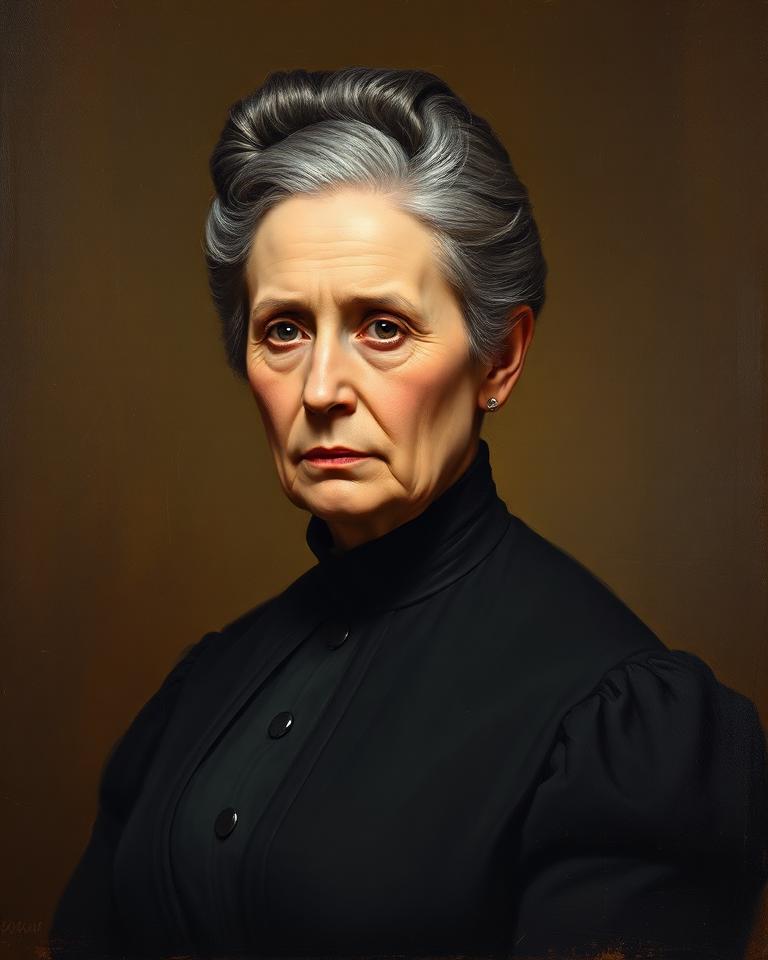
Quick Facts
- Years
- 1820 – 1906
- Category
- Social Reformers & Humanitarians
- Subcategory
- Women's Suffrage
- Nationality
- American
- Occupation
- Social Reformer
Susan B. Anthony
1820 – 1906 · American · Social Reformer
Audiobook

Life Lessons from Susan B. Anthony
Marcus Alden · 51 min
Susan B. Anthony (1820–1906) was an American social reformer whose organizing helped transform women’s voting rights from a marginalized demand into a national political movement. Raised in a reform-minded Quaker family, she first worked as a teacher and became active in temperance and antislavery campaigns. Her partnership with Elizabeth Cady Stanton combined Anthony’s organizational discipline with Stanton’s writing and political analysis, sustaining decades of agitation for women’s civil and political equality.
Anthony traveled widely, delivered hundreds of speeches, organized conventions, circulated petitions, raised funds, edited a newspaper, and lobbied lawmakers. In 1872, she voted in Rochester, New York, despite laws denying women the franchise. Her arrest and trial turned a single ballot into a nationally publicized challenge to women’s political exclusion.
She did not live to see nationwide woman suffrage. Fourteen years after her death, however, the Nineteenth Amendment prohibited denying the vote on account of sex and became popularly known as the “Susan B. Anthony Amendment.” Scholars still study Anthony because her life illuminates the power—and limits—of organized reform. Her achievements were substantial, but her alliances, rhetoric about race, and strategic disputes reveal conflicts within nineteenth-century movements over citizenship, equality, and political priorities.
Quick Facts
| Field | Details |
|---|---|
| Full Name | Susan Brownell Anthony |
| Common Name(s) | Susan B. Anthony; SBA among colleagues |
| Born | February 15, 1820 |
| Died | March 13, 1906 |
| Age at Death | 86 |
| Birthplace | Adams, Massachusetts, United States |
| Nationality | American |
| Occupation | Social reformer, lecturer, organizer, teacher, editor |
| Historical Era | Antebellum era, Civil War, Reconstruction, Gilded Age, Progressive Era |
| Famous For | Leadership in the U.S. woman-suffrage movement; voting in 1872 and being tried for it |
| Political Affiliation if applicable | Worked with abolitionist and Republican allies but held no major elective office and was not consistently bound to one party |
| Religion if significant | Raised Quaker; later associated with liberal and Unitarian religious circles |
| Education | District school, family school, and Deborah Moulson’s Female Seminary near Philadelphia; no college degree |
| Parents | Daniel Anthony and Lucy Read Anthony |
| Spouse(s) | Never married |
| Children | None |
| Major Works | The Revolution newspaper; speeches including “Is It a Crime for a U.S. Citizen to Vote?”; coeditor and publisher of History of Woman Suffrage |
| Major Achievements | Organized state and national suffrage campaigns; helped found the Women’s Loyal National League, National Woman Suffrage Association, and International Council of Women; arrested and convicted for voting; helped reunify the suffrage movement |
Early Life
Susan Brownell Anthony was born on February 15, 1820, in Adams, Massachusetts. She was the second of eight children born to Daniel Anthony, a cotton manufacturer, and Lucy Read Anthony; six children survived to adulthood. Her father was a Quaker committed to discipline, education, and moral reform. Her mother came from a family with different religious traditions but supported her children’s ambitions.
The Anthony household encouraged purposeful work and discussion of public questions. Reformers and abolitionists later visited the family home, exposing Susan to debates about slavery, temperance, and human equality. Quaker teaching emphasized the spiritual equality of women and men, although Quaker institutions did not always practice complete social equality.
When Anthony was six, the family moved to Battenville, New York, where her father operated a mill. She studied in local schools and in a school established by her father. After a district teacher refused to teach her long division because she was a girl, her father arranged stronger instruction. In 1837, she attended Deborah Moulson’s Female Seminary near Philadelphia.
The financial panic of 1837 damaged Daniel Anthony’s business. Susan’s schooling ended, and she began teaching to help support the family. From 1839 to 1845 she taught in several communities. She then became head of the female department at Canajoharie Academy in New York. The lower compensation paid to women teachers sharpened her awareness of institutional inequality.
In 1845, the family settled on a farm near Rochester. The household became connected to Frederick Douglass, William Lloyd Garrison, and other reformers. This environment gave Anthony both a network and a model of sustained civic activism.
Rise to Prominence
Anthony’s first major field of reform was temperance. Alcohol abuse could leave nineteenth-century wives vulnerable because married women possessed limited control over property, earnings, and children. In 1852, Anthony was prevented from speaking at a temperance meeting in Albany because she was a woman. She responded by helping organize the Woman’s New York State Temperance Society.
The decisive personal turning point was her 1851 meeting with Elizabeth Cady Stanton, arranged by Amelia Bloomer. Stanton was already prominent after the 1848 Seneca Falls Convention. The two formed an unusually effective partnership: Stanton often developed arguments and drafted texts, while Anthony organized meetings, secured signatures, managed logistics, and carried their program across the country.
Anthony also expanded her antislavery work. As an agent of the American Anti-Slavery Society, she organized meetings and faced hostile crowds. Opponents sometimes interrupted lectures or threatened speakers. Such experiences trained her in public persuasion and hardened her commitment to rights that did not depend on popular approval.
During the 1850s, Anthony and Stanton campaigned for reforms in New York’s laws governing married women. They gathered petitions and lobbied legislators. New York’s 1860 reforms expanded married women’s control of property and earnings and improved certain guardianship rights, though later legislation altered some provisions.
By the Civil War, Anthony was nationally known within reform circles. Her fame widened through wartime petitioning, postwar debates over citizenship, the newspaper The Revolution, and her dramatic 1872 vote and prosecution.
Major Achievements
Reforming Married Women’s Legal Status
Anthony organized petition drives and legislative campaigns for women’s property, wage, and parental rights in New York. The state’s 1860 legislation strengthened married women’s economic position. She did not accomplish this alone, but her fieldwork connected legal arguments to a visible constituency.
The campaign mattered because coverture often placed a married woman’s property and earnings under her husband’s authority. These reforms established practical precedents for women’s independent legal identity.
Building the Women’s Loyal National League
In 1863, Anthony and Stanton founded the Women’s Loyal National League, which collected roughly 400,000 signatures urging a constitutional amendment to abolish slavery. The Thirteenth Amendment resulted from wartime politics and many actors, not from this petition alone, but the league demonstrated women’s capacity for national political organization.
Its methods—local networks, standardized petitions, publicity, and coordinated lobbying—became a template for later suffrage work.
Founding the National Woman Suffrage Association
After Congress proposed the Fifteenth Amendment, protecting voting rights against racial discrimination but not sex discrimination, the movement fractured. Anthony and Stanton founded the National Woman Suffrage Association (NWSA) in 1869. It sought a federal amendment and addressed broader issues affecting women.
The NWSA kept national constitutional change at the center of debate. Its opposition to the Fifteenth Amendment without women’s inclusion, however, produced a bitter rupture with former allies and remains one of the most criticized aspects of Anthony’s career.
Publishing The Revolution
From 1868 to 1870, Anthony and Stanton published The Revolution, a weekly newspaper whose motto declared, “Men, their rights, and nothing more; women, their rights, and nothing less.” It discussed suffrage, labor, divorce, education, and economic independence.
The newspaper extended the movement’s reach but accumulated debt. Anthony assumed substantial financial responsibility and spent years repaying it through lectures. Its brief life illustrates both the ambition and financial fragility of reform publishing.
Voting in 1872 and Challenging the Law
On November 5, 1872, Anthony voted in the presidential election in Rochester with fourteen other women. They argued that the Fourteenth Amendment’s citizenship guarantees protected their right to vote. Federal authorities arrested Anthony later that month.
At her 1873 trial, Justice Ward Hunt directed the jury to return a guilty verdict and refused to let Anthony testify because defendants in federal criminal cases were then considered incompetent witnesses. When invited to speak before sentencing, she denounced the proceeding. Hunt fined her $100; she refused to pay, and the government did not pursue collection, thereby preventing an appeal.
The case did not establish a right to vote. In 1875, the Supreme Court rejected the broader constitutional theory in Minor v. Happersett. Nevertheless, Anthony’s prosecution dramatized the contradiction between female citizenship and political exclusion.
Reunifying and Internationalizing the Movement
In 1890, the NWSA merged with the American Woman Suffrage Association to form the National American Woman Suffrage Association (NAWSA). Anthony served as president from 1892 to 1900. She encouraged state campaigns while maintaining the demand for a federal amendment.
Anthony also helped establish the International Council of Women in 1888 and cultivated reform networks abroad. These institutions gave women durable platforms for coordination across regions and generations.
Preserving the Movement’s History
Anthony, Stanton, Matilda Joslyn Gage, and later Ida Husted Harper assembled the multivolume History of Woman Suffrage. Anthony supplied records, money, contacts, and editorial labor.
The volumes preserved invaluable documents, but scholars caution that they reflect their editors’ perspective and privilege certain organizations and leaders. They are both essential primary sources and partisan accounts.
Leadership and Work
Anthony led through persistence, travel, correspondence, and organizational control rather than dazzling prose. She planned lecture routes, found halls and hosts, raised money, recruited workers, monitored legislation, and maintained relationships through letters. Her ability to turn principles into schedules, petitions, and institutions was her defining strength.
She made decisions pragmatically and often accepted incremental victories while keeping a federal amendment as the ultimate objective. She could work with people who disagreed on religion, party politics, or tactics if she believed cooperation would advance suffrage.
Her closest working relationship was with Stanton. Their differences were productive but real: Stanton was more willing to challenge organized religion and conventional marriage, while Anthony sometimes worried that controversial positions would obstruct suffrage. Anthony also mentored younger activists, including Carrie Chapman Catt and Anna Howard Shaw.
Her strengths included endurance, fundraising, memory, personal loyalty, and willingness to withstand ridicule. Her weaknesses included impatience, centralizing tendencies, and tactical alliances that could compromise claims to universal equality. She sometimes treated woman suffrage as the overriding reform, underestimating how race and class shaped other women’s political experiences.
Personal Life
Anthony never married and had no children. Remaining single gave her unusual mobility and legal independence in an era when marriage constrained women’s property and contracts. She did not simply reject affection or domestic life; she maintained intense friendships and remained deeply connected to siblings, nieces, nephews, and colleagues.
Her sister Mary Stafford Anthony became a suffragist and shared the Rochester home that served as Susan’s base. Anthony’s correspondence reveals warm, demanding friendships with Stanton and many other reformers. The women relied on one another emotionally and professionally, though disputes over strategy could be sharp.
Anthony lived simply and traveled relentlessly, often enduring uncomfortable rail journeys and modest lodgings. She was known for discipline and directness, but also for humor and hospitality. Contrary to caricatures of suffragists as uniformly hostile to fashion, she recognized clothing’s public symbolism; she briefly wore the reform dress associated with “bloomers” before abandoning it because ridicule distracted from her message.
Her health remained strong enough for decades of travel, though age eventually reduced her activity. She died at her Rochester home on March 13, 1906, from heart failure and pneumonia after an illness. She was buried in Mount Hope Cemetery.
Philosophy and Beliefs
Anthony’s central political belief was that women were citizens entitled to equal civil and political rights. She argued that government lacked democratic legitimacy when half the population could not consent through the ballot. Voting, in her view, was not merely symbolic; it was a tool through which women could defend wages, property, children, and personal safety.
Her Quaker upbringing contributed ideals of moral equality, plain speech, and individual conscience. As an adult, she moved beyond orthodox Quaker institutions and associated with religious liberals and freethinkers. Unlike Stanton, she generally avoided making criticism of Christianity a central suffrage strategy.
Anthony opposed slavery and supported Black freedom, yet her postwar rhetoric sometimes contradicted her universalist principles. During controversy over the Fifteenth Amendment, she made statements that invoked racial and educational hierarchies to argue against enfranchising men while excluding women. Historians distinguish her long record of abolitionist activity from rhetoric that was nonetheless racist and harmful.
Economically, Anthony supported women’s right to work, retain earnings, enter professions, and receive equal pay. She occasionally cooperated with labor reformers but never developed a comprehensive economic program. Her ethical method emphasized agitation within constitutional politics: petition, speech, press, litigation, voting tests, and legislative lobbying.
Challenges and Controversies
The greatest controversy concerns the Fifteenth Amendment. Anthony and Stanton opposed its ratification unless women were included, while Lucy Stone, Frederick Douglass, and others supported it as an urgent protection for Black men facing racial terror. Defenders of Anthony emphasize that she demanded universal suffrage and resented the insertion of “male” into constitutional law. Critics answer that she sometimes framed educated white women as more deserving than Black or immigrant men, reinforcing racism and nativism. Both her abolitionist record and her damaging rhetoric belong in an accurate account.
Anthony also accepted assistance from George Francis Train, a wealthy campaigner known for racist and eccentric views, during an 1867 Kansas suffrage campaign and in launching The Revolution. She rejected his racism, but the alliance alienated abolitionist colleagues. It exemplified her willingness to prioritize resources and publicity over reputational risk.
Her movement did not consistently represent all women. Black suffragists such as Frances Ellen Watkins Harper and Mary Church Terrell confronted racism within reform organizations and argued that race and sex could not be separated. Working-class women likewise did not always find their economic priorities reflected in Anthony’s constitutional focus.
Anthony’s prosecution is sometimes mythologized. She was not imprisoned for voting, did not pay the fine, and did not personally write the Nineteenth Amendment. Senator Aaron A. Sargent introduced the amendment’s wording in Congress in 1878 after consultation with suffrage leaders. Anthony’s importance lies in organizing sustained pressure, not in solitary authorship.
Finally, History of Woman Suffrage shaped later memory while marginalizing rival organizations and some activists. Modern scholarship uses it critically rather than treating it as a neutral record.
Legacy
Anthony died before nationwide woman suffrage became constitutional law. The Nineteenth Amendment was ratified on August 18, 1920, and certified on August 26. It barred voting discrimination “on account of sex,” though discriminatory laws and violence continued to obstruct many Black, Native American, Asian American, and Latina women.
Her Rochester home is now the National Susan B. Anthony Museum & House. Her birthplace in Adams, Massachusetts, is also preserved as a museum. Her grave in Mount Hope Cemetery attracts visitors, particularly on election days.
In 1979, Anthony became the first historical woman portrayed on a circulating United States coin when the Susan B. Anthony dollar was issued. Statues and monuments commemorate her, including works that place her alongside Stanton and Lucretia Mott. In 2020, New York City’s Central Park unveiled the Women’s Rights Pioneers Monument featuring the three reformers.
Her legacy remains both inspirational and contested. She demonstrated how an unpopular cause could be sustained across generations through organizations, records, fundraising, and political pressure. Modern study also asks whose voices those organizations elevated and whose they neglected. That combination of achievement and limitation makes Anthony central to the history of American democracy.
Interesting Facts
- Anthony’s middle name was Brownell, her maternal grandmother’s surname.
- She learned to read at an early age and received unusually strong schooling for a girl of her era.
- She began earning wages as a teacher while still a young woman.
- Amelia Bloomer introduced Anthony to Elizabeth Cady Stanton in 1851.
- Anthony and Stanton worked together for more than fifty years.
- She organized antislavery meetings despite threats and hostile interruptions.
- The Women’s Loyal National League gathered about 400,000 antislavery petition signatures.
- The Revolution was headquartered in New York City.
- Anthony incurred and eventually repaid debts associated with the newspaper.
- She was one of fifteen women who voted in Rochester in the 1872 election.
- Her trial occurred in Canandaigua, New York, in June 1873.
- The judge fined her $100, which she refused to pay.
- She spoke at every annual national women’s-rights convention from 1852 through 1905 except one, according to her biographical record.
- A federal woman-suffrage amendment was first introduced in Congress in 1878 using wording later adopted in the Nineteenth Amendment.
- Anthony served as NAWSA president from 1892 to 1900.
- She celebrated her eightieth birthday at a public event in Washington, D.C.
- Her Rochester house served as both a family home and an organizing center.
- The Susan B. Anthony dollar entered circulation in 1979.
Famous Quotes
-
“Men, their rights, and nothing more; women, their rights, and nothing less.” — Motto of The Revolution beginning in 1868. It summarized the newspaper’s demand for equality rather than special privilege.
-
“I shall never pay a dollar of your unjust penalty.” — Anthony’s response after sentencing in 1873. She rejected the legitimacy of punishment for voting.
-
“Resistance to tyranny is obedience to God.” — Spoken during her 1873 courtroom protest, adapting a long-established revolutionary maxim. It cast disenfranchisement as moral tyranny.
-
“The only question left to be settled now is: Are women persons?” — From “Is It a Crime for a U.S. Citizen to Vote?” delivered before her trial. Anthony used constitutional language to challenge exclusion.
-
“For any State to make sex a qualification that must ever result in the disfranchisement of one entire half of the people is to pass a bill of attainder.” — From the same speech. She argued that sex-based voting rules punished an entire class.
-
“It was we, the people, not we, the white male citizens…who formed the Union.” — From her 1872–73 voting-rights speech. She interpreted the Constitution’s opening words as inclusive of women.
-
“There never will be complete equality until women themselves help to make laws and elect lawmakers.” — Documented in Ida Husted Harper’s account of Anthony’s later public remarks. It expresses her belief in the ballot as protective power.
-
“Failure is impossible.” — Anthony’s famous final public message, conveyed at the 1906 Washington suffrage convention when illness limited her speech. It meant that decades of organization had made eventual victory achievable, not that setbacks had disappeared.
-
“Cautious, careful people, always casting about to preserve their reputation and social standing, never can bring about a reform.” — Commonly traced to Anthony through Harper’s biography. It describes the personal risk demanded by reform.
-
“Organize, agitate, educate, must be our war cry.” — Frequently attributed to Anthony and consistent with her methods, but exact wording and original occasion are difficult to establish; treat the attribution cautiously.
Timeline
- 1820 — Born in Adams, Massachusetts, on February 15.
- 1826 — Family moves to Battenville, New York.
- 1837 — Attends Deborah Moulson’s Female Seminary; family suffers financial losses in the Panic of 1837.
- 1839 — Begins a sustained period of teaching.
- 1845 — Family relocates to the Rochester area.
- 1846 — Becomes head of the female department at Canajoharie Academy.
- 1849 — Leaves teaching and increases reform activity.
- 1851 — Meets Elizabeth Cady Stanton.
- 1852 — Helps establish the Woman’s New York State Temperance Society and enters organized women’s-rights work.
- 1853–1860 — Campaigns for married women’s property and legal rights in New York.
- 1856 — Becomes an agent for the American Anti-Slavery Society.
- 1860 — New York expands married women’s property and earnings rights.
- 1863 — Founds the Women’s Loyal National League with Stanton.
- 1866 — Helps organize the American Equal Rights Association.
- 1867 — Campaigns in Kansas for woman suffrage.
- 1868 — Begins publishing The Revolution with Stanton.
- 1869 — Helps found the National Woman Suffrage Association.
- 1872 — Votes in Rochester and is arrested.
- 1873 — Convicted in federal court and fined $100.
- 1876 — Helps present a women’s Declaration of Rights at the U.S. centennial celebration.
- 1878 — Senator Aaron A. Sargent introduces a federal woman-suffrage amendment.
- 1881–1886 — First three volumes of History of Woman Suffrage appear.
- 1888 — Helps organize the International Council of Women.
- 1890 — NWSA and AWSA merge to form NAWSA.
- 1892 — Becomes NAWSA president.
- 1900 — Retires from the NAWSA presidency.
- 1905 — Attends her final national suffrage convention.
- 1906 — Dies in Rochester on March 13.
- 1920 — Nineteenth Amendment is ratified and certified.
- 1979 — Susan B. Anthony dollar enters circulation.
Frequently Asked Questions
Who was Susan B. Anthony?
Susan B. Anthony was an American organizer, lecturer, editor, abolitionist, temperance advocate, and leader of the woman-suffrage movement. She spent more than half a century building organizations, arranging conventions, circulating petitions, lobbying legislators, and speaking throughout the United States. Her best-known action was casting a ballot in 1872 and defending that act as a constitutional right. She died in 1906, fourteen years before the Nineteenth Amendment was ratified.
What was Susan B. Anthony most famous for?
She is most famous for campaigning for women’s voting rights and for voting illegally under the law then enforced in Rochester, New York, in 1872. Her arrest and trial turned disfranchisement into a concrete national controversy. She was also a major institution builder who helped create the National Woman Suffrage Association, reunify the movement in NAWSA, and preserve its records.
Did Susan B. Anthony write the Nineteenth Amendment?
Not by herself. Senator Aaron A. Sargent of California introduced the federal amendment in 1878, using language developed within the suffrage movement. Anthony strongly promoted that proposal, and it later became popularly known as the Susan B. Anthony Amendment. Constitutional change resulted from generations of work by many organizers, voters, lobbyists, legislators, and state campaigns.
Did Susan B. Anthony live to vote legally?
She voted in 1872, but authorities treated the act as illegal and prosecuted her. She did not live to see nationwide constitutional protection against sex-based disfranchisement in 1920. Some western states enfranchised women during her lifetime, and she witnessed important state victories, but New York did not grant women full voting rights until 1917, after her death.
Why was Anthony arrested?
Anthony registered and voted in the presidential election of November 5, 1872. She argued that women’s national citizenship under the Fourteenth Amendment carried voting rights. A federal deputy marshal arrested her on November 18 for knowingly voting without a lawful right. Her prosecution tested a strategy often called the New Departure, through which suffragists claimed the Constitution already protected women’s vote.
What happened at her trial?
At the June 1873 trial, Justice Ward Hunt ruled against Anthony’s constitutional argument and directed the jury to find her guilty rather than allowing ordinary deliberation. Anthony could not testify under the evidentiary law of the time. Before sentencing, she delivered a defiant protest. Hunt imposed a $100 fine and costs. She refused payment; officials did not enforce the fine, closing off a route to appellate review.
Was Susan B. Anthony an abolitionist?
Yes. Anthony organized meetings for the American Anti-Slavery Society and faced hostility for doing so. During the Civil War, she and Stanton led the Women’s Loyal National League’s enormous emancipation petition campaign. Nevertheless, her later opposition to a Fifteenth Amendment that enfranchised men but not women led her to use racist rhetoric and form questionable alliances. Historians therefore assess both her abolitionist service and her postwar failures.
Why did the suffrage movement split in 1869?
The immediate issue was the Fifteenth Amendment. Anthony and Stanton opposed it unless women were included and created the National Woman Suffrage Association. Lucy Stone and allies supported the amendment as an essential protection for Black men and formed the American Woman Suffrage Association, which emphasized state campaigns. Strategic, personal, and organizational differences deepened the division. The groups reunited in 1890.
What was Anthony’s relationship with Elizabeth Cady Stanton?
They were close friends and political partners for more than fifty years. Stanton was a powerful writer and theorist who had significant family responsibilities; Anthony was an indefatigable traveling organizer. Anthony often arranged audiences and promoted texts Stanton drafted. They sometimes disagreed, especially when Stanton’s criticism of religion threatened, in Anthony’s view, to alienate potential suffrage supporters.
Was Susan B. Anthony a Quaker?
She was raised in a Quaker family, and Quaker values shaped her belief in moral equality and conscience. Her father belonged to a reform-minded branch of the Society of Friends. Anthony later moved in broader liberal religious circles and did not remain narrowly defined by Quaker doctrine. Religion remained an influence, but political equality became the principal focus of her public life.
Did Susan B. Anthony marry?
No. She never married and had no children. A single life allowed her to travel and retain legal and financial independence that married women often lacked under nineteenth-century law. She nevertheless belonged to a close extended family and maintained deep friendships. It is misleading to portray her as isolated; her organizing depended on a large network of emotional and practical relationships.
What was The Revolution?
The Revolution was a weekly reform newspaper launched in 1868 by Anthony and Stanton, with Parker Pillsbury as an editor and initial financial support from George Francis Train. It advocated women’s rights and discussed labor, marriage, divorce, and current politics. The paper was influential but financially unsuccessful. Anthony assumed debts connected to it and repaid them through years of lecturing.
Did Anthony support equal pay?
Yes. Her experience as a teacher exposed her to lower wages for women performing comparable work. She repeatedly linked the ballot to women’s economic independence, access to occupations, control of earnings, and equal compensation. Although she sometimes worked with labor activists, suffrage remained her dominant strategy, and her program did not fully address every structural concern raised by working-class women.
Why is Anthony criticized today?
Criticism focuses especially on racist and elitist statements made during the Fifteenth Amendment conflict, her alliance with George Francis Train, and movement histories that marginalized Black and rival suffragists. Some scholars also criticize her tendency to prioritize sex discrimination without adequately analyzing its intersection with race and class. These criticisms do not erase her achievements; they produce a fuller, less celebratory historical interpretation.
What did “Failure is impossible” mean?
The phrase was Anthony’s final celebrated public message to suffragists in 1906. It did not deny the movement’s many defeats. Rather, it expressed confidence that decades of organizing, state victories, public education, and leadership development had made permanent abandonment of the cause unlikely. The words became a movement slogan after her death and are best understood as strategic optimism.
Where is Susan B. Anthony buried?
She is buried in Mount Hope Cemetery in Rochester, New York, near members of her family and other notable residents. Her grave has become a civic site. Visitors frequently leave flowers, notes, and “I Voted” stickers, especially during major elections, linking contemporary political participation with the unfinished history of voting rights.
What institutions preserve her history?
The National Susan B. Anthony Museum & House preserves her Rochester home and interprets her reform work. The Susan B. Anthony Birthplace Museum occupies her birthplace in Adams, Massachusetts. Collections of her papers and movement records are held by major libraries and archives, including the Library of Congress. Mount Hope Cemetery and several monuments also serve as public memorial sites.
Lessons We Can Learn
- Organization turns ideals into action. Anthony converted equality claims into petitions, meetings, budgets, and legislative campaigns. Modern movements also need durable infrastructure.
- Partnerships can unite different talents. Stanton’s writing and Anthony’s organizing were complementary. Effective teams need not have identical skills.
- Persistence matters over long time horizons. Anthony worked for decades without seeing final national victory. Structural reform often outlasts individual careers.
- Public acts can clarify abstract injustice. Her 1872 ballot exposed the practical meaning of exclusion. Carefully chosen tests can make legal disputes understandable.
- Records preserve movements. Anthony collected correspondence and helped publish a history. Documentation enables later generations to learn, while requiring critical interpretation.
- Financial management is part of reform. The Revolution spread ideas but generated serious debt. Mission-driven work still requires sustainable financing.
- Alliances carry ethical costs. Cooperation with George Francis Train brought resources and reputational damage. Leaders should evaluate both immediate gains and affected communities.
- Universal language must match inclusive practice. Anthony proclaimed equality but sometimes used racist rhetoric. Modern advocacy must examine who is excluded by strategy and speech.
- Defeat can reveal the next strategy. The failure of the constitutional voting test strengthened demands for an explicit amendment. Legal setbacks can clarify necessary change.
- Leadership includes succession. Anthony encouraged younger leaders and supported organizational continuity. Lasting institutions cannot depend on one personality.
Related Historical Figures
- Elizabeth Cady Stanton — Anthony’s closest collaborator, principal writer, and strategic partner in women’s rights.
- Frederick Douglass — Abolitionist and suffrage advocate who was a friend and ally but disputed Anthony’s position on the Fifteenth Amendment.
- Lucy Stone — Suffrage leader whose support for the Fifteenth Amendment contributed to the 1869 organizational split.
- Matilda Joslyn Gage — NWSA leader and coeditor of the early volumes of History of Woman Suffrage.
- Lucretia Mott — Senior abolitionist and women’s-rights pioneer whose work helped establish the movement Anthony joined.
- Amelia Bloomer — Temperance and women’s-rights activist who introduced Anthony to Stanton.
- Frances Ellen Watkins Harper — Black abolitionist and suffragist who insisted that race, sex, and economic injustice be addressed together.
- Ida B. Wells-Barnett — Journalist, anti-lynching activist, and suffragist whose work exposed racism within American democracy and parts of the suffrage movement.
- Carrie Chapman Catt — Anthony’s younger colleague and later NAWSA president who helped lead the final campaign for the Nineteenth Amendment.
- Anna Howard Shaw — Minister, physician, lecturer, and NAWSA leader who worked closely with Anthony and extended her organizational legacy.
Related Historical Figures