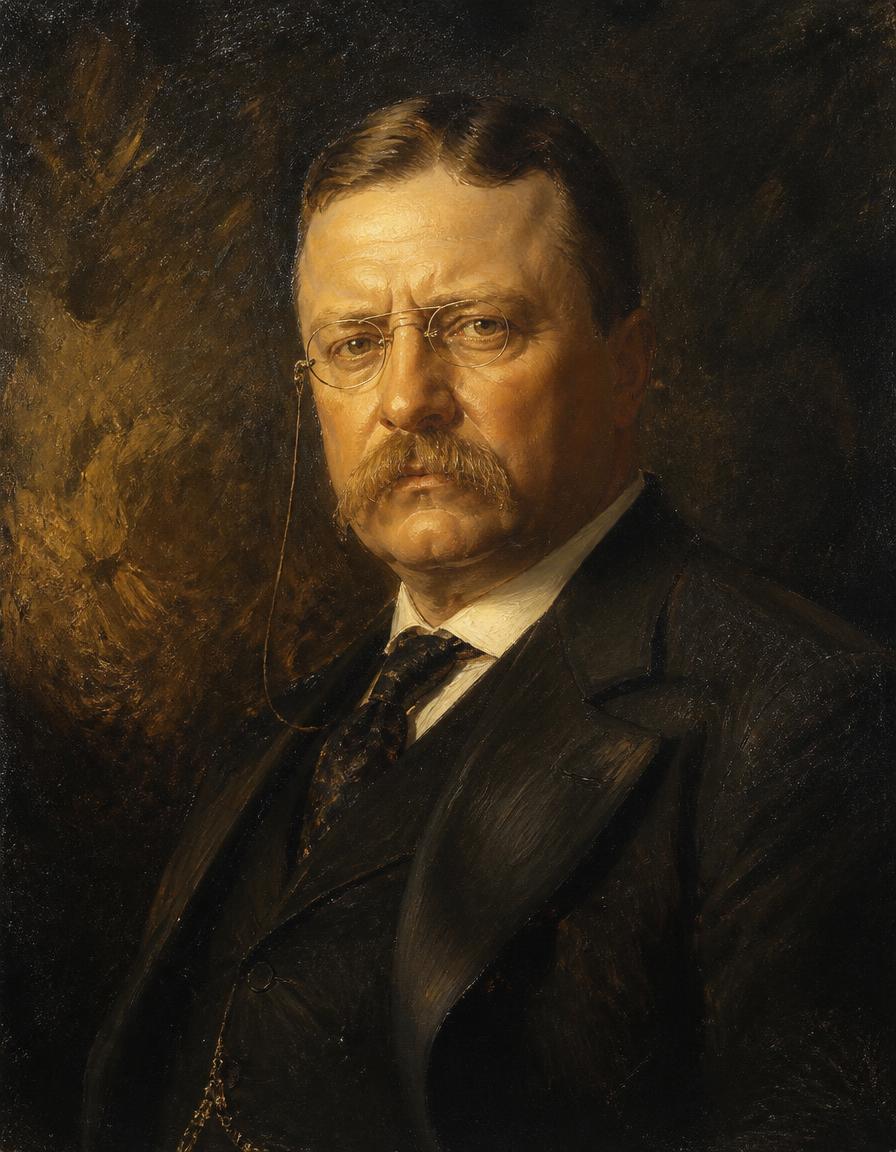
Quick Facts
- Years
- 1858 – 1919
- Category
- World Leaders & Revolutionaries
- Nationality
- American
- Occupation
- President & Reformer
Theodore Roosevelt
1858 – 1919 · American · President & Reformer
Audiobook

Life Lessons from Theodore Roosevelt
Marcus Alden · 51 min
Theodore Roosevelt Jr. (1858–1919) was an American statesman, reformer, soldier, writer, naturalist, and the 26th president of the United States. Taking office after President William McKinley’s assassination in 1901, Roosevelt became the youngest person ever to assume the presidency. His forceful personality and expansive understanding of executive power helped transform the office into the center of national political life.
Roosevelt is remembered for the “Square Deal,” his promise of fairness among workers, consumers, and businesses; for challenging powerful corporate combinations; and for advancing federal regulation of food, drugs, and railroads. He also made conservation a national priority, protecting roughly 230 million acres of public land through forests, monuments, wildlife refuges, parks, and related measures. Abroad, he promoted an active American role, helped mediate the Russo-Japanese War, supported construction of the Panama Canal, and received the Nobel Peace Prize.
His record also contains serious contradictions. He advocated democratic reform at home while endorsing imperial power abroad, and many of his views on race and civilization reflected—and sometimes intensified—the hierarchies of his era. Roosevelt remains important because his career illuminates enduring questions about presidential authority, economic inequality, environmental stewardship, military power, and the limits of progressive reform.
Quick Facts
| Field | Details |
|---|---|
| Full Name | Theodore Roosevelt Jr. |
| Common Name(s) | Theodore Roosevelt; TR; “Teddy” (a nickname he disliked) |
| Born | October 27, 1858 |
| Died | January 6, 1919 |
| Age at Death | 60 |
| Birthplace | New York City, New York, United States |
| Nationality | American |
| Occupation | Politician, president, civil servant, soldier, writer, rancher, naturalist |
| Historical Era | Gilded Age and Progressive Era |
| Famous For | Square Deal reforms, conservation, trust regulation, Panama Canal, Nobel Peace Prize |
| Political Affiliation | Republican; Progressive Party presidential nominee in 1912 |
| Religion | Dutch Reformed tradition; associated with the Reformed Church in America |
| Education | Harvard College, A.B., 1880; attended Columbia Law School without graduating |
| Parents | Theodore Roosevelt Sr. and Martha Bulloch Roosevelt |
| Spouse(s) | Alice Hathaway Lee Roosevelt; Edith Kermit Carow Roosevelt |
| Children | Alice Lee, Theodore III, Kermit, Ethel, Archibald, Quentin |
| Major Works | The Naval War of 1812; The Winning of the West; The Rough Riders; The Strenuous Life; An Autobiography |
| Major Achievements | 26th U.S. president; Square Deal; conservation expansion; Panama Canal diplomacy; mediation of Russo-Japanese War; Nobel Peace Prize |
Early Life
Theodore Roosevelt was born into a prosperous New York family. His father, Theodore Roosevelt Sr., was a glass importer and philanthropist; his mother, Martha “Mittie” Bulloch Roosevelt, came from a Georgia family with Confederate connections. The Civil War therefore divided the family emotionally: his father supported the Union but hired a substitute rather than serve, while maternal relatives supported the Confederacy.
Roosevelt was a sickly child who suffered severe asthma. Educated largely at home, he developed an intense curiosity about animals and assembled a small natural-history collection. His father urged him to strengthen his body, advice that helped produce Roosevelt’s lifelong commitment to strenuous exercise. Boxing, hiking, rowing, riding, and hunting became both physical disciplines and elements of his public identity.
At Harvard College, Roosevelt studied widely, pursued natural history, boxed, and became active in student organizations. His father’s death in 1878 deeply affected him. Roosevelt graduated in 1880 and entered Columbia Law School, but he found public life more compelling than legal study.
Important intellectual influences included his father’s civic morality, the natural sciences, historical writing, Protestant duty, and the nationalism of the post–Civil War generation. Roosevelt admired courage, action, and public service. Those ideals could inspire reform and conservation, but they also encouraged his enthusiasm for warfare, expansion, and cultural hierarchy.
Rise to Prominence
Roosevelt entered the New York State Assembly in 1882 as a Republican representing Manhattan. Though only in his twenties, he gained attention by investigating corruption and confronting powerful interests within his own party. He learned both the possibilities and constraints of machine politics.
His private life changed catastrophically on February 14, 1884, when his wife, Alice Hathaway Lee Roosevelt, and his mother died in the same house, hours apart. Roosevelt recorded that “the light has gone out of my life.” He then spent extended periods ranching in the Dakota Territory, where he hunted, raised cattle, pursued thieves, and cultivated his image as a Western outdoorsman. The devastating winter of 1886–87 damaged his ranching investments.
Returning to public affairs, Roosevelt ran unsuccessfully for mayor of New York in 1886. He later served on the U.S. Civil Service Commission, where he promoted merit-based appointments, and as president of the New York City Police Board, where he pursued administrative reform with mixed results.
As assistant secretary of the Navy under McKinley, Roosevelt advocated naval readiness. When the Spanish-American War began in 1898, he resigned and helped organize the First U.S. Volunteer Cavalry, popularly called the Rough Riders. Their charge at San Juan Heights in Cuba made him a national hero, although Black regular troops and other units were also crucial to the victory.
Roosevelt won election as governor of New York in 1898. His reform initiatives disturbed Republican organization leader Thomas C. Platt, who helped place him on McKinley’s 1900 ticket as vice president. McKinley’s assassination brought Roosevelt to the presidency on September 14, 1901.
Major Achievements
The Square Deal and Corporate Regulation
Roosevelt’s domestic program became known as the Square Deal. He argued that government should not automatically favor capital or labor, but should protect the public interest. During the 1902 anthracite coal strike, he invited both sides to Washington and threatened federal intervention—not simply against the union, as earlier presidents often had done. Arbitration produced wage increases and reduced working hours without formal union recognition.
His administration brought antitrust actions against corporations including the Northern Securities Company. Roosevelt did not oppose all large businesses; he distinguished between combinations he considered socially responsible and those abusing power. His approach strengthened the principle that corporations were subject to federal authority.
Railroad, Food, and Drug Regulation
The Elkins Act of 1903 targeted railroad rebates, while the Hepburn Act of 1906 expanded the Interstate Commerce Commission’s authority over rates. These laws did not eliminate railroad abuses, but they increased federal regulatory capacity.
Public concern intensified after investigative journalism exposed dangerous products and unsanitary meatpacking conditions. Roosevelt supported the Meat Inspection Act and Pure Food and Drug Act of 1906. Their enforcement had limitations, yet they became foundations for modern consumer protection and federal food-and-drug regulation.
Conservation of Public Lands
Conservation was one of Roosevelt’s most durable achievements. Working with officials and experts such as Gifford Pinchot, he used executive authority and legislation to protect forests, wildlife, watersheds, and culturally important sites. His administration established or enlarged national forests, created federal bird reservations and game preserves, and used the Antiquities Act of 1906 to proclaim national monuments.
Across multiple categories, Roosevelt protected approximately 230 million acres. His conservation philosophy generally favored scientifically managed use rather than leaving all land untouched. That approach helped institutionalize federal stewardship, although some protected-land policies disregarded Indigenous peoples’ existing relationships with those landscapes.
The Panama Canal
Roosevelt regarded a canal through Central America as essential to commerce and naval mobility. After Colombia’s senate rejected a canal treaty, Panama declared independence in 1903 while U.S. naval forces discouraged Colombian intervention. The United States quickly recognized Panama and secured control of the Canal Zone under a treaty negotiated with Philippe Bunau-Varilla, who represented Panama despite being a French citizen.
Construction proceeded under enormous technical and medical challenges. The canal opened in 1914, after Roosevelt left office. It transformed global shipping and American strategy, but the methods used to obtain the Canal Zone generated lasting resentment. The United States transferred control of the canal to Panama at the end of 1999 under later treaties.
Diplomacy and the Nobel Peace Prize
Roosevelt helped mediate negotiations ending the Russo-Japanese War. The Treaty of Portsmouth was signed in 1905, and Roosevelt received the 1906 Nobel Peace Prize—the first awarded to a U.S. president. His mediation demonstrated the United States’ growing diplomatic influence.
He also hosted the 1906 Algeciras Conference process concerning Morocco and pursued agreements aimed at balancing power in the Pacific. His diplomacy combined negotiation with military preparedness, summarized by the proverb he popularized: “Speak softly and carry a big stick.”
Expansion of Presidential Leadership
Roosevelt viewed the president as a “steward of the people” who could act unless the Constitution or law specifically forbade it. He used publicity, commissions, executive orders, litigation, and personal negotiation to shape national debate. This energetic model permanently enlarged expectations of presidential leadership, while also raising continuing concerns about executive overreach.
Leadership and Work
Roosevelt led through action, publicity, and personal persuasion. He called the presidency a “bully pulpit”—using “bully” in the period sense of excellent—from which public opinion could be mobilized. He read rapidly, dictated extensively, consulted specialists, and moved between subjects with unusual energy.
His strengths included political courage, intellectual curiosity, administrative experimentation, and an ability to translate complicated issues into moral language. He could cooperate with party professionals while pressuring them toward reform. He also understood symbolism: naval tours, White House conferences, and publicized investigations helped make policy visible.
His weaknesses were related to the same temperament. He could be impatient, self-righteous, impulsive, and dismissive of constitutional or diplomatic caution. He personalized disputes and sometimes exaggerated the divide between honorable and dishonorable opponents. His preference for decisive action contributed to the controversial intervention in Panama.
Roosevelt’s relationships were pragmatic. He worked with reformers such as Gifford Pinchot but disagreed with preservationist John Muir over resource use. He initially supported successor William Howard Taft, then concluded that Taft had betrayed progressive principles. Their rupture divided the Republican Party and helped Democrat Woodrow Wilson win in 1912.
Personal Life
Roosevelt married Alice Hathaway Lee in 1880. Their daughter, Alice Lee Roosevelt, was born in 1884, two days before her mother died from kidney disease. Roosevelt’s sister Anna helped care for the child during his Western period.
In 1886 he married his childhood friend Edith Kermit Carow. They had five children: Theodore III, Kermit, Ethel, Archibald, and Quentin. Edith managed the large household and guarded the family’s privacy. The children’s lively behavior made the Roosevelt White House famous, while Alice became a celebrity known for wit and independence.
The family home at Sagamore Hill in Oyster Bay, New York, served as Roosevelt’s refuge and an informal political headquarters. He loved reading, writing, natural history, hunting, riding, rowing, hiking, and family games. He was an extraordinarily productive author whose subjects ranged from warfare and Western history to wildlife and politics.
Roosevelt’s health was complicated. Childhood asthma receded but never entirely lost its significance. A 1902 carriage accident injured his leg, and a 1912 assassin’s bullet remained lodged in his chest. Disease contracted during a 1913–14 South American expedition further weakened him. His son Quentin’s death in aerial combat during World War I devastated him. Roosevelt died in his sleep at Sagamore Hill on January 6, 1919.
Philosophy and Beliefs
Roosevelt’s progressivism emphasized national power, civic duty, social order, and regulated capitalism. He accepted private property and large-scale enterprise but believed government must restrain abuses and preserve fair opportunity. He rejected both unregulated plutocracy and revolutionary socialism.
His “New Nationalism,” articulated most prominently in 1910, called for strong federal supervision of corporations, social insurance, labor protections, and political reform. In 1912, his Progressive Party platform went beyond much of his presidential record and supported measures including women’s suffrage and national social-welfare programs.
Religiously, Roosevelt came from the Dutch Reformed tradition. His language emphasized moral responsibility, service, courage, and national purpose more than theological doctrine. He often framed politics as an ethical struggle, a habit that energized supporters but sometimes narrowed his tolerance for disagreement.
Roosevelt believed peace depended upon strength and readiness. He supported arbitration and diplomacy, yet celebrated martial virtues and accepted empire as a vehicle of strategic power and what he considered civilization. His racial views were inconsistent and hierarchical. He sometimes defended individual Black achievement and invited Booker T. Washington to dine at the White House, but he also embraced white superiority, supported imperial rule, and failed to challenge structural racism consistently.
Challenges and Controversies
Roosevelt’s handling of the Brownsville affair remains one of the gravest criticisms of his presidency. After a 1906 shooting in Brownsville, Texas, he ordered the dishonorable discharge of 167 Black soldiers who denied involvement and were not individually tried. Later investigations undermined the collective accusation, and the Army changed the discharges to honorable in 1972. Defenders once cited military discipline; critics stress the absence of due process and the role of racial prejudice.
His role in Panama was celebrated by supporters as strategic decisiveness and condemned by opponents as coercive imperialism. Roosevelt later boasted that he “took the Canal Zone,” although the exact diplomatic history was more complicated than that slogan. Colombia received a U.S. expression of regret and compensation under a treaty ratified in 1921.
His conservation program protected vast landscapes, but conservation could also impose federal authority over Indigenous communities and local users. Modern scholarship therefore studies both environmental benefits and dispossession.
Roosevelt’s record on race mixed gestures of inclusion with beliefs in Anglo-American dominance. He denounced some mob violence and appointed certain Black officeholders, yet accommodated Southern white power in important ways. His invitation to Booker T. Washington prompted racist backlash, but Roosevelt subsequently became more politically cautious.
The 1912 Progressive campaign broadened reform debate but split Republicans. Roosevelt won more popular and electoral votes than Taft, yet Wilson captured the presidency. Critics viewed Roosevelt’s third-party candidacy as egotistical; supporters considered it a principled response to a conservative party establishment.
His enthusiasm for war also remains controversial. Roosevelt associated combat with national vigor and fiercely criticized Wilson’s neutrality during much of World War I. Admirers see realism and preparedness; critics see militarism.
Legacy
Roosevelt helped create the modern presidency: nationally visible, policy-driven, and expected to manage economic and social conflict. Later presidents from both parties adopted parts of his approach to executive leadership, regulation, conservation, and public communication.
His environmental legacy survives in national forests, monuments, wildlife refuges, and agencies strengthened during his administration. Theodore Roosevelt National Park in North Dakota preserves landscapes associated with his ranching years. Sagamore Hill National Historic Site preserves his home, and his Manhattan birthplace is also administered as a national historic site.
His image appears on Mount Rushmore beside George Washington, Thomas Jefferson, and Abraham Lincoln. The choice reflects his association with national growth and modern federal power, while Mount Rushmore itself remains controversial because it was carved in the Black Hills, land sacred to the Lakota and guaranteed to them under the 1868 Treaty of Fort Laramie before U.S. seizure.
Institutions bearing his name include the Theodore Roosevelt Association and numerous schools, parks, ships, and public buildings. In 2001, Roosevelt received the Medal of Honor posthumously for his conduct in Cuba.
Modern assessments are necessarily mixed. He advanced consumer protection and conservation while participating in imperialism and racial hierarchy. Studying Roosevelt reveals how reform can coexist with exclusion—and why energetic leadership requires legal, ethical, and democratic restraints.
Interesting Facts
- Roosevelt was 42 when he became president, the youngest person to assume the office.
- John F. Kennedy remains the youngest person elected president.
- Roosevelt’s childhood natural-history collection was called the “Roosevelt Museum of Natural History.”
- His first major book, The Naval War of 1812, appeared in 1882.
- He served as a New York assemblyman before turning 24.
- His mother and first wife died in the same house on the same day.
- The Rough Riders were officially the First U.S. Volunteer Cavalry.
- Roosevelt was the first U.S. president to ride in an automobile publicly while in office.
- He was the first sitting president to travel outside the United States, visiting Panama in 1906.
- He was the first American president to receive a Nobel Prize.
- The “teddy bear” name arose after a 1902 hunting incident in which he refused to shoot a restrained bear.
- He disliked being called “Teddy,” preferring Theodore or TR.
- He invited Booker T. Washington to dine at the White House in 1901.
- Roosevelt read extensively and wrote more than 30 books.
- He temporarily blinded one eye while boxing in the White House.
- He survived an assassination attempt in Milwaukee in 1912 and completed his speech before seeking hospital care.
- A folded speech and metal eyeglass case slowed the bullet.
- He explored Brazil’s River of Doubt with Cândido Rondon in 1913–14.
- The river was later renamed Rio Roosevelt.
- He received the Medal of Honor posthumously in 2001.
Famous Quotes
- “Speak softly and carry a big stick; you will go far.” — Used in a 1900 letter and later speeches. It expressed Roosevelt’s preference for calm diplomacy supported by credible power.
- “The government should assume the power of supervision and regulation over all corporations doing an interstate business.” — From his 1901 annual message to Congress, summarizing his regulatory outlook.
- “I wish to preach, not the doctrine of ignoble ease, but the doctrine of the strenuous life.” — From his 1899 Chicago speech, urging effort, public duty, and national ambition.
- “The credit belongs to the man who is actually in the arena.” — From “Citizenship in a Republic,” delivered in Paris in 1910. It praises courageous participation despite failure.
- “The conservation of natural resources is the fundamental problem.” — From his 1907 message concerning inland waterways. It framed conservation as a national necessity.
- “I believe in a square deal.” — A recurring formulation in Roosevelt’s speeches, expressing his claim that government should deal fairly with competing groups.
- “The most important single ingredient in the formula of success is knowing how to get along with people.” — Documented in Roosevelt collections and often cited as an observation about practical leadership.
- “Death had to take Roosevelt sleeping, for if he had been awake, there would have been a fight.” — Often misattributed to Roosevelt; Vice President Thomas R. Marshall reportedly said it after Roosevelt’s death.
- “Do what you can, with what you have, where you are.” — Frequently attributed to Roosevelt, but he credited the thought to Squire Bill Widener in An Autobiography. Attribution should therefore be qualified.
- “Believe you can and you’re halfway there.” — Widely attributed to Roosevelt online, but reliable primary documentation is lacking; treat it as disputed.
Timeline
- 1858 — Born in New York City on October 27.
- 1876 — Entered Harvard College.
- 1878 — His father died.
- 1880 — Graduated from Harvard; married Alice Hathaway Lee; entered Columbia Law School.
- 1882 — Elected to the New York State Assembly; published The Naval War of 1812.
- 1884 — His mother and first wife died on February 14; he spent extended time in the Dakota Territory.
- 1886 — Married Edith Kermit Carow; unsuccessfully ran for New York City mayor.
- 1889 — Joined the U.S. Civil Service Commission.
- 1895 — Became president of the New York City Police Board.
- 1897 — Appointed assistant secretary of the Navy.
- 1898 — Served with the Rough Riders in Cuba; elected governor of New York.
- 1900 — Elected vice president on McKinley’s ticket.
- 1901 — Became president after McKinley’s assassination.
- 1902 — Intervened in the anthracite coal strike; inspired the “teddy bear” name.
- 1903 — Established federal protection at Pelican Island; supported Panama’s separation from Colombia; signed the Elkins Act.
- 1904 — Announced the Roosevelt Corollary; elected president in his own right.
- 1905 — Mediated the Russo-Japanese peace settlement; Northern Securities decision reinforced antitrust policy.
- 1906 — Received the Nobel Peace Prize; signed major food, drug, railroad, and monument legislation; discharged Black soldiers after the Brownsville affair.
- 1907 — Sent the Great White Fleet on its global voyage.
- 1909 — Left the presidency; departed on an African expedition.
- 1910 — Delivered the “New Nationalism” and “Man in the Arena” speeches.
- 1912 — Led the Progressive Party; survived an assassination attempt; lost the presidential election to Wilson.
- 1913–1914 — Joined the River of Doubt expedition in Brazil.
- 1917 — Sought permission to raise a World War I volunteer division; Wilson refused.
- 1918 — His son Quentin was killed in France.
- 1919 — Died at Sagamore Hill on January 6.
- 2001 — Awarded the Medal of Honor posthumously.
Frequently Asked Questions
Why is Theodore Roosevelt important?
Roosevelt reshaped the presidency and the federal government’s relationship to corporations, workers, consumers, and natural resources. His administration pursued antitrust cases, strengthened railroad regulation, enacted landmark food and drug laws, and protected vast areas of public land. Internationally, he advanced the Panama Canal, mediated the Russo-Japanese War, and asserted a larger American role. His importance also lies in the contradictions of his career: progressive reform existed alongside imperialism, racial hierarchy, and expansive executive power.
Was Theodore Roosevelt related to Franklin D. Roosevelt?
Yes, but not closely. Theodore Roosevelt and Franklin D. Roosevelt were fifth cousins. Franklin married Theodore’s niece, Eleanor Roosevelt, making Theodore her uncle and Franklin’s distant cousin-in-law as well. Theodore represented the Oyster Bay branch of the Roosevelt family; Franklin came from the Hyde Park branch. Their political programs differed, though Franklin’s New Deal inherited aspects of the energetic presidency and national reform tradition associated with Theodore.
How did Theodore Roosevelt become president?
Roosevelt was elected vice president in 1900 as William McKinley’s running mate. On September 6, 1901, anarchist Leon Czolgosz shot McKinley in Buffalo, New York. McKinley died eight days later, and Roosevelt took the oath of office. At 42 years and 322 days old, he became the youngest person to assume the presidency. He later won election in his own right in 1904.
What was the Square Deal?
The Square Deal was Roosevelt’s broad domestic promise of fair treatment for the public, labor, and business. Historians often summarize it as control of corporations, consumer protection, and conservation of natural resources. It was not a single law or fully coherent program. Rather, it described measures such as trust regulation, railroad oversight, mediation in the coal strike, and food-safety legislation. Roosevelt sought to reform capitalism, not replace it.
Was Roosevelt really a “trust buster”?
Yes, but the label can mislead. His administration filed more antitrust actions than its predecessors and successfully challenged Northern Securities. Roosevelt did not believe every large corporation should be broken apart. He distinguished between “good” trusts that accepted public responsibility and “bad” trusts that abused power. His deeper goal was federal supervision of the modern corporate economy. Taft’s administration eventually filed more antitrust cases, despite Roosevelt’s later criticism of him.
What did Roosevelt do for conservation?
Roosevelt protected about 230 million acres through national forests, federal bird reservations, game preserves, national parks, and national monuments. He strengthened the Forest Service, worked closely with Gifford Pinchot, and convened a national conservation conference. His policy emphasized managed, sustainable use of resources. Although foundational to modern conservation, it could conflict with Indigenous land rights and local practices, a dimension emphasized by recent scholarship.
Did Theodore Roosevelt create national parks?
He did not create the national park idea or the first national park; Yellowstone was established in 1872. During Roosevelt’s presidency, Congress established five national parks, and he signed the measures. He also proclaimed 18 national monuments under the Antiquities Act, though later boundary changes affected several sites. His greatest contribution was making conservation a sustained federal priority across forests, wildlife refuges, monuments, reclamation projects, and parks.
Why did Roosevelt receive the Nobel Peace Prize?
Roosevelt received the 1906 Nobel Peace Prize primarily for helping mediate an end to the Russo-Japanese War. Russian and Japanese representatives negotiated at Portsmouth, New Hampshire, and signed a treaty in September 1905. Roosevelt communicated with both governments and helped bridge disagreements. He was the first U.S. president and first American statesman to receive the prize. The award illustrates the diplomatic side of a leader also known for military preparedness.
What was Roosevelt’s role in creating the Panama Canal?
Roosevelt made the canal a strategic priority. After Colombia rejected a treaty, Panama declared independence, and U.S. naval forces prevented effective Colombian intervention. Washington quickly recognized Panama and obtained canal rights in a highly favorable treaty. Roosevelt considered the result decisive statecraft; critics saw coercion against Colombia and an unequal arrangement with Panama. Construction began under his administration, but the canal opened in 1914 under Wilson.
What were the Rough Riders?
The Rough Riders were the First U.S. Volunteer Cavalry, organized for the Spanish-American War. Roosevelt resigned as assistant secretary of the Navy to become its lieutenant colonel and later colonel. The regiment included Western cowboys, miners, law officers, and athletes. Its service in Cuba—especially around San Juan Heights—made Roosevelt famous. Popular memory often understates the essential role of Black regular soldiers and other U.S. units in the fighting.
Why is there a teddy bear named after him?
During a Mississippi bear hunt in 1902, guides tied a bear to a tree after an exhausting chase and invited Roosevelt to shoot it. He refused to kill the restrained animal, regarding the act as unsporting, though the bear was later killed by another participant. A political cartoon popularized the incident. Toymakers then marketed stuffed bears associated with “Teddy,” creating the enduring name, even though Roosevelt disliked that nickname.
What happened in the Brownsville affair?
After shots were fired in Brownsville, Texas, in 1906, local residents accused Black soldiers of the 25th Infantry. The soldiers denied involvement. Roosevelt ordered 167 men discharged without honor after they refused or were unable to identify perpetrators. No individual trials established guilt. Later reviews exposed serious evidentiary problems, and in 1972 the Army changed most discharges to honorable. The episode is widely judged a major injustice of his presidency.
Why did Roosevelt run again in 1912?
Roosevelt became dissatisfied with President Taft, whom he believed had abandoned progressive reform. After losing the Republican nomination amid disputed delegate contests, he and his supporters created the Progressive Party, nicknamed the Bull Moose Party. Roosevelt advocated New Nationalism, women’s suffrage, social insurance, and stronger corporate regulation. He finished second, ahead of Taft but behind Wilson. The Republican split was crucial to Wilson’s victory.
Did Theodore Roosevelt survive an assassination attempt?
Yes. On October 14, 1912, John Schrank shot Roosevelt in Milwaukee before a campaign speech. A metal eyeglass case and folded manuscript slowed the bullet. Because Roosevelt was not coughing blood, he concluded that his lung had probably not been penetrated and spoke for roughly 80 minutes before receiving hospital treatment. Doctors left the bullet in place because removal posed greater risks. He carried it for the rest of his life.
What were Roosevelt’s views on race?
They were contradictory but fundamentally shaped by the racial hierarchies of his time. Roosevelt sometimes opposed particular injustices, appointed some Black officials, and publicly honored individuals such as Booker T. Washington. Yet he also believed in Anglo-American superiority, supported imperial rule over nonwhite peoples, accommodated segregationist politics, and denied due process to Black soldiers in the Brownsville affair. Scholars reject portrayals that treat isolated inclusive actions as evidence of modern racial equality.
What was the Roosevelt Corollary?
Announced in 1904, the Roosevelt Corollary extended the Monroe Doctrine by asserting that the United States could exercise “international police power” in cases of chronic instability or wrongdoing in the Western Hemisphere. Roosevelt presented it as a way to prevent European intervention over debts. In practice, it rationalized repeated U.S. interference in Latin America and the Caribbean. It became an important expression of American regional dominance.
How did Theodore Roosevelt die?
Roosevelt died in his sleep at Sagamore Hill early on January 6, 1919, at age 60. The immediate cause was a coronary embolism. His health had deteriorated after the dangerous Brazilian expedition, recurring infections, and other medical problems. The death of his youngest son, Quentin, during World War I also caused profound grief. Roosevelt was buried at Youngs Memorial Cemetery in Oyster Bay, New York.
What is Theodore Roosevelt’s historical reputation?
Presidential surveys often rank Roosevelt among the more consequential U.S. presidents because of his leadership, reforms, conservation, and diplomacy. Reputation is not the same as moral endorsement. Modern historians give greater attention to his imperialism, racial beliefs, Brownsville decision, and use of executive power. His standing remains substantial, but contemporary scholarship presents a more complete and critical portrait than older heroic biographies often did.
Lessons We Can Learn
- Adversity can be answered with disciplined effort. Roosevelt’s response to childhood illness shows how structured habits can build confidence, though willpower is not a substitute for medical care.
- Government must adapt to economic change. His corporate regulation recognized that industrial concentration required institutions stronger than nineteenth-century remedies.
- Leaders should mediate rather than automatically choose powerful allies. The coal strike showed the value of treating labor disputes as public problems.
- Consumer safety requires enforceable standards. The 1906 laws demonstrate why markets need trustworthy inspection and labeling systems.
- Environmental choices shape generations. Roosevelt’s land protections illustrate the lasting value of acting before resources are irreversibly damaged.
- Expertise improves policy. His work with foresters, scientists, commissioners, and public-health investigators shows the importance of specialized knowledge.
- Decisiveness needs legal and ethical limits. Panama and Brownsville reveal how energetic leadership can become coercive or unjust.
- Public communication is part of leadership. Roosevelt used the presidency to explain issues and build support, anticipating modern agenda-setting.
- Personal loyalty should not replace institutional judgment. His rupture with Taft shows the dangers of personalizing political disagreement.
- Historical heroes require critical examination. Roosevelt’s reforms and prejudices coexisted; responsible citizenship requires learning from both achievement and harm.
Related Historical Figures
- William McKinley — President under whom Roosevelt served as assistant navy secretary and vice president; his assassination elevated Roosevelt.
- William Howard Taft — Roosevelt’s chosen successor, later rival, and opponent in the divided 1912 election.
- Woodrow Wilson — Democrat who defeated Roosevelt and Taft in 1912 and later faced Roosevelt’s attacks over World War I policy.
- Edith Kermit Carow Roosevelt — Roosevelt’s second wife, family partner, and manager of Sagamore Hill and the presidential household.
- Alice Roosevelt Longworth — His eldest child, a celebrated political personality who maintained influence in Washington for decades.
- Booker T. Washington — Black educator invited to dine at the White House; their association exposed both racial barriers and Roosevelt’s political caution.
- Gifford Pinchot — Chief forester and close ally who shaped Roosevelt’s utilitarian conservation program.
- John Muir — Naturalist who discussed preservation with Roosevelt and influenced public support for protected landscapes, despite policy differences.
- J. P. Morgan — Financier whose corporate network became a major target in the Northern Securities antitrust case.
- Alfred Thayer Mahan — Naval strategist whose theories of sea power influenced Roosevelt’s military and foreign-policy thinking.
Related Historical Figures