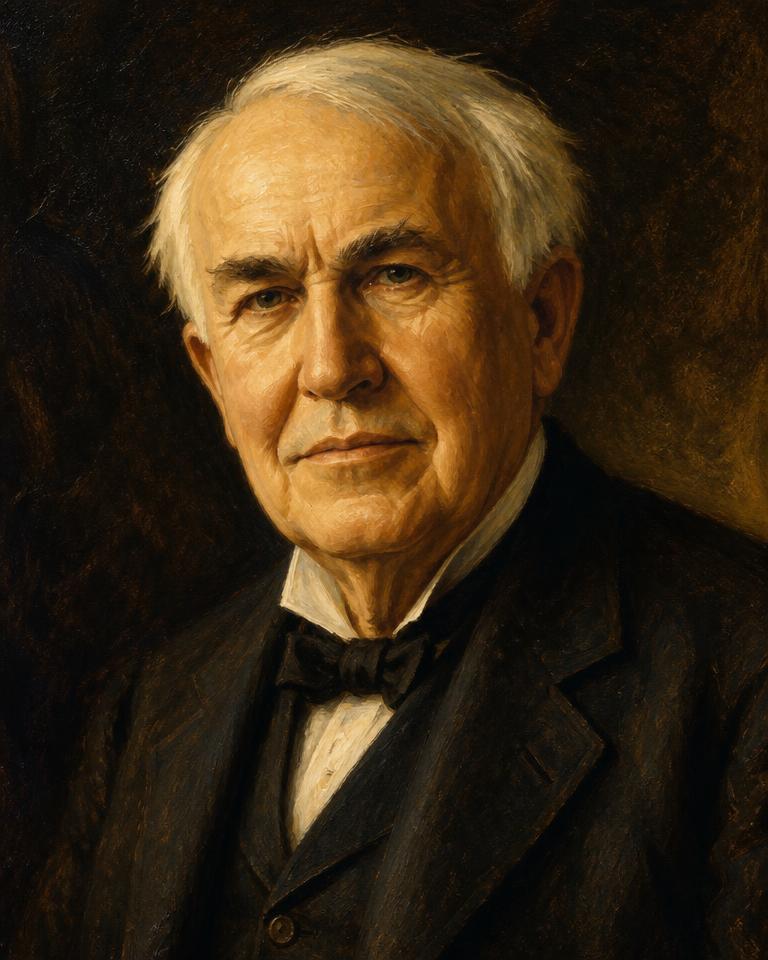
Quick Facts
- Years
- 1847 – 1931
- Category
- Scientists & Inventors
- Subcategory
- Invention
- Nationality
- American
- Occupation
- Inventor & Entrepreneur
Thomas Edison
1847 – 1931 · American · Inventor & Entrepreneur
Audiobook

Life Lessons from Thomas Edison
Marcus Alden · 36 min
Thomas Alva Edison (1847–1931) was an American inventor, experimenter, and entrepreneur whose laboratories helped shape modern electrical and communications industries. He received 1,093 United States patents—an extraordinary record for his era—and participated in developing commercially practical systems for recorded sound, electric lighting, power distribution, motion pictures, and industrial research.
Edison did not invent every device popularly credited to him from nothing. His particular genius was often improvement and integration: he and his employees combined existing scientific knowledge, patented components, manufacturing methods, and business organization into dependable systems. The incandescent lamp illustrates this approach. Earlier experimenters had produced electric light, but Edison's group created a durable high-resistance lamp and an interconnected generating and distribution network suitable for commercial service.
His Menlo Park and West Orange facilities became influential models for organized research and development. Yet his career also involved failed ventures, aggressive patent litigation, harsh business competition, and disputes over credit. The celebrated “War of the Currents” and the contested contributions of laboratory workers complicate heroic accounts of a solitary genius.
Edison remains important because his career connects invention with teamwork, intellectual property, manufacturing, finance, publicity, and infrastructure. His achievements—and their costs—offer a revealing case study in how technology enters everyday life.
Quick Facts
| Field | Details |
|---|---|
| Full Name | Thomas Alva Edison |
| Common Name(s) | Thomas Edison; “The Wizard of Menlo Park” |
| Born | February 11, 1847 |
| Died | October 18, 1931 |
| Age at Death | 84 |
| Birthplace | Milan, Ohio, United States |
| Nationality | American |
| Occupation | Inventor, entrepreneur, laboratory director |
| Historical Era | Industrial Revolution; Second Industrial Revolution |
| Famous For | Phonograph, practical incandescent-lighting system, electric-power networks, motion-picture technology, industrial research laboratories |
| Political Affiliation if applicable | No enduring major-party affiliation central to his career; he advised government during World War I |
| Religion if significant | Raised in a Protestant environment; later expressed an unconventional, naturalistic belief in a “Supreme Intelligence” and rejected traditional ideas of personal immortality |
| Education | Brief formal schooling; educated largely at home and through independent study |
| Parents | Samuel Ogden Edison Jr. and Nancy Matthews Elliott Edison |
| Spouse(s) | Mary Stilwell (m. 1871; died 1884); Mina Miller (m. 1886) |
| Children | Marion Estelle, Thomas Alva Jr., William Leslie, Madeleine, Charles, Theodore Miller |
| Major Works | Phonograph; quadruplex telegraph; carbon telephone transmitter; incandescent-lamp and electric-power system; Kinetograph and Kinetoscope; alkaline storage battery |
| Major Achievements | 1,093 U.S. patents; first commercially successful central electric station in the United States; pioneering industrial R&D organizations; major contributions to sound recording and motion pictures |
Early Life
Thomas Edison was born in Milan, Ohio, the youngest surviving child of Samuel and Nancy Edison. His father had left Canada after taking part in the unsuccessful Rebellion of 1837 and pursued several occupations in the United States. His mother, formerly a teacher, played the leading role in Thomas's education.
The family moved to Port Huron, Michigan, in 1854. Edison attended school only briefly. Later stories often dramatized a conflict with a teacher, but the secure point is that his formal education was limited and Nancy supervised much of his learning at home. He read widely, especially works on science and mechanics, and conducted chemical experiments as a boy.
Edison developed severe hearing loss during childhood and adolescence. Its exact cause remains uncertain. He later offered differing explanations, while biographers have considered illness and other factors. His deafness created real difficulties, but Edison said it also reduced distraction and aided concentration.
At about twelve, he sold newspapers, snacks, and other goods on trains running between Port Huron and Detroit. He also published the Grand Trunk Herald, a small newspaper printed aboard a train. These ventures introduced him to sales, publicity, and the practical economics of technology.
After helping a station agent's child escape danger—details vary among retellings—Edison learned telegraphy. The telegraph network was then transforming commerce and news during the Civil War era. Working as an itinerant operator gave him access to equipment, technically skilled colleagues, and a rapidly expanding industry.
Rise to Prominence
During the 1860s Edison worked at telegraph offices in several cities. Night shifts sometimes gave him time to read and experiment, although his tinkering could irritate employers. His first U.S. patent, issued in 1869, covered an electric vote recorder. Legislators showed little interest because faster voting did not necessarily serve political strategy. The failure taught him to prioritize inventions with identifiable customers.
Edison moved to New York in 1869. After repairing or improving stock-reporting machinery, he found work in the financial-telegraph business. His advances in stock tickers and printing telegraphs brought substantial income. In 1870 he established a shop in Newark, New Jersey, where machinists and experimenters manufactured and improved telegraphic equipment.
His quadruplex telegraph, developed in the 1870s, could transmit four messages over one wire—two in each direction. Western Union valued the potential savings. A dispute over rights and payment led to litigation, foreshadowing the patent conflicts that marked Edison's career.
In 1876 Edison opened a laboratory at Menlo Park, New Jersey. It united chemistry, machine work, electrical experimentation, drafting, and testing. Skilled associates—including Charles Batchelor, John Kruesi, Francis Upton, and others—were essential to its productivity.
Edison's 1877 phonograph made him internationally famous. A machine that could record and reproduce sound astonished audiences. Newspapers called him the “Wizard of Menlo Park.” He then pursued electric lighting, promising a practical alternative to gas illumination. The successful public demonstration at Menlo Park in late 1879 transformed him from a notable telegraph inventor into a symbol of technological modernity.
Major Achievements
Telegraphy and the Quadruplex System
Edison's early inventions improved automatic, printing, and multiplex telegraphy. The quadruplex allowed four simultaneous signals on one wire, increasing the capacity of existing infrastructure without requiring four separate lines.
This mattered because telegraph companies depended on expensive networks. Greater capacity meant lower transmission costs and higher potential revenue. The work also taught Edison about circuits, markets, patents, manufacturing, and corporate negotiation—skills that underpinned his later enterprises.
The Carbon Telephone Transmitter
Alexander Graham Bell's telephone transmitted speech, but early instruments produced weak signals. Edison developed a carbon-based transmitter in 1877–1878 that varied electrical resistance in response to sound. This yielded louder, clearer transmission over useful distances.
Other inventors, notably Emile Berliner and David Edward Hughes, also worked on loose-contact and carbon microphone principles, and patent rights became contested. Nevertheless, Edison's transmitter was an important step toward commercially effective telephony. Carbon microphones remained widely used for decades.
The Phonograph
In 1877 Edison and his team built the first practical machine that both recorded and reproduced sound. The original tinfoil phonograph used a stylus to emboss vibrations onto a rotating cylinder. Edison recited “Mary Had a Little Lamb” during an early demonstration, although no recording of that moment survives.
The phonograph introduced the startling possibility that speech and music could outlast the performance that created them. The first device was fragile and initially had limited practical use. Later cylinder improvements by Edison and competitors, followed by disc systems, established the recorded-sound industry. Modern audio media descend conceptually from this breakthrough.
Incandescent Lighting and an Electrical System
Edison did not invent the first incandescent lamp. Humphry Davy, Warren de la Rue, Joseph Swan, and others had produced earlier examples. Edison's achievement was to develop, with his staff, a long-lasting high-resistance lamp compatible with an economically designed system.
In October 1879 his laboratory tested a successful carbon-filament lamp. Bamboo and other carbonized materials were subsequently used. Equally important were generators, underground conductors, sockets, switches, meters, fuses, and parallel distribution.
The Pearl Street Station began supplying direct-current electricity to part of lower Manhattan on September 4, 1882. It demonstrated centralized generation for lighting customers. Although alternating current eventually became dominant for long-distance distribution, the integrated utility model transformed cities, industry, and domestic life.
Industrial Research at Menlo Park and West Orange
Menlo Park institutionalized collaborative experimentation. Edison recruited specialists, maintained workshops, acquired extensive materials, and pursued many trials in parallel. His famous reputation for persistence reflected a structured organization as much as individual stamina.
In 1887 he opened a much larger laboratory complex at West Orange, New Jersey. Research operated alongside factories producing phonographs, films, batteries, and other goods. These laboratories helped establish a model later adopted by corporate and government research organizations: salaried teams combining science, engineering, patent work, and manufacturing.
Motion-Picture Technology
Beginning in the late 1880s, Edison assigned William Kennedy Laurie Dickson and other employees to develop motion-picture equipment. Their work produced the Kinetograph camera and Kinetoscope viewing cabinet. The nearby Black Maria studio, completed in 1893, created short films for individual viewing.
Motion pictures had many pioneers, including Eadweard Muybridge, Étienne-Jules Marey, the Lumière brothers, and others. Edison's operation was nevertheless crucial to early American production and exhibition. Later projection systems made communal screen viewing standard. Edison's companies helped commercialize the medium, although their patent enforcement also generated resistance.
The Alkaline Storage Battery
Edison spent years developing a nickel-iron alkaline battery. He hoped initially to power electric automobiles, but early versions suffered leakage and inconsistent performance. He halted sales, redesigned the product, and returned it to market after extensive testing.
Gasoline vehicles prevailed, yet the battery found uses in industrial trucks, railway signaling, mining lamps, and other demanding applications. The project demonstrates both Edison's persistence and a recurring limitation: technical improvement could not always overcome market shifts.
Leadership and Work
Edison led through intense personal involvement. He defined ambitious commercial problems, moved rapidly from sketches to prototypes, and expected long hours. His laboratories documented experiments in notebooks and tested large numbers of materials or configurations.
His strength was systems thinking. He understood that a lamp without generators, wiring, meters, and a business plan would not create an electrical industry. He also recognized publicity's value, staging demonstrations and cultivating newspapers and investors.
The laboratory was collaborative but hierarchical. Assistants supplied crucial expertise, while patents and publicity often emphasized Edison as the organizing inventor. Some employees found the environment exhilarating; others objected to exhausting schedules or insufficient recognition. Dickson's motion-picture work and the contributions of Batchelor, Upton, Kruesi, and many unnamed workers challenge the lone-genius image.
Edison could make bold commitments before solving every technical problem. This attracted capital and motivated teams, but it could produce inflated expectations. He was resilient after failure, yet sometimes remained attached to favored approaches—most famously direct current and certain unsuccessful mining technologies.
Personal Life
Edison married Mary Stilwell, an employee at one of his businesses, on Christmas Day 1871. They had three children: Marion Estelle, Thomas Alva Jr., and William Leslie. Mary died in 1884 at age twenty-nine; the precise cause remains uncertain in surviving accounts.
In 1886 Edison married Mina Miller, daughter of inventor and industrialist Lewis Miller. They lived at Glenmont in Llewellyn Park, West Orange, and had Madeleine, Charles, and Theodore. Mina managed a large household and protected family and social routines amid Edison's demanding work life. Charles later became governor of New Jersey and briefly led the family company.
Edison often slept irregularly, taking short naps while pursuing experiments. Popular accounts sometimes overstate how little he slept, but his long work sessions are well documented. He enjoyed practical jokes, music despite his hearing loss, reading, and conversation with prominent visitors.
His friendships included industrialist Henry Ford and naturalist John Burroughs. Edison, Ford, Burroughs, and tire manufacturer Harvey Firestone undertook highly publicized camping trips as the “Vagabonds.” The excursions mixed friendship, outdoor recreation, publicity, and discussion of industry and nature.
Edison's hearing impairment deepened with age. He sometimes used his teeth or skull vibrations to perceive music and sound equipment. In his final years his health declined from diabetes-related complications. He died at Glenmont on October 18, 1931.
Philosophy and Beliefs
Edison valued experimentation, utility, discipline, and commercial applicability. He distrusted explanations that could not be tested and often portrayed invention as prolonged problem-solving rather than sudden inspiration. His notebooks and repeated trials support that practical outlook.
His religious views were unconventional. In a 1910 interview he denied belief in the traditional immortal soul and described nature as governed by a “Supreme Intelligence.” Public reaction prompted clarification, but he did not embrace orthodox Christian doctrine. His statements are best understood as naturalistic and sometimes deistic rather than simply atheistic.
Politically, Edison was not a systematic partisan thinker. He proposed reforms, commented on public affairs, and favored technological solutions to social problems. During World War I he chaired the Naval Consulting Board and advocated preparedness while expressing opposition to aggressive war.
His ethics contained tensions. He celebrated useful invention and mass access to technology, yet practiced forceful patent enforcement and competitive publicity. He saw patents as necessary rewards for costly research, while critics viewed some legal campaigns as attempts to control markets.
Challenges and Controversies
Credit and the “Lone Inventor” Myth
Edison's name became attached to achievements produced by teams and built upon earlier work. Admirers argue that he selected problems, organized resources, directed testing, and accepted financial risk—genuine forms of invention. Critics answer that popular narratives minimize assistants and rival innovators. Both points are important: Edison was neither a fraudulent figurehead nor an isolated creator.
The War of the Currents
Edison championed low-voltage direct current, while George Westinghouse promoted alternating-current systems incorporating work associated with Nikola Tesla and others. AC could be transformed to high voltages for efficient transmission and then reduced for consumers.
Edison interests emphasized AC's dangers. Public demonstrations involved electrocuting animals, and electrician Harold P. Brown—who had ties to the Edison camp—promoted AC for the electric chair. Historians debate Edison's exact control over every act, but his organization clearly participated in a fear-based campaign. AC ultimately became the dominant distribution standard, though DC remains important in electronics, batteries, transmission applications, and modern grids.
Patent Litigation and Motion-Picture Control
Edison companies repeatedly defended patents in court. In motion pictures, Edison joined other firms in the Motion Picture Patents Company in 1908. Its licensing system attempted to regulate cameras, projectors, and film supply.
Supporters saw patent pools as a way to reduce lawsuits and standardize business. Independent producers regarded the organization as restrictive. Courts weakened its authority, and federal antitrust action ended the arrangement. The episode contributed to filmmakers' search for operating freedom, although the claim that Edison single-handedly drove the entire industry to Hollywood is an oversimplification.
Failed Iron-Ore Milling Venture
In the 1890s Edison invested heavily in separating low-grade iron ore using magnetic machinery. He built a large operation in northern New Jersey, but falling prices for richer Midwestern ore made the process uneconomic. The project consumed years and substantial funds.
Some equipment and techniques informed Edison's later cement business, but the venture was a major commercial failure. It illustrates how technical ingenuity cannot guarantee success when commodity prices and logistics move against a project.
Animals and Electrical Demonstrations
Internet accounts often claim Edison personally electrocuted the elephant Topsy in 1903 to discredit AC. This is misleading. Topsy was killed by Luna Park authorities after being judged dangerous; the execution included poison, strangulation, and electricity, and an Edison film crew recorded it. Edison was not present, and the event occurred after the main current war. His broader campaign against AC remains ethically troubling, but this particular story should not be distorted.
Relations with Nikola Tesla
Tesla worked briefly for an Edison enterprise in New York in 1884. Later retellings describe a promised $50,000 bonus that Edison refused, but the story relies heavily on Tesla's later account and its details are disputed. The two men represented contrasting technical approaches and became symbolic rivals, yet their direct personal interaction was limited. Westinghouse—not Tesla alone—was Edison's principal commercial opponent in the current conflict.
Legacy
Edison's most enduring legacy is not a single object but an innovation system. He linked laboratories, patents, investors, factories, marketing, and infrastructure. Corporate research centers developed by General Electric, Bell Labs, chemical companies, and government agencies later expanded this model.
His technologies helped normalize recorded media, electric service, and moving images. General Electric traces part of its corporate ancestry to Edison General Electric, which merged with Thomson-Houston in 1892. His direct business control did not survive every merger, but his ventures seeded major industries.
Important historic sites preserve his life and work. Thomas Edison National Historical Park in West Orange includes the laboratory complex and Glenmont. The reconstructed Menlo Park laboratory is a central feature of The Henry Ford in Dearborn, Michigan. Milan, Ohio, preserves his birthplace as the Thomas Edison Birthplace Museum.
His name appears on schools, awards, streets, monuments, and the Edison Medal of the Institute of Electrical and Electronics Engineers. Memorial observances after his death included dimming electric lights across parts of the United States.
Modern scholarship presents a more balanced Edison than older heroic biographies. It recognizes exceptional persistence and organizational ability while restoring credit to collaborators, predecessors, and rivals. He remains relevant to debates about teamwork, patents, entrepreneurial risk, technological systems, and the responsibilities of powerful innovators.
Interesting Facts
- Edison held 1,093 U.S. patents and additional patents abroad.
- His first patent was for an electric vote recorder.
- Legislators did not adopt the vote recorder, teaching him to consider market demand.
- He printed a newspaper while working on a train as a boy.
- Severe hearing loss affected most of his adult life.
- Menlo Park was among the earliest laboratories organized for continuous invention.
- The nickname “Wizard of Menlo Park” followed the phonograph's debut.
- His first phonograph recorded sound on tinfoil wrapped around a cylinder.
- He did not invent the first incandescent lamp; his team made electric lighting commercially systematic.
- Pearl Street Station began service in Manhattan in 1882.
- The Black Maria motion-picture studio rotated to use sunlight.
- Edison received the French Legion of Honor.
- Congress awarded him the Congressional Gold Medal in 1928.
- He served as president of the first Naval Consulting Board during World War I.
- His nickel-iron battery outlived its original electric-car market.
- He maintained thousands of laboratory notebooks with his staff.
- Henry Ford preserved and reconstructed Edison's Menlo Park buildings in Michigan.
- Edison's last breath was reportedly captured in a test tube at Ford's request, although whether any tube literally contains it cannot be established scientifically.
Famous Quotes
- “Genius is one per cent inspiration and ninety-nine per cent perspiration.” Reported in Harper's Monthly in 1932 from an earlier Edison statement. It summarizes his emphasis on sustained labor, though punctuation and wording vary.
- “I have not failed. I've just found 10,000 ways that won't work.” Widely attributed to Edison, but no secure primary-source wording has been established. Treat it as disputed.
- “To invent, you need a good imagination and a pile of junk.” Recorded in collections of Edison's remarks; it reflects his practice of keeping varied materials available for experiments.
- “There is no substitute for hard work.” Commonly associated with Edison and consistent with his public philosophy, though exact original context is uncertain.
- “We will make electricity so cheap that only the rich will burn candles.” A famous prediction associated with his electric-light campaign; variants exist, and its precise occasion is disputed.
- “I never did a day's work in my life. It was all fun.” Reported as Edison's reflection on his enjoyment of invention, expressing enthusiasm rather than a literal absence of labor.
- “The value of an idea lies in the using of it.” Commonly documented in compilations of his statements; it captures his preference for practical application.
- “Our greatest weakness lies in giving up. The most certain way to succeed is always to try just one more time.” Frequently attributed to Edison, but a definitive contemporaneous source is difficult to verify; attribution is uncertain.
- “Opportunity is missed by most people because it is dressed in overalls and looks like work.” Long associated with Edison and printed in twentieth-century quotation sources; exact first usage remains unclear.
- “I find out what the world needs. Then I go ahead and try to invent it.” Attributed to an 1880s interview and often used to explain his market-oriented method; wording varies across reproductions.
Timeline
- 1847 — Born on February 11 in Milan, Ohio.
- 1854 — Family moves to Port Huron, Michigan.
- 1859 — Begins selling goods and newspapers on trains around this period.
- 1862 — Learns telegraphy during his adolescence.
- 1863–1868 — Works as an itinerant telegraph operator.
- 1869 — Receives first patent, for an electric vote recorder; moves to New York.
- 1870 — Establishes a manufacturing and invention shop in Newark.
- 1871 — Marries Mary Stilwell.
- 1874 — Develops the quadruplex telegraph.
- 1876 — Opens the Menlo Park laboratory.
- 1877 — Develops the phonograph and works on the carbon telephone transmitter.
- 1878 — Establishes the Edison Electric Light Company.
- 1879 — Demonstrates a successful high-resistance incandescent lamp.
- 1880 — Receives a major U.S. patent for his electric lamp.
- 1882 — Pearl Street Station begins commercial electric service in Manhattan.
- 1884 — Mary Edison dies; Nikola Tesla briefly works for an Edison company.
- 1886 — Marries Mina Miller.
- 1887 — Opens the West Orange laboratory complex.
- 1888 — Begins concentrated motion-picture research.
- 1891 — Patents important motion-picture camera and viewing concepts.
- 1892 — Edison General Electric merges into General Electric.
- 1893 — Black Maria studio is completed; motion-picture production expands.
- 1894 — First commercial Kinetoscope parlor opens in New York.
- 1896 — Edison interests enter projected motion-picture exhibition.
- 1899 — Leaves the unsuccessful iron-ore milling venture.
- 1901–1910 — Concentrates heavily on improving the alkaline storage battery.
- 1908 — Motion Picture Patents Company is organized.
- 1915 — Heads the Naval Consulting Board.
- 1928 — Receives the Congressional Gold Medal.
- 1929 — Participates in the Light's Golden Jubilee at Dearborn with Henry Ford and President Herbert Hoover.
- 1931 — Dies on October 18 at Glenmont, West Orange, New Jersey.
Frequently Asked Questions
What did Thomas Edison invent?
Edison and his laboratory organizations developed or substantially improved devices in telegraphy, telephony, recorded sound, electric lighting, motion pictures, batteries, and industrial materials. His best-known products include the phonograph, carbon telephone transmitter, practical high-resistance incandescent lamp, Kinetoscope, and nickel-iron battery. “Invented” requires care, however: many technologies had multiple pioneers. Edison's distinctive achievement was frequently to turn experimental concepts into integrated, manufacturable, commercially supported systems.
Did Edison invent the light bulb?
Not in the simple sense suggested by popular legend. Electric arc lights and incandescent lamps existed before Edison's work, and inventors such as Joseph Swan had produced incandescent devices. Edison and his team developed a durable high-resistance lamp suited to parallel circuits and combined it with generators, wiring, meters, sockets, switches, and central stations. It is more accurate to say that he helped create a commercially practical incandescent-lighting system rather than the first electric bulb.
How many patents did Edison receive?
Edison received 1,093 United States patents, covering inventions and improvements across many fields. He also obtained patents in other countries. The number demonstrates the scale of his laboratory activity but should not be treated as a perfect measure of personal creativity. Patents often emerged from collaborative work, could vary greatly in importance, and sometimes became subjects of litigation. His patent record is most meaningful when considered alongside his ability to organize development and commercialization.
Was Thomas Edison deaf?
Edison had severe hearing loss from youth, and it worsened over time. The precise medical cause is not securely known. Edison told different stories, including accounts involving illness or a train incident, but historians cannot confirm one definitive explanation. The impairment complicated communication and limited his experience of music, yet he sometimes described reduced hearing as helpful because it blocked distractions. That positive framing should not obscure the practical disability he lived with.
Who worked in Edison's laboratories?
Hundreds of employees contributed over the laboratories' lifetimes. Important early associates included machinist and close collaborator Charles Batchelor, master mechanic John Kruesi, mathematician and physicist Francis Upton, chemist Otto Moses, and motion-picture developer W. K. L. Dickson. Glassworkers, draftsmen, machinists, chemists, bookkeepers, and factory employees also made essential contributions. Edison set priorities and directed programs, but the laboratory's achievements depended upon multidisciplinary teamwork.
What was Menlo Park?
Menlo Park was Edison's New Jersey research and development site, opened in 1876. It brought machine shops, chemical facilities, technical books, instruments, and skilled personnel together in one organization. The phonograph and major components of the incandescent-lighting system emerged there. Its importance lies partly in method: instead of pursuing inventions only as an isolated craftsman, Edison operated a sustained laboratory capable of tackling several commercial problems and moving prototypes toward manufacturing.
Why was the phonograph important?
The phonograph made it possible to record and reproduce sound with one machine. Before it, voices and musical performances disappeared unless represented through writing or notation. The early tinfoil device was delicate, but its basic achievement opened new possibilities for entertainment, dictation, education, language preservation, and historical documentation. Later cylinder and disc technologies improved sound quality and durability, creating a mass recorded-music industry and changing how people experienced performance.
What was the War of the Currents?
The War of the Currents was an 1880s–1890s commercial and public-relations struggle over electrical distribution. Edison businesses favored direct current, while George Westinghouse promoted alternating current, supported by transformers and patents associated with Nikola Tesla and others. Edison's camp stressed AC's hazards, at times through disturbing electrocution demonstrations. AC's ability to transmit power efficiently over longer distances gave it a decisive advantage. Modern systems use both forms for different purposes.
Did Edison and Tesla hate each other?
Their relationship is often exaggerated into a lifelong personal feud. Tesla briefly worked for an Edison enterprise in 1884, then left and pursued his own projects. Tesla later criticized Edison's empirical style, while their technologies became symbols of the AC–DC conflict. However, Westinghouse was the central commercial AC rival, and Edison and Tesla had relatively limited direct contact. Stories about a promised $50,000 payment come mainly from later recollection and remain disputed in detail.
Did Edison electrocute an elephant?
Edison did not personally kill Topsy, the elephant electrocuted at Luna Park in 1903. Park officials arranged her execution after declaring her dangerous. Poison and strangulation were also employed, and an Edison-associated camera crew filmed the event. Edison was not present, and the principal current war had largely passed. The Edison organization's earlier role in anti-AC electrocution publicity is documented and deserves criticism, but connecting Topsy directly to a personal Edison demonstration is inaccurate.
Was Edison a scientist or an inventor?
He is best described as an inventor, experimental researcher, and entrepreneur. Edison used scientific findings and employed scientifically trained staff, but he generally focused on devices, systems, and commercial applications rather than developing fundamental scientific theory. His approach combined empirical testing, mechanical skill, electrical knowledge, manufacturing, and business strategy. The distinction is not absolute: industrial research often blends science and engineering, and Edison's laboratories helped institutionalize that blend.
Why did Edison's direct-current system lose?
Low-voltage DC stations served compact urban districts effectively, but power losses made long-distance distribution difficult and expensive. AC voltage could be raised for efficient transmission and lowered near consumers with transformers. This allowed larger generating stations to serve broader territories. Economics and engineering therefore favored AC for general grids. DC did not disappear: batteries, electronics, traction systems, high-voltage DC transmission, and renewable-energy equipment all use it extensively today.
What was Edison's greatest failure?
His magnetic iron-ore milling enterprise is often considered his largest commercial failure. Edison attempted to process low-grade New Jersey ore by crushing rock and separating magnetic particles. The machinery worked imperfectly, and richer ore from the Mesabi Range became cheap enough to destroy the venture's economics. He lost substantial time and money. Still, experience with crushing and processing equipment aided his later Portland cement operation, showing how failed projects can yield transferable knowledge.
How did Edison become wealthy?
His first substantial earnings came from telegraph and stock-ticker improvements. Patent sales, licensing agreements, manufacturing enterprises, and investment followed. He attracted financiers for electric-light development and established companies to produce equipment and operate systems. Wealth did not arrive through royalties alone, and some ventures lost heavily. Edison's finances were intertwined with factories, patents, corporate reorganizations, and investors such as J. P. Morgan's associates.
What role did Edison play in motion pictures?
Edison initiated and financed a laboratory program in which W. K. L. Dickson and colleagues developed the Kinetograph camera and Kinetoscope viewer. His company produced short films and helped establish commercial exhibition in the United States. Edison was one pioneer among many, not the sole inventor of cinema. His businesses later promoted projection and enforced patents aggressively through litigation and the Motion Picture Patents Company, making his legacy both technologically important and commercially controversial.
Where can people visit Edison's historic sites?
Thomas Edison National Historical Park in West Orange, New Jersey, preserves his vast laboratory complex and Glenmont, his family home. The Thomas Edison Birthplace Museum operates in Milan, Ohio. At The Henry Ford in Dearborn, Michigan, visitors can see Henry Ford's reconstruction of the Menlo Park laboratory and related structures. Collections of Edison documents and artifacts are also held by the National Park Service, Rutgers University, the Smithsonian Institution, and other museums and archives.
Lessons We Can Learn
- Solve a real need. The unused vote recorder taught Edison that technical merit does not ensure adoption. Today, innovators must understand users, incentives, and institutions.
- Build systems, not isolated products. His lamp succeeded with generators, wiring, meters, and service. Modern products likewise depend on infrastructure and support.
- Use multidisciplinary teams. Menlo Park combined machinists, chemists, physicists, and draftsmen. Complex problems rarely yield to one specialty.
- Test assumptions repeatedly. Thousands of documented trials refined filaments and batteries. Careful iteration converts attractive concepts into reliable products.
- Learn from failure. Iron-ore milling lost money, but some techniques informed cement production. Failed work can preserve useful knowledge.
- Adapt when evidence changes. Edison's long defense of DC shows the danger of commitment becoming rigidity. Leaders must reassess favored technologies.
- Credit collaborators. The contributions of Upton, Batchelor, Kruesi, Dickson, and others demonstrate why fair attribution strengthens historical and workplace integrity.
- Match invention with manufacturing. Edison designed for production and distribution, not merely demonstrations. Scalability remains essential to meaningful impact.
- Treat publicity ethically. His demonstrations created excitement, but anti-AC fear campaigns damaged his reputation. Persuasion should not outrun evidence or safety.
- Balance patents and competition. Patents financed expensive research, yet aggressive control could obstruct rivals. Modern innovation benefits from both incentives and open competition.
Related Historical Figures
- Nikola Tesla — Briefly worked for an Edison company and developed AC motors and power systems that became symbols of the current rivalry.
- George Westinghouse — Edison's principal commercial opponent in the AC–DC struggle and a major electrical industrialist.
- Alexander Graham Bell — Telephone pioneer whose invention was strengthened commercially by improved transmitters, including Edison's.
- Joseph Swan — British developer of incandescent lamps; his work overlapped and competed with Edison's, leading eventually to a joint British company.
- Charles Batchelor — Edison's trusted associate who contributed substantially to telegraph, lighting, and laboratory projects.
- Francis Upton — Mathematically trained physicist whose calculations helped develop Edison's electrical-lighting system.
- W. K. L. Dickson — Employee who led much of the practical motion-picture development in Edison's laboratory.
- J. P. Morgan — Financier associated with Edison's electrical enterprises and the corporate consolidation that produced General Electric.
- Henry Ford — Industrialist, friend, and admirer who preserved Menlo Park's memory and joined Edison on publicized camping trips.
- John Burroughs — Naturalist and friend who traveled with Edison, Ford, and Harvey Firestone as one of the “Vagabonds.”
Related Historical Figures