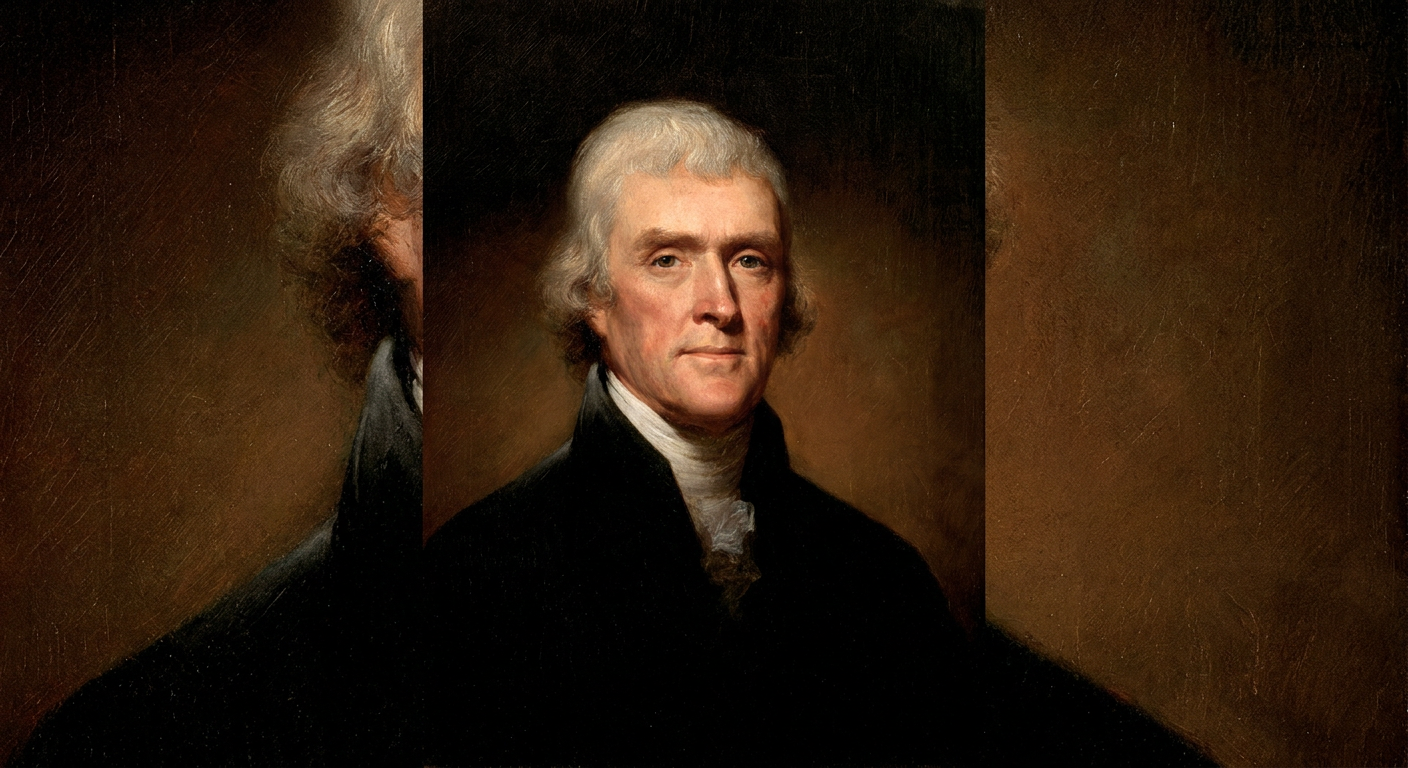
Quick Facts
- Years
- 1743 – 1826
- Category
- World Leaders & Revolutionaries
- Nationality
- American
- Occupation
- Statesman, diplomat, lawyer, political philosopher, architect, planter, and third president of the United States
Thomas Jefferson
1743 – 1826 · American · Statesman, diplomat, lawyer, political philosopher, architect, planter, and third president of the United States
Recommended Audiobooks
Listen next from Marcus Alden

Life Lessons from Simon Bolivar
Marcus Alden · 55 min

Life Lessons from George Washington
Marcus Alden · 54 min
Thomas Jefferson helped give the United States its language of liberty, expanded its territory, and shaped its political identity. As the principal author of the Declaration of Independence, he expressed the revolutionary claim that human beings possess equal natural rights and that legitimate governments depend on popular consent. As the nation’s third president, he completed the Louisiana Purchase, supported the Lewis and Clark expedition, and presided over a peaceful transfer of power between rival political parties.
Yet Jefferson’s life contains one of the central contradictions of American history. He denounced slavery in principle while enslaving more than 600 people over his lifetime. Most historians also conclude that he fathered children with Sally Hemings, an enslaved woman at Monticello whose ability to consent was constrained by enslavement. His statements about racial equality often fell far short of the universal language he wrote in 1776.
Jefferson was also a diplomat, lawyer, architect, planter, inventor, educational reformer, and founder of the University of Virginia. His curiosity ranged from law and languages to agriculture and natural history. People still study him not because he offers a simple heroic model, but because his achievements and failures illuminate enduring questions about democracy, power, race, religion, education, and the gap between political ideals and lived reality.
Quick Facts
| Fact | Details |
|---|---|
| Full Name | Thomas Jefferson |
| Common Name(s) | Thomas Jefferson; Jefferson |
| Born | April 13, 1743 |
| Died | July 4, 1826 |
| Age at Death | 83 |
| Birthplace | Shadwell, Colony of Virginia, British America |
| Nationality | American |
| Occupation | Statesman, lawyer, diplomat, planter, architect, writer, and president |
| Historical Era | American Revolution and Early Republic |
| Famous For | Drafting the Declaration of Independence; Louisiana Purchase; founding the University of Virginia |
| Political Affiliation | Democratic-Republican; earlier an Anti-Federalist-aligned critic of centralized power |
| Religion | Raised Anglican; later associated with rational, nontrinitarian Christianity, though scholars differ over labels such as “deist” |
| Education | College of William & Mary; legal study under George Wythe |
| Parents | Peter Jefferson and Jane Randolph Jefferson |
| Spouse(s) | Martha Wayles Skelton Jefferson, married 1772–1782 |
| Children | Six documented children with Martha, of whom Martha and Mary survived to adulthood; the historical consensus holds that Jefferson also fathered Sally Hemings’s six known children, four of whom reached adulthood |
| Major Works | Declaration of Independence; Notes on the State of Virginia; Virginia Statute for Religious Freedom; Jefferson’s parliamentary manual; extensive correspondence |
| Major Achievements | Third U.S. president; Louisiana Purchase; Lewis and Clark expedition; religious-liberty legislation; founder of the University of Virginia |
Early Life
Jefferson was born into Virginia’s wealthy planter class. His father, Peter Jefferson, was a surveyor, mapmaker, planter, and local official; his mother, Jane Randolph, belonged to a prominent colonial family. Their position gave Thomas land, education, and social connections unavailable to most Virginians. That privilege depended partly upon enslaved labor.
As a boy, Jefferson studied classical languages and developed lasting interests in books, music, mathematics, and the natural world. At the College of William & Mary, beginning in 1760, professor William Small introduced him to Enlightenment science and philosophy. Small also connected him with Governor Francis Fauquier and lawyer George Wythe.
Under Wythe, Jefferson undertook a demanding legal education. He read British law, political history, and works by thinkers such as John Locke, whose theories of natural rights and government by consent influenced Jefferson’s later writing. He entered legal practice in 1767 and handled land, debt, and inheritance cases across Virginia.
The colony was then entering a constitutional crisis with Britain. Parliamentary taxation and imperial controls persuaded Jefferson and other colonial leaders that traditional English liberties were in danger. His privileged background prepared him for leadership, while the imperial dispute gave that leadership a revolutionary direction.
Rise to Prominence
Jefferson joined Virginia’s House of Burgesses in 1769. He was not known as a commanding public speaker; his influence came through carefully composed arguments. In 1774 he wrote A Summary View of the Rights of British America, asserting that colonists possessed rights that Parliament could not simply override. The pamphlet circulated beyond Virginia and established his reputation.
Chosen for the Second Continental Congress in 1775, Jefferson served among older, better-known revolutionaries. In June 1776, a committee assigned him the first draft of a declaration explaining independence. John Adams later said Jefferson was selected because of his writing ability, Virginia identity, and reputation.
Congress revised his draft, removing and changing substantial passages, including a condemnation of the transatlantic slave trade. The Declaration adopted on July 4 made Jefferson internationally famous. Its equality principle would later be invoked by abolitionists, women’s-rights advocates, civil-rights leaders, and independence movements—often against social arrangements Jefferson himself accepted or maintained.
Major Achievements
The Declaration of Independence
Jefferson transformed colonial complaints into a broad argument: people possess inherent rights, government exists to protect them, and citizens may replace destructive governments. The document did not create equality in practice, but it supplied a moral standard later reformers used to challenge exclusion.
Religious Freedom in Virginia
Jefferson drafted the Virginia Statute for Religious Freedom in 1777. James Madison helped secure its enactment in 1786. It rejected compulsory religious support and declared that civil rights should not depend on religious belief. The measure influenced the First Amendment and became one of the three accomplishments Jefferson chose for his gravestone.
The Louisiana Purchase and Western Exploration
In 1803 Jefferson’s administration purchased approximately 828,000 square miles from France for $15 million. The acquisition nearly doubled the country’s claimed territory and secured access to the Mississippi River and New Orleans.
Jefferson worried privately that the Constitution did not clearly authorize such a purchase, but he accepted a broad practical use of presidential power. He then sponsored the Lewis and Clark expedition, which gathered geographic and scientific information and established American claims. Expansion also accelerated pressure on Indigenous nations whose homelands were treated as available for U.S. settlement.
Founding the University of Virginia
After leaving the presidency, Jefferson planned the University of Virginia’s curriculum, buildings, library, and academic organization. Opened in 1825, it was designed as a nonsectarian public institution with an elected governing board rather than direct clerical control. Its “academical village” remains a major architectural landmark.
Leadership or Work
Jefferson led through writing, private persuasion, patronage, and long-range planning more readily than through public oratory. He valued information and often requested reports before deciding policy. His architectural drawings, farming records, correspondence, and book catalogues reveal a methodical mind, although his finances were poorly controlled.
As president, he presented himself as a republican alternative to Federalist ceremony and centralized government. He reduced some taxes and military expenditures and pardoned people convicted under the Sedition Act. Nevertheless, circumstances led him to exercise substantial federal authority, especially through the Louisiana Purchase and the Embargo Act.
His strengths included intellectual range, strategic patience, and an exceptional ability to express political principles. His weaknesses included indirectness, conflict avoidance, partisan suspicion, and a tendency to separate ideals from consequences. Relationships with figures such as James Madison were durable, but his rivalry with Alexander Hamilton helped produce the first national party system.
Personal Life
Jefferson married the widowed Martha Wayles Skelton in 1772. Their marriage appears to have been affectionate, but repeated pregnancies and illness weakened Martha. She died in 1782 at age 33. Jefferson never remarried. Of their six children, only Martha Jefferson Randolph and Mary Jefferson Eppes lived to adulthood.
Monticello was both Jefferson’s home and a forced-labor plantation. Archaeology and surviving records show that it was a complex community of enslaved craftspeople, agricultural workers, domestic workers, and families. Jefferson kept detailed records of their labor while also buying, selling, hiring out, and punishing enslaved people within the system he controlled.
Documentary, statistical, oral-history, and genetic evidence underpin the broad scholarly consensus that Jefferson fathered Sally Hemings’s six known children. Hemings was Martha Jefferson’s much younger half-sister and was enslaved by Jefferson. Four Hemings children survived to adulthood; Jefferson allowed two to leave and formally freed two in his will.
Jefferson enjoyed violin, gardening, architecture, food, wine, horseback riding, and books. He suffered recurring headaches and later rheumatism, urinary difficulties, and declining mobility. Despite large landholdings, expensive tastes, agricultural instability, inherited obligations, and poor financial management left him deeply in debt.
Philosophy or Beliefs
Jefferson’s political thought drew upon natural-rights theory, classical republicanism, and faith in an educated citizenry. He idealized independent farmers, distrusted inherited privilege, and feared concentrated financial and governmental power. He nevertheless believed government should support education, exploration, commerce, and territorial security.
He defended freedom of conscience and opposed established churches. His private writings rejected doctrines such as the Trinity and emphasized Jesus’s ethical teachings over miracles. Calling him simply an atheist is inaccurate; calling him a conventional Christian is also misleading. Historians variously describe his outlook as deistic, Unitarian, rational Christian, or religiously heterodox.
His universal language about rights coexisted with racist assumptions and slaveholding. Jefferson sometimes called slavery unjust and feared its consequences, yet he did not embrace immediate emancipation or racial equality. He generally promoted gradual emancipation combined with colonization outside the United States—a position rejected by many Black Americans and later abolitionists.
Challenges and Controversies
Slavery and race
Slavery is the most serious challenge to celebratory interpretations of Jefferson. He inherited enslaved people, expanded his holdings through marriage, and relied on their labor. Although he proposed limited reforms and ended U.S. participation in the international slave trade effective in 1808, he freed very few people and never used his national influence to pursue general emancipation.
Some defenders emphasize his antislavery statements, legal constraints, debt, and fear of sectional conflict. Critics answer that these factors do not erase his choices or the human suffering from which he benefited. Modern scholarship generally treats the contradiction between his equality language and slaveholding as fundamental rather than incidental.
Sally Hemings
For generations, many white historians dismissed reports that Jefferson fathered Hemings’s children. A 1998 Y-chromosome study showed a genetic link between the Jefferson male line and a Hemings descendant. Genetics alone cannot identify one man, but when combined with Jefferson’s presence at likely conception times, family testimony, and documentary patterns, most specialists conclude that he was the father. A minority has proposed another Jefferson male, but no alternative candidate is supported by comparable evidence.
Indigenous peoples and expansion
Jefferson studied Indigenous languages and sometimes praised Native political and intellectual abilities. At the same time, his administration promoted land cessions, commercial dependency, cultural assimilation, and U.S. settlement. Policies he advanced helped establish pressures that later governments turned into large-scale dispossession and forced removal.
Presidency and civil liberties
The Embargo Act of 1807 attempted to keep the United States out of European warfare by halting foreign trade. It damaged American merchants, encouraged smuggling, and proved difficult to enforce. Critics saw its enforcement as an intrusive use of federal power inconsistent with Jefferson’s limited-government principles.
Jefferson also encouraged the prosecution of former vice president Aaron Burr for treason. Burr was acquitted because the constitutional standard required stronger evidence of an overt treasonous act. The episode exposed tensions between presidential suspicion and judicial independence.
Debt and management
Jefferson’s plantation enterprises often underperformed, and he continued building, purchasing books, and entertaining despite mounting debt. Broader economic instability and inherited liabilities contributed, but so did his choices. After his death, most of his property—including enslaved people—was sold to satisfy creditors.
Legacy
Jefferson’s words became more democratic than the society in which he wrote them. Abraham Lincoln placed the Declaration’s equality principle at the center of the struggle over slavery. Frederick Douglass and later civil-rights leaders used the nation’s founding promises to expose injustice. International movements also adapted Jeffersonian language, although democratic ideas had many sources beyond him.
His record remains contested. Admirers point to religious liberty, educational innovation, territorial expansion, scientific curiosity, and resistance to aristocracy. Critics emphasize slavery, racism, Indigenous dispossession, and executive overreach. Responsible commemoration now seeks to hold these realities together.
Monticello, the University of Virginia, the Jefferson Memorial, the Library of Congress’s Jefferson collection, and numerous schools and places preserve his influence. Public institutions increasingly include the experiences of enslaved families alongside Jefferson’s achievements. His legacy endures not as a settled verdict but as a debate over whether a nation can fulfill principles articulated by people who violated them.
Interesting Facts
- Jefferson was born under the old British calendar on April 2, corresponding to April 13 under the modern calendar.
- He was about six feet two inches tall, unusually tall for his era.
- He learned violin and played for much of his life.
- His Shadwell home burned in 1770, destroying many books and papers.
- He designed and repeatedly rebuilt Monticello over several decades.
- He owned thousands of books and organized them by memory, reason, and imagination.
- After the British burned Washington, he sold 6,487 books to Congress, helping rebuild its library.
- He popularized, but did not invent, several devices, including a rotating bookstand and improved copying apparatus.
- His Notes on the State of Virginia was the only full-length book he published.
- He served as governor of Virginia during the Revolutionary War.
- He succeeded Benjamin Franklin as U.S. minister to France.
- He served as George Washington’s first secretary of state.
- He became vice president after losing the 1796 presidential election.
- The disputed election of 1800 required 36 House ballots.
- He kept daily weather observations for decades.
- He prepared an edited compilation of Jesus’s teachings, commonly called the Jefferson Bible.
- He and John Adams died on July 4, 1826, the Declaration’s 50th anniversary.
- Jefferson’s gravestone mentions the Declaration, religious freedom, and the University of Virginia—but not his presidency.
Famous Quotes
- “We hold these truths to be self-evident, that all men are created equal.” — Declaration of Independence, 1776. Its expansive language outlasted the exclusions of Jefferson’s society and became a standard for later reform movements.
- “Governments are instituted among Men, deriving their just powers from the consent of the governed.” — Declaration, 1776. Jefferson summarized the principle that political authority must rest on popular legitimacy.
- “I have sworn upon the altar of God eternal hostility against every form of tyranny over the mind of man.” — Letter to Benjamin Rush, 1800. Written in defense of freedom of thought; shortened versions often omit the original context.
- “A wall of separation between Church & State.” — Letter to the Danbury Baptist Association, 1802. The phrase explained Jefferson’s understanding of the First Amendment, though its precise legal application remains debated.
- “I cannot live without books.” — Letter to John Adams, 1815. Jefferson wrote while discussing the sale of his library to Congress.
- “Honesty is the first chapter in the book of wisdom.” — Letter to Nathaniel Macon, 1819. The statement connected personal integrity with sound public judgment.
- “Laws and institutions must go hand in hand with the progress of the human mind.” — Letter to Samuel Kercheval, 1816. Jefferson argued that institutions should be revised as knowledge and circumstances change.
- “The tree of liberty must be refreshed from time to time with the blood of patriots and tyrants.” — Letter to William Stephens Smith, 1787. Authentic but frequently detached from Jefferson’s reaction to Shays’ Rebellion; it expresses violent revolutionary rhetoric, not a general legal principle.
- “I like the dreams of the future better than the history of the past.” — Letter to John Adams, 1816. The line reflects his optimism during the two men’s late-life reconciliation.
Timeline
- 1743 — Born at Shadwell, Virginia.
- 1760 — Entered the College of William & Mary.
- 1767 — Admitted to legal practice.
- 1769 — Joined the Virginia House of Burgesses.
- 1772 — Married Martha Wayles Skelton.
- 1774 — Wrote A Summary View of the Rights of British America.
- 1775 — Entered the Second Continental Congress.
- 1776 — Drafted the Declaration of Independence.
- 1779–1781 — Served as governor of Virginia.
- 1782 — Martha Jefferson died.
- 1784 — Began diplomatic service in Europe.
- 1785–1789 — Served as U.S. minister to France.
- 1786 — Virginia enacted his Statute for Religious Freedom.
- 1790–1793 — Served as secretary of state.
- 1797–1801 — Served as vice president under John Adams.
- 1801 — Became president after the contested election of 1800.
- 1803 — Completed the Louisiana Purchase; authorized the Lewis and Clark expedition.
- 1804 — Won reelection.
- 1807 — Signed the Embargo Act and legislation ending U.S. participation in the international slave trade.
- 1809 — Retired to Monticello.
- 1815 — Sold his library to Congress.
- 1819 — University of Virginia chartered.
- 1825 — University of Virginia opened.
- 1826 — Died at Monticello on July 4.
Frequently Asked Questions
1. Why is Thomas Jefferson important?
Jefferson gave memorable expression to the natural-rights principles used to justify American independence. As president, he oversaw the Louisiana Purchase and encouraged western exploration. He also championed religious freedom and founded the University of Virginia. His importance includes his contradictions: he wrote that all people were created equal while enslaving human beings. Studying both sides helps explain how democratic principles could emerge within a deeply unequal society.
2. Did Jefferson write the Declaration of Independence alone?
Jefferson wrote the initial draft, but the Declaration was a collective political document. John Adams, Benjamin Franklin, Roger Sherman, and Robert R. Livingston served with him on the drafting committee. Adams and Franklin suggested changes, and the Continental Congress edited the text further before adoption. Jefferson therefore deserves recognition as principal author, not sole creator. Its arguments also drew upon colonial grievances, Enlightenment ideas, British legal traditions, and earlier declarations.
3. What did “all men are created equal” mean in 1776?
The phrase asserted that people possessed natural rights and that no hereditary ruler had an inherent right to govern them without consent. In practice, the new nation denied political and civil equality to women, enslaved people, most Indigenous people, and many men without property. Later activists treated the words more universally than many founders did. Their significance lies partly in this capacity to challenge institutions that contradicted the principle.
4. How many people did Jefferson enslave?
Jefferson enslaved more than 600 people over his lifetime, though not all at once. Some were inherited, others came through marriage, and many were born into slavery at his plantations. They worked in agriculture, domestic service, textile production, metalworking, carpentry, and other skilled occupations. Jefferson occasionally freed individuals but did not free the great majority. Following his death, many were sold because his estate was deeply indebted.
5. Did Jefferson father Sally Hemings’s children?
Most historians and Monticello scholars conclude that he fathered all six of Hemings’s known children. The conclusion combines genetic evidence linking a descendant to the Jefferson male line with records showing Jefferson was at Monticello during probable conception periods and with family testimony. DNA cannot identify him individually, so a minority suggests another male relative. However, no alternative explanation fits the surviving evidence as comprehensively.
6. Who was Sally Hemings?
Sally Hemings was an enslaved woman at Monticello and the half-sister of Jefferson’s wife, Martha, because both were probably fathered by John Wayles. Hemings accompanied Jefferson’s daughter to France, where slavery lacked firm legal standing. According to her son Madison’s later account, she returned after Jefferson promised privileges and eventual freedom for her children. The relationship cannot be understood apart from Jefferson’s ownership and the unequal power created by slavery.
7. What was Jefferson’s greatest presidential achievement?
The Louisiana Purchase is usually considered his greatest presidential achievement. It secured New Orleans, expanded U.S. claims west of the Mississippi, and nearly doubled the nation’s territory at a comparatively low financial cost. The purchase also revealed a constitutional tension because Jefferson had previously advocated strict limits on federal authority. Its long-term effects included economic expansion, intensified conflict over slavery, and growing dispossession of Indigenous nations.
8. Why was the election of 1800 significant?
Jefferson and Aaron Burr received equal numbers of electoral votes because electors did not yet cast separate ballots for president and vice president. The House of Representatives chose Jefferson after 36 ballots. More broadly, the election transferred national power from the Federalists to the Democratic-Republicans without civil war or a coup. This peaceful change between bitter rivals became an important test of the young constitutional system and prompted adoption of the Twelfth Amendment.
9. Was Jefferson a Democrat or Republican?
Modern party labels do not fit him neatly. Jefferson led the Democratic-Republican Party, usually called the Republican Party by its members. It opposed Alexander Hamilton’s Federalists and favored an agrarian republic, sympathy for France, and a narrower interpretation of federal power. It was an ancestor of the modern Democratic Party, but its beliefs and coalition differed greatly from those of present-day parties. Jefferson was not a member of today’s Republican Party, which formed decades later.
10. What were Jefferson’s religious beliefs?
Jefferson believed in a creator, valued Jesus as an ethical teacher, and strongly defended religious liberty. He rejected or questioned several traditional Christian doctrines, including the Trinity and miracles. Scholars therefore describe him variously as a deist, Unitarian, rational Christian, or religious skeptic. No single modern label perfectly captures his changing private beliefs. Politically, his clearest commitment was that government should neither impose religious doctrine nor punish peaceful belief.
11. What was the Jefferson Bible?
Late in life, Jefferson assembled passages from the four Gospels into a work emphasizing Jesus’s moral teachings. He removed miracle stories, supernatural claims, and the Resurrection narrative. Its formal title was The Life and Morals of Jesus of Nazareth. Jefferson prepared it for private study rather than public worship. The volume illustrates both his admiration for Christian ethics and his rejection of theology he considered inconsistent with reason.
12. Why did the Embargo Act fail?
Jefferson hoped economic pressure would force Britain and France to respect neutral American shipping without requiring war. The 1807 law restricted foreign trade, but European powers endured the pressure while American merchants, sailors, and farmers suffered major losses. Smuggling increased, and enforcement demanded powers that appeared inconsistent with Jefferson’s limited-government ideals. Congress replaced the embargo shortly before he left office. The policy demonstrated the limits of economic coercion against stronger military powers.
13. Did Jefferson invent anything?
Jefferson designed or improved practical devices, but popular accounts often exaggerate by calling him their inventor. He used a revolving bookstand, polygraph copying machine, dumbwaiters, and a modified moldboard plow. Some devices were created by others and adapted or promoted by him. His genuine distinction was the integration of design, observation, and experimentation into daily life. He generally did not pursue patents, believing useful knowledge should circulate widely.
14. Were Jefferson and John Adams friends?
They were revolutionary colleagues and friends, then partisan opponents during the 1790s. Their relationship deteriorated amid political attacks surrounding the elections of 1796 and 1800. In 1812, encouraged by mutual friends, they resumed correspondence. Their letters explored religion, revolution, aging, government, and their shared past. Both died on July 4, 1826, the 50th anniversary of the Declaration, giving their reconciliation lasting symbolic importance.
15. What is Jefferson’s reputation today?
Jefferson remains admired for his writing, religious-liberty advocacy, educational vision, and presidential achievements. At the same time, scholarship and public history give far greater attention to slavery, Sally Hemings, race, and Indigenous dispossession than older commemorations did. Some people regard his contradictions as disqualifying; others argue that his principles can be separated from his conduct. Most historians instead examine achievements and harms together, resisting both uncritical hero worship and oversimplified dismissal.
Lessons We Can Learn
- Powerful principles may exceed their author. The Declaration’s equality language empowered later movements Jefferson did not anticipate. Ideas can become tools for correcting their creators’ failures.
- Examine conduct as well as words. Jefferson criticized slavery but continued to benefit from it. Ethical claims deserve evaluation against practical choices.
- Education sustains self-government. His University of Virginia project reflected his belief that citizens need knowledge to judge public affairs—a conclusion, not a guarantee, supported by his work.
- Compromise can preserve injustice. Jefferson often postponed confronting slavery to protect political unity. Avoiding immediate conflict may deepen long-term harm.
- Strict principles face practical tests. The Louisiana Purchase contradicted Jefferson’s constitutional caution but achieved strategic goals. Leaders should explain and scrutinize such departures.
- Economic pressure carries domestic costs. The embargo hurt Americans more quickly than its intended targets. Policy makers must identify who bears a strategy’s risks.
- Curiosity benefits leadership. Jefferson gathered scientific, geographic, and agricultural information. Broad learning can improve decisions when paired with ethical judgment.
- Debt can limit freedom of action. His financial problems shaped his estate and the lives of enslaved families sold after his death. Private management can have severe public and human consequences.
- Historical memory should include the excluded. Monticello’s story is incomplete without enslaved workers and families. Institutions become more accurate when they recover suppressed experiences.
- Reconciliation need not erase disagreement. Jefferson and Adams renewed their friendship without pretending their conflicts had never occurred. Their correspondence shows the value of sustained civic dialogue.
Related Historical Figures
- George Washington — Appointed Jefferson secretary of state; disagreements within Washington’s cabinet helped create national political parties.
- John Adams — Revolutionary collaborator, presidential rival, and later correspondent whose life remained closely intertwined with Jefferson’s.
- James Madison — Jefferson’s closest political ally, collaborator on religious freedom, and successor as president.
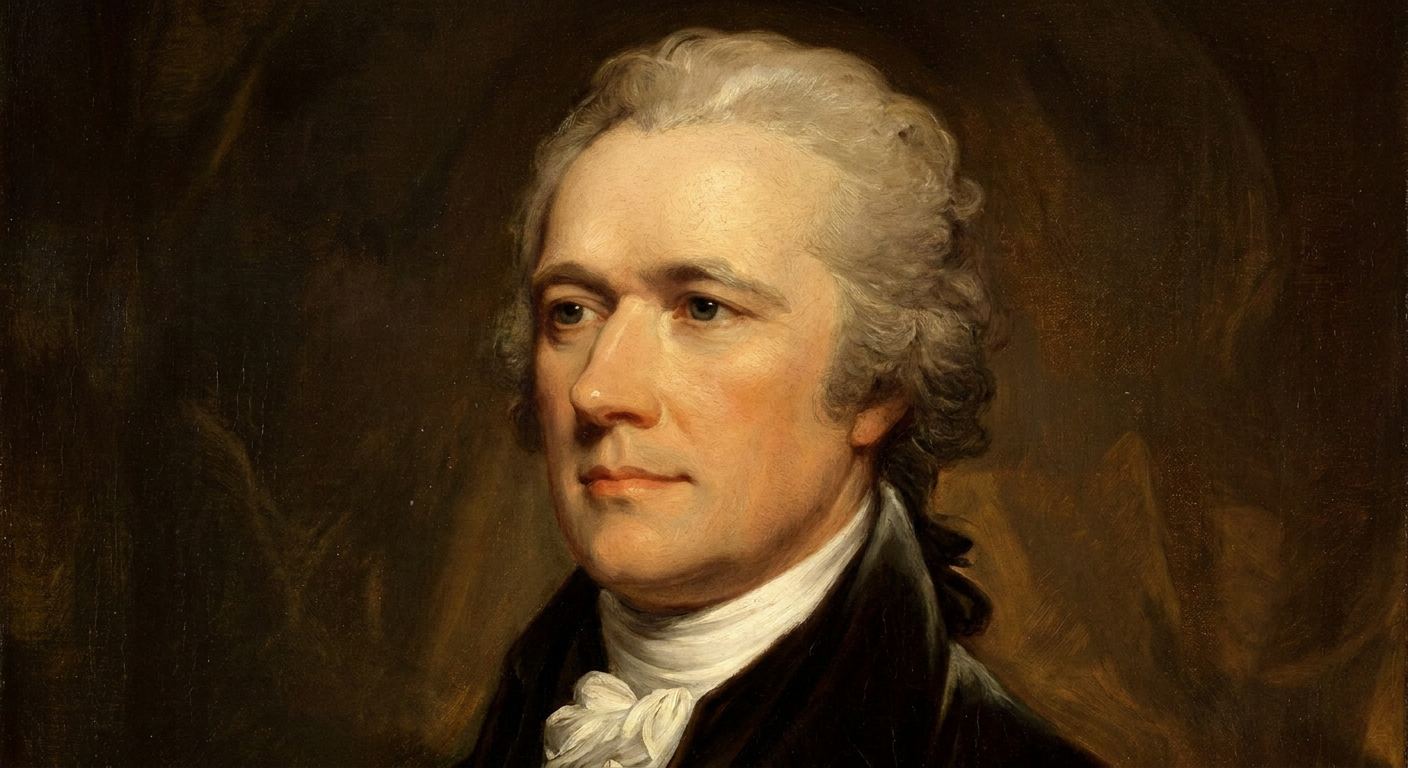
- Alexander Hamilton — Jefferson’s principal ideological rival over federal power, finance, foreign policy, and the nation’s economic future.
- Benjamin Franklin — Fellow diplomat and member of the committee that reviewed Jefferson’s Declaration draft.
- Sally Hemings — Enslaved woman at Monticello whom the historical consensus identifies as the mother of Jefferson’s children.
- Martha Jefferson Randolph — Jefferson’s eldest surviving daughter, household manager, political hostess, and guardian of parts of his memory.
- Meriwether Lewis — Jefferson’s former secretary and chosen leader of the expedition through the Louisiana territory.
- Sacagawea — Lemhi Shoshone woman whose knowledge and diplomacy assisted the Lewis and Clark expedition sponsored by Jefferson.
- Frederick Douglass — Abolitionist who invoked the Declaration’s principles while condemning the nation’s failure to apply them to Black Americans.
Watch and Learn
“Thomas Jefferson & His Democracy: Crash Course US History #10” — CrashCourse — approximately 13 minutes. This widely viewed educational overview clearly explains Jeffersonian politics, the election of 1800, westward expansion, and the contradictions between republican ideals and slavery. Its fast pace makes it best as an introduction or review, supplemented by deeper museum and scholarly sources.
Watch and Learn
Thomas Jefferson & His Democracy: Crash Course US History #10 · CrashCourse
Related Historical Figures