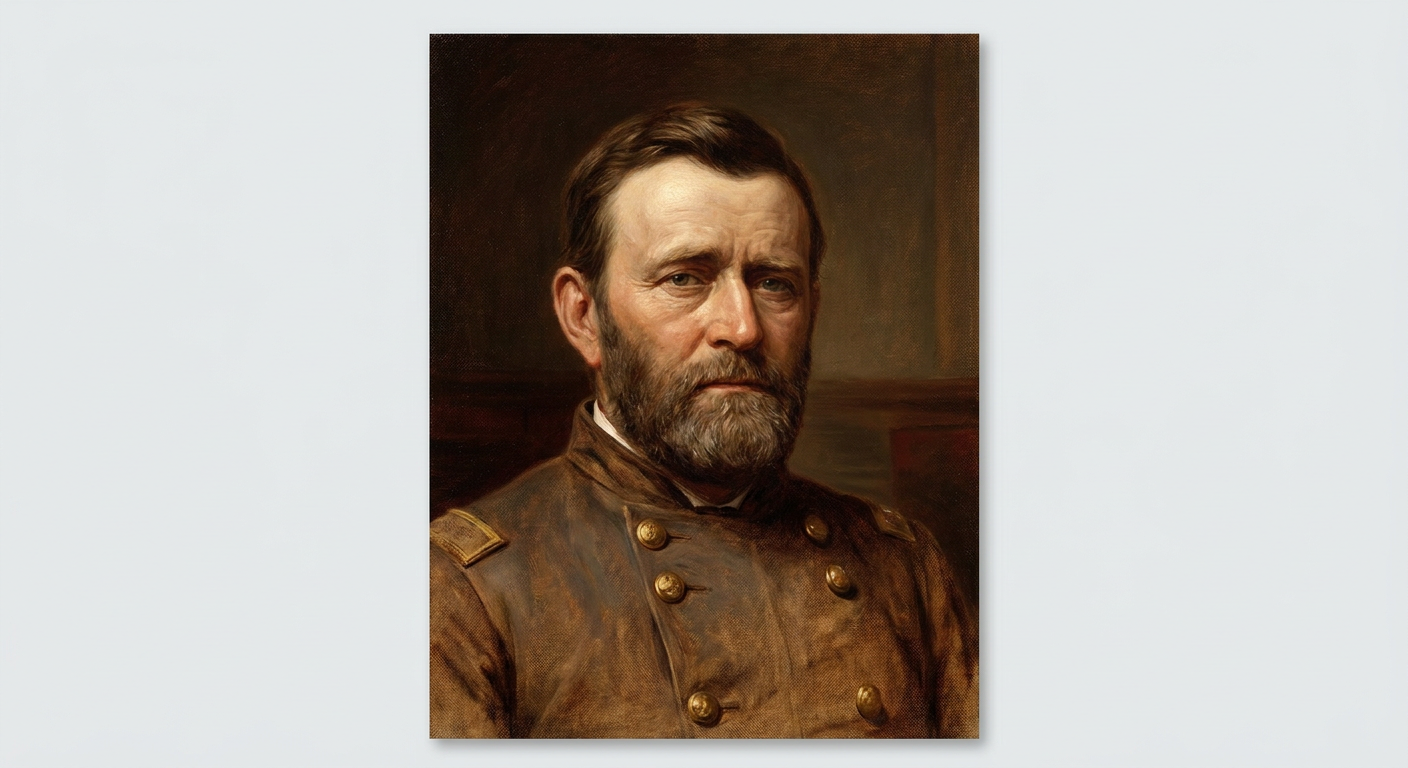
Quick Facts
- Years
- 1822 – 1885
- Category
- World Leaders & Revolutionaries
- Nationality
- American
- Occupation
- Army general, statesman, and 18th president of the United States
Ulysses S. Grant
1822 – 1885 · American · Army general, statesman, and 18th president of the United States
Recommended Audiobooks
Listen next from Marcus Alden

Life Lessons from Simon Bolivar
Marcus Alden · 55 min

Life Lessons from George Washington
Marcus Alden · 54 min
Ulysses S. Grant rose from obscurity and repeated personal setbacks to become the Union general most responsible for defeating the Confederacy, and then the 18th president of the United States. Quiet, persistent, and unusually calm in crisis, he coordinated enormous armies across multiple theaters of the American Civil War. His victories at Fort Donelson, Vicksburg, Chattanooga, and ultimately Appomattox helped preserve the Union and destroy slavery.
Grant's presidency remains more complicated. He defended Reconstruction, supported federal protection for Black citizenship, and used the government against the Ku Klux Klan. His administration also negotiated peaceful settlements abroad and created Yellowstone National Park. Yet corruption among associates, an economic depression, and destructive federal policies toward Native peoples damaged his record.
After leaving office, Grant traveled around the world, lost his savings in a financial fraud, and completed one of the most admired military memoirs in American literature while dying from cancer. Historians once portrayed him mainly as a brutal general and failed president. Modern scholarship has challenged that interpretation, emphasizing his strategic ability and commitment to civil rights while continuing to examine his serious limitations. Grant remains worth studying because his life connects military leadership, emancipation, Reconstruction, political power, personal failure, and remarkable perseverance.
Quick Facts
| Field | Information |
|---|---|
| Full Name | Hiram Ulysses Grant; officially recorded at West Point as Ulysses S. Grant |
| Common Name(s) | Ulysses S. Grant; U. S. Grant; Sam Grant |
| Born | April 27, 1822 |
| Died | July 23, 1885 |
| Age at Death | 63 |
| Birthplace | Point Pleasant, Ohio, United States |
| Nationality | American |
| Occupation | Army officer, commanding general, president, memoirist |
| Historical Era | Westward expansion, Civil War, Reconstruction, Gilded Age |
| Famous For | Leading Union armies to victory and serving as the 18th U.S. president |
| Political Affiliation | Republican |
| Religion | Raised in a Methodist family; baptized by a Methodist minister in 1885 |
| Education | United States Military Academy, class of 1843 |
| Parents | Jesse Root Grant and Hannah Simpson Grant |
| Spouse(s) | Julia Boggs Dent Grant |
| Children | Frederick, Ulysses Jr., Ellen, and Jesse |
| Major Works | Personal Memoirs of U. S. Grant |
| Major Achievements | Vicksburg campaign, Confederate surrender at Appomattox, Reconstruction enforcement, suppression of the Ku Klux Klan, Treaty of Washington |
Early Life
Grant was born Hiram Ulysses Grant in Point Pleasant, Ohio, and grew up mainly in nearby Georgetown. His father, Jesse, operated a tannery and held strong antislavery views. His mother, Hannah, was reserved and deeply Methodist. Grant disliked tannery work but displayed an exceptional ability to handle horses, a skill that later helped make him an accomplished cavalryman and rider.
Jesse secured his son's appointment to the U.S. Military Academy. The congressman submitting the nomination mistakenly entered his name as Ulysses S. Grant. Rather than struggle indefinitely against military paperwork, Grant accepted the new form. The middle initial did not stand for an actual middle name, although classmates associated it with his mother's surname, Simpson, and nicknamed him “Sam” from his initials, U.S.
Grant graduated from West Point in 1843, ranking 21st in a class of 39. He was not an outstanding classroom student, but he excelled in horsemanship and mathematics. He hoped to teach mathematics after completing his service obligation.
Assigned to the 4th U.S. Infantry, Grant met Julia Dent through her brother and became engaged to her. The couple delayed marriage while Grant served in the Mexican-American War.
Rise to Prominence
Under generals Zachary Taylor and Winfield Scott, Grant fought at Palo Alto, Resaca de la Palma, Monterrey, Veracruz, and Mexico City. He served primarily as a quartermaster, learning how armies moved, ate, and obtained supplies. He also volunteered for dangerous combat assignments. Although he performed bravely, he later judged the war an unjust effort to expand slavery.
Grant married Julia in 1848. Army postings then separated him from his family. While stationed on the Pacific Coast, he struggled with loneliness, money, and reportedly alcohol. He resigned his commission in 1854 after warnings from his commander. The precise circumstances remain debated because the surviving evidence is incomplete, but alcohol was a recurring concern among contemporaries.
Civilian life brought little success. Grant farmed near St. Louis, sold firewood, collected debts, and worked in real estate before joining his father's leather-goods business in Galena, Illinois. During this period, he owned one enslaved man, William Jones, whom he legally freed in 1859 rather than selling him. Grant nevertheless lived and worked within the Dent family's slaveholding environment, an important contradiction in his early life.
When the Civil War began in 1861, Grant helped organize Illinois volunteers. His military experience brought him command of the 21st Illinois Infantry and promotion to brigadier general. In February 1862, he captured Fort Henry and Fort Donelson. His demand for “unconditional and immediate surrender” made him a national figure and gave rise to the popular nickname “Unconditional Surrender” Grant.
Major Achievements
Saving the Union through coordinated warfare
Grant understood that the Confederacy could not be defeated by capturing one city or winning one spectacular battle. Its armies, transportation networks, supplies, and capacity to continue fighting all had to be attacked. As general-in-chief in 1864, he coordinated Union operations across a vast continent, preventing Confederate armies from easily shifting reinforcements between fronts.
The Vicksburg campaign
Vicksburg, Mississippi, controlled a vital section of the Mississippi River. After several failed approaches, Grant moved his army down the river's western bank, crossed south of the city, cut loose from a conventional supply base, and won a sequence of rapid battles. Vicksburg surrendered on July 4, 1863.
The victory split the Confederacy, reopened the Mississippi to Union traffic, and elevated Grant to the highest level of command. Military historians frequently rank the campaign among the most skillful in American history.
Chattanooga and promotion
In late 1863, Grant took charge of trapped Union forces at Chattanooga. He restored supply routes and directed victories at Lookout Mountain and Missionary Ridge, driving Confederate forces back into Georgia. President Abraham Lincoln promoted him to lieutenant general in March 1864, placing all Union armies under his direction.
Appomattox and reunification
Grant's 1864 Overland Campaign against Robert E. Lee produced horrifying casualties at the Wilderness, Spotsylvania, and Cold Harbor. Unlike earlier Union commanders, however, Grant continued maneuvering after setbacks. He crossed the James River, besieged Petersburg, and eventually forced Lee's army westward.
Lee surrendered at Appomattox Court House on April 9, 1865. Grant offered generous terms: Confederate soldiers could return home, officers could retain sidearms, and men could keep horses needed for spring planting. These conditions encouraged other Confederate armies to surrender and reduced the danger of prolonged guerrilla warfare.
Defending Reconstruction
As president from 1869 to 1877, Grant supported the 15th Amendment and federal enforcement of Black voting rights. He signed Enforcement Acts and approved military and legal action against the Ku Klux Klan. Federal prosecutions severely weakened the first Klan, especially in South Carolina. This was one of the strongest federal civil-rights interventions before the 20th century.
Diplomacy and conservation
Grant's administration settled major disputes with Britain through the 1871 Treaty of Washington and international arbitration. It also avoided war with Spain during the Virginius crisis. In 1872, Grant signed the law establishing Yellowstone as the world's first national park, although Indigenous peoples were not consulted and were later excluded from lands they had long used.
Leadership or Work
Grant's leadership rested on clarity, persistence, logistical knowledge, and emotional steadiness. His written orders were usually direct because he wanted subordinates to understand both the task and its purpose. He accepted calculated risk but rarely confused caution with inactivity.
He worked well with aggressive commanders such as William T. Sherman and Philip Sheridan. He also maintained a productive relationship with Lincoln, who valued his willingness to act. Grant's great strength was strategic integration: he saw separate armies as parts of one national effort.
His weaknesses were more visible in politics. Loyal to friends and reluctant to suspect dishonesty, he sometimes defended appointees after evidence justified removing them. Military directness did not always translate effectively into managing Congress, factions, or patronage.
Personal Life
Grant and Julia shared a devoted marriage despite long wartime separations. Julia's crossed eyes attracted cruel public comments, but Grant opposed surgery intended merely to improve her appearance. They had four children and frequently traveled or lived together when circumstances allowed.
Grant was reserved, modest, and uncomfortable with ceremony. He loved horses, smoked cigars heavily, and could be unexpectedly humorous among friends. Reports about his drinking deserve care: evidence shows episodes and sustained concern, particularly during lonely assignments, but political enemies also exaggerated the issue. During his most important campaigns, trusted aides helped guard against temptation.
Financial judgment was a continuing weakness. In 1884, Grant lost nearly everything after Ferdinand Ward, his son's business partner, operated their investment firm as a fraudulent scheme. Soon afterward, doctors diagnosed Grant with throat cancer, probably related to cigar smoking.
Philosophy or Beliefs
Grant believed preservation of constitutional government justified force against secession. His understanding of the war broadened: Union and emancipation became inseparable, and he supported recruiting Black soldiers. By his presidency, he regarded federal protection of Black citizenship as necessary because state authorities often refused to provide it.
Religiously, Grant was less demonstrative than many contemporaries. He respected Christianity, advocated religious liberty, and criticized public funding of sectarian schools. Near death, he was baptized by Methodist bishop John Philip Newman.
Grant favored national unity, but not unity purchased by abandoning lawful rights. His Native American “Peace Policy” sought to reduce warfare and replace corrupt agents, yet it remained paternalistic and assimilationist. It did not challenge the larger process of dispossession and failed to prevent devastating conflicts.
Challenges and Controversies
Heavy wartime casualties
Critics labeled Grant a butcher because Union losses were severe, especially in 1864. Cold Harbor became the clearest symbol of this criticism, and Grant later regretted ordering the final assault there. Defenders note that he confronted Lee continuously, operated strategically across several theaters, and ultimately shortened a war already producing enormous casualties. Historians still debate particular decisions, but the old claim that Grant relied only on superior numbers is no longer widely accepted.
Presidential scandals
Grant was not shown to have personally profited from corruption, but scandals damaged his administration. They included the Whiskey Ring tax conspiracy, corrupt trading-post arrangements involving Secretary of War William Belknap, and controversies connected to railroad finance. Grant's loyalty sometimes obstructed accountability, even though prosecutions also occurred under his government.
Reconstruction's retreat
Grant vigorously confronted the first Ku Klux Klan, but Northern commitment to Reconstruction declined during his second term. The Panic of 1873 caused a deep depression, Democrats regained power in Congress, and organized white supremacist violence intensified. Grant sometimes sent federal forces south but could not secure durable protection everywhere. Scholars differ over how much more he could realistically have accomplished amid collapsing political support.
Native American policy
Grant hoped religious organizations and new administrators would reduce frontier corruption and bloodshed. Nevertheless, reservation confinement, forced cultural change, broken promises, settler expansion, and wars continued. The destruction of Native sovereignty under his administration is a major limitation of his humanitarian reputation.
Legacy
Grant died at Mount McGregor, New York, on July 23, 1885, days after completing his memoirs. Mark Twain's publishing company issued the books, whose success provided Julia with financial security. Praised for their clear prose and restrained tone, the memoirs remain a classic of military autobiography.
Grant's reputation declined during the late 19th and early 20th centuries, when interpretations sympathetic to the former Confederacy depicted Reconstruction as illegitimate. Later historians restored attention to his generalship and civil-rights record. The reassessment is not uncritical: corruption, Native policy, and political misjudgments remain central to balanced evaluations.
Grant is memorialized at the General Grant National Memorial in New York, commonly called Grant's Tomb; the Ulysses S. Grant National Historic Site near St. Louis; his Galena home; and his birthplace in Ohio. His portrait appears on the U.S. fifty-dollar bill. Numerous counties, schools, roads, and statues bear his name.
Interesting Facts
- Grant's birth name was Hiram Ulysses Grant.
- The “S” in Ulysses S. Grant officially stood for nothing.
- West Point classmates called him Sam because of the initials “U.S.”
- He was one of his era's most skilled military horsemen.
- Grant initially hoped to become a mathematics teacher.
- He served under both Zachary Taylor and Winfield Scott in Mexico.
- He condemned the Mexican-American War in his memoirs despite fighting bravely in it.
- Grant freed William Jones, whom he had enslaved, in 1859.
- Fort Donelson produced his “Unconditional Surrender” nickname.
- His Vicksburg victory came one day after the Union victory at Gettysburg.
- Congress revived the rank of lieutenant general for him in 1864.
- He was the first president elected after Andrew Johnson's impeachment trial.
- Grant created the Department of Justice soon after it was established by Congress in 1870 and used federal legal machinery against the Klan.
- He was the first former U.S. president to travel around the world.
- Grant unsuccessfully sought an unprecedented third presidential nomination in 1880.
- He finished his memoirs shortly before dying from throat cancer.
- His funeral procession in New York drew an enormous national gathering.
- Grant's Tomb is the largest mausoleum in North America.
Famous Quotes
- “No terms except an unconditional and immediate surrender can be accepted.” Grant wrote this to Simon Bolivar Buckner at Fort Donelson in 1862. It expressed firmness and created his famous nickname.
- “I propose to fight it out on this line if it takes all summer.” In a May 1864 dispatch, Grant signaled that the Overland Campaign would continue despite terrible losses.
- “The war is over—the rebels are our countrymen again.” Horace Porter later reported Grant saying this after Appomattox while stopping celebratory firing. The wording comes from recollection, but it reflects Grant's conciliatory policy.
- “Let us have peace.” The closing words of Grant's 1868 letter accepting the Republican presidential nomination became his campaign slogan.
- “I know no method to secure the repeal of bad or obnoxious laws so effective as their stringent execution.” In his first inaugural address, Grant argued that faithful enforcement could expose defective legislation.
- “I felt like anything rather than rejoicing at the downfall of a foe who had fought so long and valiantly.” In his memoirs, Grant recalled his sadness at Lee's surrender despite believing the Confederate cause was profoundly wrong.
- “The cause of the great War of the Rebellion against the United States will have to be attributed to slavery.” Grant's memoirs rejected later attempts to separate the war from slavery.
- “Leave the matter of religion to the family altar, the church, and the private school.” In an 1875 speech, Grant supported public education without sectarian control; the statement reflected contemporary debates about religion and schools.
- “There had to be an end to slavery.” In his memoirs, Grant summarized what he saw as the war's necessary transformative result.
Timeline
- 1822 — Born at Point Pleasant, Ohio.
- 1839 — Entered the United States Military Academy.
- 1843 — Graduated from West Point and joined the 4th Infantry.
- 1846–1848 — Served in the Mexican-American War.
- 1848 — Married Julia Dent.
- 1854 — Resigned from the Army.
- 1859 — Freed William Jones and continued struggling financially.
- 1861 — Returned to military service during the Civil War.
- 1862 — Captured Fort Donelson; fought at Shiloh.
- 1863 — Captured Vicksburg and won at Chattanooga.
- 1864 — Became lieutenant general and general-in-chief; began the Overland Campaign.
- 1865 — Accepted Lee's surrender at Appomattox.
- 1866 — Became General of the Army.
- 1868 — Elected president.
- 1869 — Began his first presidential term.
- 1870–1871 — Enforced anti-Klan legislation and supported Black voting rights.
- 1872 — Signed the Yellowstone act and won reelection.
- 1877 — Left office and began a world tour.
- 1880 — Failed to win the Republican nomination for a third term.
- 1884 — Lost his fortune in the Grant & Ward collapse; began writing his memoirs.
- 1885 — Completed his memoirs and died on July 23.
- 1897 — Grant's Tomb was dedicated in New York City.
Frequently Asked Questions
1. Why was Ulysses S. Grant important?
Grant was the Union's most consequential military commander during the final half of the Civil War. He captured Vicksburg, coordinated nationwide operations, defeated Robert E. Lee, and accepted the surrender at Appomattox. As president, he used federal authority to protect Black voting rights and suppress the Ku Klux Klan. His record also includes administrative scandals and damaging Native policies, making him important not only as a victorious general but as a revealing figure in the struggles over Reconstruction and national power.
2. Was Ulysses S. Grant his real name?
He was born Hiram Ulysses Grant. When Congressman Thomas Hamer nominated him to West Point, the academy recorded him as Ulysses S. Grant, apparently assuming Simpson, his mother's surname, was his middle name. Grant tried to correct the mistake but eventually accepted the new form. The “S” therefore had no official meaning. His classmates turned the initials U.S. into the nickname “Sam,” which some military friends continued to use.
3. Was Grant a successful student at West Point?
Grant was an average cadet rather than an academic star. He graduated 21st among 39 students in 1843. Mathematics and horsemanship were his strongest areas, and his riding attracted particular admiration. He disliked military discipline and did not initially envision a permanent Army career. Nevertheless, West Point gave him technical training, professional contacts, and experience with officers—including future opponents—who later became important during the Civil War.
4. Did Grant support the Mexican-American War?
Grant performed courageously in the war but later condemned it. In his memoirs, he called it one of the most unjust wars ever waged by a stronger nation against a weaker one and linked it to the expansion of slavery. At the time, however, he believed a junior officer had a duty to serve when ordered. The conflict provided crucial practical lessons in combat, logistics, and command that he later applied during the Civil War.
5. Did Grant own an enslaved person?
Yes. Grant owned William Jones, an enslaved man, for an uncertain period before legally freeing him in Missouri in 1859. Grant could have sold Jones during a period of financial hardship but instead manumitted him. This act does not erase Grant's participation in a slaveholding environment: he worked on land belonging to his father-in-law, Frederick Dent, whose household enslaved numerous people. Grant's later commitment to emancipation therefore represented a significant evolution rather than lifelong consistency.
6. Was Grant an alcoholic?
Grant sometimes drank excessively, particularly during isolated peacetime postings away from his family, and fellow officers regarded alcohol as a genuine vulnerability. It probably contributed to the circumstances surrounding his 1854 resignation, although definitive documentation is lacking. Political opponents later sensationalized the issue. Evidence does not support the claim that he routinely commanded while incapacitated, and associates helped him avoid alcohol during crucial campaigns. Historians generally distinguish a recurring personal weakness from the caricature of constant drunkenness.
7. Why was Fort Donelson important?
The capture of Fort Donelson in February 1862 opened important routes into the Confederate interior and forced the surrender of roughly 12,000 Confederate soldiers. It was among the Union's first major victories after months of discouragement. Grant's refusal to negotiate anything except immediate surrender made him nationally famous. The victory demonstrated his willingness to move aggressively, exploit opportunities, and coordinate army and naval forces.
8. What made the Vicksburg campaign remarkable?
Grant overcame difficult terrain, repeated failed approaches, and a fortress protected by high ground. He moved south of Vicksburg, crossed the Mississippi, and advanced inland while relying less than usual on a fixed supply line. His army defeated separate Confederate forces before besieging the city. Vicksburg's surrender gave the Union control of the Mississippi and divided the Confederacy geographically. The campaign is admired for operational mobility, logistics, deception, and Grant's recovery from earlier failures.
9. Was Grant a “butcher” who ignored casualties?
Grant accepted losses that were appalling, particularly during the 1864 campaign, and his attack at Cold Harbor was a serious mistake he later regretted. Yet the “butcher” label oversimplifies his record. Robert E. Lee's army also suffered losses it could replace less readily, while Grant directed operations across multiple fronts toward a strategic objective. Modern historians generally recognize him as a sophisticated commander, though they continue to debate whether particular assaults were justified.
10. Why were Grant's terms to Lee generous?
Grant wanted surrender, not humiliation or a continuing guerrilla conflict. At Appomattox, Confederate soldiers were paroled and allowed to return home; officers retained sidearms, and men who owned horses could keep them for planting. Grant also arranged food for Lee's hungry troops. The terms did not decide every political issue of Reconstruction, but they encouraged peaceful military capitulation and became a powerful symbol of reconciliation under federal victory.
11. What did Grant accomplish as president?
Grant supported the 15th Amendment, signed civil-rights and enforcement legislation, and authorized federal action against the Ku Klux Klan. His administration created a more effective federal justice apparatus, negotiated the Treaty of Washington, stabilized postwar finances, and established Yellowstone National Park. He also appointed African Americans and Jewish Americans to public office. These achievements coexist with corruption among appointees, economic crisis, inconsistent Reconstruction policy, and harmful treatment of Native nations.
12. Was Grant personally corrupt?
No convincing evidence shows that Grant stole public money or personally profited from the major scandals of his administration. However, he demonstrated poor judgment by trusting dishonest or compromised associates and sometimes defended friends too long. The Whiskey Ring, Indian trading-post scandal, and other controversies created an atmosphere of corruption. A balanced assessment separates Grant's personal honesty from his administrative responsibility for appointments, supervision, and loyalty that impeded accountability.
13. How did Grant fight the Ku Klux Klan?
Grant supported Enforcement Acts that made interference with voting and civil rights a federal offense. When terrorism overwhelmed local authorities, his administration used federal marshals, troops, prosecutors, and temporary suspension of habeas corpus in parts of South Carolina. Hundreds of Klansmen were prosecuted, and the first Klan was substantially broken. The success was real but temporary because later paramilitary organizations emerged as Northern support for Reconstruction weakened.
14. What was Grant's policy toward Native Americans?
Grant's Peace Policy attempted to reduce warfare, remove corrupt agents, and place reservation administration partly under religious organizations. He appointed Ely S. Parker, a Seneca leader, as commissioner of Indian affairs. Yet the policy sought assimilation rather than Native sovereignty, while settlers and federal power continued taking Indigenous lands. Wars, coercive reservation policies, destruction of food sources, and broken commitments persisted. Historians therefore regard the policy as reformist in intention but deeply paternalistic and destructive in operation.
15. Why are Grant's memoirs famous?
Grant wrote with directness, economy, and unusual self-control. His memoirs explain military problems clearly without excessive self-glorification, acknowledge mistakes, and connect the Civil War to slavery. He completed them while suffering severe throat cancer and financial ruin. Published by Mark Twain's firm, the books earned substantial royalties for Julia Grant. They remain valuable primary sources, although—as with every memoir—the author's perspective and retrospective judgments require critical reading.
Lessons We Can Learn
- Persistence must serve a strategy. Grant continued after setbacks at Vicksburg, but he also changed methods; endurance without adaptation would have achieved little.
- Clear instructions improve execution. His concise orders gave subordinates objectives and room to act, a principle still relevant to leadership.
- Logistics shape outcomes. Quartermaster experience taught Grant that supplies and movement can matter as much as battlefield courage.
- Do not confuse calmness with passivity. Grant's reserved personality concealed decisive action when circumstances demanded it.
- Treat defeated opponents without needless humiliation. Appomattox suggests that firm victory can coexist with practical restraint.
- Loyalty requires judgment. Grant's defense of questionable associates shows how personal loyalty can undermine public responsibility.
- Institutions must protect legal rights. His anti-Klan campaign demonstrates that constitutional promises need enforcement, not merely declaration.
- Good intentions do not guarantee just results. The Peace Policy's paternalism warns that reform imposed without affected peoples' power can remain harmful.
- Admitting mistakes strengthens historical credibility. Grant acknowledged regretting Cold Harbor, even though scholars debate how fully he confronted its cost.
- Late work can redefine a life. Completing his memoirs while dying illustrates disciplined purpose, though its modern inspirational meaning is an interpretation rather than a historical fact.
Related Historical Figures
- Abraham Lincoln — President who promoted Grant and relied on him to finish the Civil War.
- Robert E. Lee — Confederate commander whose army Grant defeated and accepted at Appomattox.
- William T. Sherman — Grant's trusted subordinate and partner in coordinated Union strategy.
- Philip Sheridan — Aggressive cavalry commander who served under Grant in Virginia.
- Julia Dent Grant — Grant's wife, closest companion, and guardian of his family legacy.
- Frederick Douglass — Black abolitionist who supported Grant's reelection because of his Reconstruction record.
- Andrew Johnson — President who clashed with Congress over Reconstruction while Grant served as general.
- Rutherford B. Hayes — Grant's presidential successor, whose administration saw Reconstruction's final collapse.
- Mark Twain — Friend and publisher whose company issued Grant's celebrated memoirs.
- Ely S. Parker — Seneca officer on Grant's staff and later commissioner of Indian affairs.
Watch and Learn
The Civil War, Part I: Crash Course US History #20 — CrashCourse — approximately 12 minutes.
This concise educational video explains the political and military setting in which Grant rose to national leadership. It is not a complete Grant biography, but it provides accessible context for the war's causes, early campaigns, emancipation, and the strategic challenges facing Union commanders.
Watch and Learn
The Civil War, Part I: Crash Course US History #20 · CrashCourse
Related Historical Figures