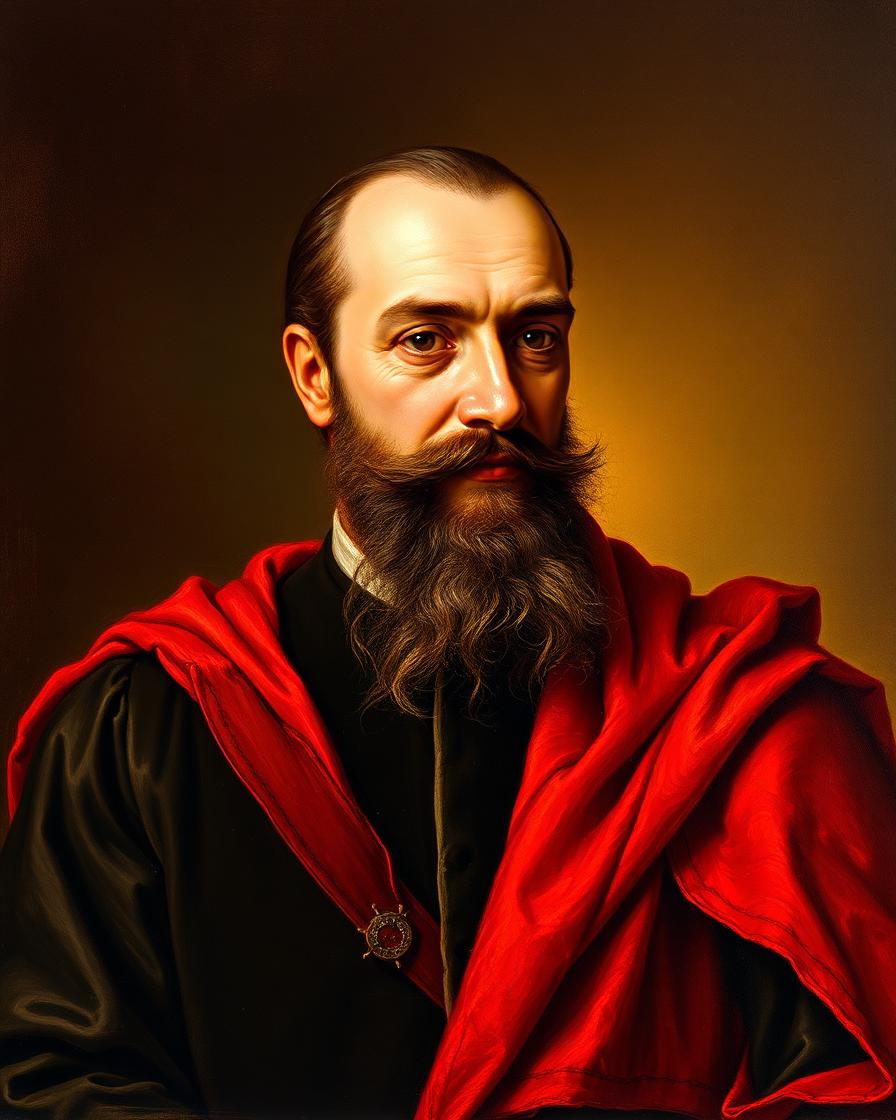
Quick Facts
- Years
- 1460 – 1524
- Category
- Explorers & Adventurers
- Nationality
- Portuguese
- Occupation
- Explorer & Admiral
Vasco da Gama
1460 – 1524 · Portuguese · Explorer & Admiral
Audiobook

Life Lessons from Vasco da Gama
Marcus Alden
Vasco da Gama was a Portuguese navigator, commander, and admiral whose first voyage to India in 1497–1499 established the first recorded direct sea route from Europe to South Asia around the Cape of Good Hope. His expedition linked the Atlantic and Indian Ocean trading worlds by sea and became a decisive episode in the history of European expansion.
Da Gama did not discover India, nor was he the first sailor to navigate the Indian Ocean. African, Arab, Persian, Indian, and other merchants had traded across those waters for centuries. His achievement was to complete a route Portuguese mariners had pursued gradually down Africa’s coast, building on Bartolomeu Dias’s rounding of the Cape in 1488.
The route transformed Portugal into a major maritime power and accelerated exchanges of goods, knowledge, people, and disease. It also helped initiate an era of armed European intervention in Indian Ocean commerce. Da Gama’s later expeditions used severe violence against competitors and civilians, making his career both historically consequential and morally controversial.
He completed three voyages to India, received the title Count of Vidigueira, and became viceroy of Portuguese India shortly before his death in Cochin in 1524. He remains studied as an exceptional navigator, an agent of empire, and a symbol of the intertwined achievements and brutality of the Age of Exploration.
Quick Facts
| Field | Details |
|---|---|
| Full Name | Vasco da Gama |
| Common Name(s) | Vasco da Gama; Dom Vasco da Gama |
| Born | Traditionally dated to about 1460; some historians favor about 1469 |
| Died | 24 December 1524 |
| Age at Death | Uncertain, probably about 55–64 |
| Birthplace | Sines, Kingdom of Portugal |
| Nationality | Portuguese |
| Occupation | Explorer, navigator, naval commander, admiral, viceroy |
| Historical Era | Age of Exploration; early Portuguese Empire |
| Famous For | Leading the first recorded direct European sea voyage to India around the Cape of Good Hope |
| Political Affiliation | Servant of the Portuguese Crown; member of the Order of Santiago earlier in life |
| Religion | Roman Catholic |
| Education | Not securely documented; probably trained in navigation, mathematics, and seamanship |
| Parents | Estêvão da Gama and Isabel Sodré |
| Spouse(s) | Catarina de Ataíde |
| Children | At least six sons and one daughter are traditionally recorded |
| Major Works | Three voyages to India; no major literary work securely attributable to him |
| Major Achievements | Opened the Cape sea route to India; commanded the 1502 armada; Count of Vidigueira; viceroy of Portuguese India |
Early Life
Vasco da Gama was born at Sines, a port in Portugal’s Alentejo region. His birth year is uncertain. The traditional date is around 1460, although documentary arguments have led some modern scholars to place it closer to 1469. This uncertainty also makes his exact age at death unknown.
His father, Estêvão da Gama, was a minor nobleman associated with the household of the Duke of Viseu and served as civil governor of Sines. His mother, Isabel Sodré, came from a family with English ancestry and maritime connections. Vasco therefore grew up within the lower nobility, close to both royal service and the sea.
Reliable details of his childhood are scarce. Later traditions place him in Évora and claim that he studied mathematics and navigation, perhaps under the astronomer Abraham Zacuto. Direct evidence for that specific mentorship is lacking. What is clear is that a commander entrusted with an oceanic expedition required practical knowledge of sailing, astronomy, discipline, and logistics, whether acquired formally or through service.
Portugal was then expanding into the Atlantic and along western Africa. Under Prince Henry the Navigator and his successors, Portuguese captains explored coastlines, developed island colonies, traded in gold and enslaved people, and improved nautical practice. The caravel, mariner’s compass, astronomical instruments, charts, and accumulated pilot knowledge all contributed to this process.
In 1488 Bartolomeu Dias rounded southern Africa, proving that the Atlantic connected with the Indian Ocean. The remaining challenge was to organize a voyage all the way to India, obtain local knowledge, survive unfamiliar monsoon systems, and return.
Da Gama appears in the surviving record in 1492, when King John II sent him to seize French ships in Portuguese ports in retaliation for attacks on Portuguese shipping. His prompt completion of that assignment probably strengthened his reputation for decisiveness.
Rise to Prominence
King Manuel I, who succeeded John II in 1495, revived the plan for an Indian expedition. Why Vasco da Gama received command is not fully documented. His noble status, maritime competence, royal loyalty, and reputation for firmness were likely factors. His father may previously have been considered for such a mission, although the evidence is incomplete.
Da Gama left Restelo, near Lisbon, on 8 July 1497. The expedition included the São Gabriel, commanded by da Gama; the São Rafael, commanded by his brother Paulo; the caravel Berrio, commanded by Nicolau Coelho; and a supply ship. Roughly 170 men sailed, though sources differ on the exact number.
Rather than hugging the African coast, the fleet made a broad sweep into the South Atlantic to exploit favorable winds—a technique known as the volta do mar. It passed the Cape of Good Hope in November 1497 and moved up the eastern African coast.
At Mozambique and Mombasa, da Gama encountered established Muslim-led commercial societies connected to the Indian Ocean economy. Relations were tense, partly because the Portuguese misunderstood local politics and possessed unimpressive gifts. At Malindi, however, they secured cooperation and an experienced pilot. The pilot’s identity remains disputed; the once-popular claim that he was the celebrated Arab navigator Ahmad ibn Majid is not accepted by most modern historians.
The fleet reached Calicut—present-day Kozhikode—on India’s Malabar Coast in May 1498. Da Gama met the Zamorin, Calicut’s ruler, but his gifts appeared modest within a wealthy commercial center. Muslim merchants also had strong reasons to distrust armed newcomers seeking privileged access. The Portuguese obtained only limited trade and departed amid tension.
The return voyage was disastrous. Da Gama sailed across the Indian Ocean during an unfavorable season, and scurvy killed many crewmen. The São Rafael was burned because too few sailors remained to operate it. The Berrio reached Portugal first in July 1499. Da Gama returned later, after pausing in the Azores, where Paulo da Gama died.
Despite enormous human losses and disappointing immediate trade, the voyage proved that direct navigation between Portugal and India was possible. Da Gama returned famous and was rewarded by the Crown.
Major Achievements
Establishing the Cape Route to India
Da Gama’s expedition was the first recorded European voyage to sail from Europe around southern Africa to India and return. It combined Atlantic wind knowledge, Dias’s discoveries, coastal diplomacy, and Indian Ocean pilotage.
The route mattered because it enabled Portugal to buy Asian commodities by sea without relying entirely on commercial chains through the eastern Mediterranean. Its long-term effect was the creation of a durable maritime connection between Europe, Africa, and Asia under growing Portuguese military pressure.
Completing a Successful Return Voyage
Reaching India was only part of the task. Returning across two oceans demonstrated that the route could support repeated expeditions, although the extreme mortality revealed its dangers.
The voyage supplied pilots, mapmakers, and royal planners with practical information about winds, distances, ports, currents, and provisioning. Pedro Álvares Cabral’s large follow-up fleet departed in 1500, and annual Portuguese India armadas soon developed.
Commanding the Armada of 1502–1503
After Cabral’s mission suffered conflict at Calicut, da Gama returned to India in 1502 with a heavily armed fleet, traditionally estimated at about twenty ships in several squadrons. His purpose was commercial and military: enforce Portuguese demands, punish resistance, and secure allied ports.
He attacked shipping, coerced rulers, and bombarded Calicut. His fleet strengthened ties with Cochin and Cannanore and imposed a more intimidating Portuguese presence. It returned with valuable cargo and reinforced the Crown’s claim to control parts of the spice trade.
The campaign also included his most notorious actions, especially the seizure and destruction of a pilgrim vessel—often called the Miri or Merī—whose passengers included women and children. The episode shows that Portuguese commercial strategy could operate through terror as well as negotiation.
Helping Lay the Foundations of Portuguese Power in Asia
Da Gama did not personally create the entire Portuguese Asian empire. Francisco de Almeida, Afonso de Albuquerque, and many others built its bases and institutions. Nevertheless, his voyages made that imperial project possible.
Portugal subsequently established forts and settlements at strategic points including Cochin, Goa, Malacca, and Hormuz. The Estado da Índia attempted to tax and redirect maritime trade through naval force, licensing, and alliances. Da Gama’s career marked the beginning of this new phase of armed European involvement in Asian waters.
Becoming Count of Vidigueira and Viceroy
After years of disputes over rewards and jurisdiction in Sines, da Gama obtained the noble title Count of Vidigueira in 1519. This made him one of the earliest Portuguese men outside the royal family to receive a hereditary comital title.
In 1524 King John III appointed him viceroy of Portuguese India. Sent to correct corruption and administrative disorder, he reached Goa in September and initiated reforms. Illness cut the mission short: he died in Cochin on 24 December 1524.
Leadership and Work
Da Gama’s leadership combined technical competence, endurance, hierarchy, religious purpose, and coercion. He kept his fleet together through long passages and made effective use of experienced captains, pilots, interpreters, and local informants.
His decisions could be bold. The South Atlantic arc of 1497 reduced exposure to difficult coastal winds, while his persistence after setbacks helped the expedition reach India. He also enforced strict discipline and expected obedience within the social conventions of royal naval service.
Diplomatically, his record was uneven. Portuguese assumptions about wealth, religion, and status repeatedly led to misunderstandings. The gifts offered at Calicut were inadequate by local standards, and attempts to present them as royal tribute were poorly received. Portuguese interpreters also struggled across unfamiliar linguistic and cultural settings.
On the second voyage, coercion became central. Da Gama used blockades, bombardment, hostage-taking, mutilation, and attacks on civilian shipping. Such conduct reflected broader early-modern practices of maritime war, but it was severe even in its own context and provoked opposition.
His strengths included courage, strategic persistence, organizational ability, and loyalty to the Crown. His weaknesses included inflexibility, cultural misjudgment, harshness, and willingness to use collective punishment. These qualities made him effective in advancing Portuguese objectives while contributing to violence and lasting hostility.
Personal Life
Around 1500, da Gama married Catarina de Ataíde, the daughter of a prominent noble family. The marriage strengthened his position within Portuguese elite society. The couple had several children, traditionally listed as six sons—Francisco, Estêvão, Paulo, Cristóvão, Pedro, and Álvaro—and a daughter, Isabel.
Several sons later served in Asia. Estêvão da Gama became governor of Portuguese India, and Cristóvão da Gama commanded a Portuguese force in Ethiopia, where he was captured and killed in 1542.
Da Gama’s closest documented personal relationship was with his brother Paulo, who commanded the São Rafael on the first voyage. Paulo’s death during the return journey appears to have deeply affected him.
Little reliable evidence survives about da Gama’s everyday habits or private interests. Descriptions of his personality come largely from chroniclers writing within political and moral frameworks. They consistently portray him as proud, determined, severe, and highly conscious of rank.
On his final voyage, he became seriously ill soon after arriving in India. Contemporary descriptions suggest a painful neck infection or abscess, sometimes interpreted as a carbuncle. A precise modern diagnosis is impossible. He died at Cochin and was initially buried in the church of St. Francis there.
Philosophy and Beliefs
Da Gama left no systematic statement of philosophy. His worldview must be reconstructed from his service, reported speeches, correspondence, and the aims of his expeditions.
He was a Catholic nobleman serving a monarchy that combined trade, dynastic ambition, and religious expansion. Portuguese leaders hoped to reach Christian powers believed to exist in the East, outflank Islamic commercial networks, spread Christianity, and acquire spices and wealth.
Da Gama appears to have accepted the hierarchical values of his era: loyalty to the king, defense of noble honor, military obedience, and confessional identity. Religious observance accompanied his voyages, but commercial and strategic goals were inseparable from missionary language.
His ethical conduct presents a stark historical problem. He could negotiate and form alliances, yet he also treated terror as a legitimate instrument against opponents. Explaining such actions through early-modern warfare does not require excusing them. His worldview demonstrates how religious conviction, commerce, and imperial violence could reinforce one another.
Challenges and Controversies
The first voyage nearly failed. Disease, poor provisioning, uncertain information, storms, and difficult diplomacy caused devastating losses. Only a fraction of the original crew returned, and the expedition brought back limited merchandise.
Da Gama’s claim to heroic status also requires qualification. He built on decades of African exploration and relied on unnamed or poorly documented African and Asian pilots, interpreters, merchants, and rulers. Calling him the “discoverer of India” is inaccurate because India and its maritime routes were known to millions of people.
The destruction of the pilgrim ship in 1502 is the central moral controversy. Portuguese chroniclers describe hundreds of passengers being trapped aboard a captured vessel that was looted and burned despite pleas and ransom offers. Details vary among accounts, but the deliberate killing of civilians is well established.
At Calicut, da Gama ordered bombardment and brutal reprisals. Defenders argue that he operated in a violent competitive environment and had instructions to retaliate for attacks on Portuguese interests. Critics respond that deliberate attacks on noncombatants and collective punishment exceeded legitimate military necessity.
His economic importance is debated as well. Older narratives presented the Cape route as immediately displacing Mediterranean and Muslim trade. Modern scholarship shows a slower and more complex process. Existing networks remained resilient, and Portuguese control was always incomplete.
His modern commemoration divides opinion. In Portugal he has long symbolized navigation and national achievement. In postcolonial interpretations, he represents invasion, coercive trade, and European imperialism. Both perspectives address genuine parts of his historical significance, but neither should erase the other.
Legacy
Da Gama’s voyages permanently altered connections among the Atlantic, Indian Ocean, and Mediterranean worlds. They enabled recurrent Portuguese fleets to enter Asian commerce and helped shift part of Europe’s economic attention toward oceanic routes.
His legacy was not a simple European “opening” of an isolated region. The Indian Ocean already possessed sophisticated commercial systems. What changed was the arrival of a European state seeking to impose naval tolls, fortified bases, and armed monopolies on parts of that system.
The Portuguese national epic Os Lusíadas by Luís de Camões, published in 1572, made da Gama’s voyage its central narrative and elevated him into a literary symbol. Later imperial culture celebrated him through monuments, street names, paintings, and public ceremonies.
His tomb is in the Church of Santa Maria at the Jerónimos Monastery in Lisbon, opposite the monument to Camões. The Vasco da Gama Tower, Vasco da Gama Bridge, and numerous schools and institutions carry his name. His birthplace, Sines, preserves memorials and a museum tradition connected to his life.
Outside Portugal, memorials can be more contested. The Vasco da Gama monument in Goa, for example, belongs to a landscape shaped by centuries of Portuguese rule. In India and East Africa, his arrival is often studied less as discovery than as the beginning of European military intrusion.
Today his career remains relevant to debates about globalization, colonialism, navigation, cultural encounter, trade, historical memory, and the ethics of commemoration.
Interesting Facts
- Da Gama’s exact birth year is uncertain.
- His first recorded royal assignment involved seizing French ships in 1492.
- His first fleet contained four vessels, including a supply ship.
- His brother Paulo commanded the São Rafael.
- The expedition used a wide South Atlantic arc rather than simply following Africa’s shoreline.
- The fleet crossed the equator twice on the first voyage.
- Da Gama reached Calicut in May 1498.
- The Portuguese gifts disappointed Calicut’s court because they appeared modest.
- The Malindi pilot’s identity is unknown; Ahmad ibn Majid was probably not that pilot.
- Scurvy killed many sailors during the return crossing.
- The São Rafael was burned because too few crewmen survived to sail it.
- Nicolau Coelho’s Berrio returned to Portugal before da Gama.
- Paulo da Gama died in the Azores on the return journey.
- Da Gama made three voyages to India.
- He became Count of Vidigueira in 1519.
- He was appointed viceroy only in 1524.
- He died less than four months after reaching India as viceroy.
- His remains were transferred from Cochin to Portugal in 1539.
- Os Lusíadas helped turn him into a national hero.
- Two lunar craters, including one named Vasco da Gama, preserve his name in astronomical nomenclature.
Famous Quotes
Authentic verbatim quotations from da Gama are rare. Most surviving words come through chroniclers or later tradition, so translations and wording vary.
- “We came to seek Christians and spices.” Reported by Álvaro Velho’s journal when the Portuguese were questioned at Calicut in 1498. It concisely expresses the expedition’s religious and commercial goals.
- “My business is with the King of Calicut.” A translated sense of da Gama’s reported insistence on negotiating directly with the ruler rather than merely with merchants. Wording varies by edition.
- “I am not a merchant, but an ambassador.” Reported in accounts of the Calicut negotiations. It reflects his concern with royal status, though exact wording is translation-dependent.
- “If you do this, you will have peace and friendship with the King of Portugal.” A recurring formula in demands attributed to him during the second voyage; surviving versions differ.
- “I will return.” Often associated with his departure from Calicut, but the precise standalone wording is disputed and should not be treated as securely documented.
- “The sea is dangerous and its storms terrible, but these obstacles have never been sufficient reason to remain ashore.” Widely circulated online but unsupported and probably apocryphal.
- “I am not afraid of the darkness. Real death is preferable to a life without living.” Frequently attributed to da Gama but not authenticated in contemporary sources.
- “We are seeking Christians and spices.” An alternative common translation of the first quotation, included to show how the journal’s wording varies rather than as a separate statement.
Because so few direct quotations survive, adding further polished sayings would risk repeating modern inventions rather than da Gama’s documented words.
Timeline
- c. 1460 or c. 1469 — Vasco da Gama is born at Sines, Portugal.
- 1488 — Bartolomeu Dias rounds the Cape of Good Hope, preparing the way for an India voyage.
- 1492 — Da Gama seizes French vessels under orders from King John II.
- 1495 — Manuel I becomes king and renews plans for an Indian expedition.
- 8 July 1497 — Da Gama’s fleet leaves near Lisbon.
- November 1497 — The fleet rounds the Cape of Good Hope.
- March–April 1498 — It visits Mozambique, Mombasa, and Malindi.
- May 1498 — Da Gama arrives near Calicut, India.
- August 1498 — The expedition leaves Calicut.
- January 1499 — The fleet reaches Malindi after a deadly ocean crossing.
- July 1499 — The Berrio reaches Portugal.
- August or September 1499 — Da Gama returns after his brother’s death in the Azores.
- c. 1500 — He marries Catarina de Ataíde.
- 1500–1501 — Cabral’s expedition follows the route and establishes relations with Cochin.
- February 1502 — Da Gama departs on his second India voyage.
- 1502 — His armada attacks shipping and Calicut, including the destruction of a pilgrim vessel.
- 1503 — Da Gama returns to Portugal with valuable cargo.
- 1519 — He becomes Count of Vidigueira.
- 1521 — John III becomes king of Portugal.
- April 1524 — Da Gama leaves Portugal for India for the third time.
- September 1524 — He arrives in Goa as viceroy.
- 24 December 1524 — He dies at Cochin.
- 1539 — His remains are transferred to Vidigueira, Portugal.
- 1880 — His remains are transferred to the Jerónimos Monastery in Lisbon.
Frequently Asked Questions
Who was Vasco da Gama?
Vasco da Gama was a Portuguese nobleman, navigator, fleet commander, and colonial administrator. He led the 1497–1499 expedition that completed the first recorded direct European sea voyage to India around southern Africa. He later commanded a powerful armada in 1502 and served briefly as viceroy of Portuguese India in 1524. His voyages helped create sustained maritime contact between Portugal and South Asia, but they also introduced a strategy of armed trade, coercion, and imperial violence into established Indian Ocean networks.
When was Vasco da Gama born?
His birth date is uncertain. Many older biographies give approximately 1460, while some scholars favor a date around 1469 based on documentary interpretation. He was born at Sines in the Kingdom of Portugal. No surviving baptismal record settles the question. Consequently, statements giving an exact birth year or exact age at death should be treated cautiously.
What did Vasco da Gama discover?
He did not discover India, Africa, or the Indian Ocean. These regions were inhabited and connected by extensive trade long before his arrival. His expedition established the first recorded direct European sea route from Portugal to India by sailing around the Cape of Good Hope. The achievement was navigational and strategic from a European perspective, not the discovery of previously unknown lands.
Why was the voyage to India important?
The voyage showed that ships could travel between western Europe and South Asia through the Atlantic and Indian oceans. This allowed Portugal to participate more directly in the spice trade and supported recurring fleets, fortified settlements, and diplomatic alliances. Over time, it also contributed to European colonial expansion and military intervention in Asian commerce. Its importance therefore includes both increased global connection and intensified imperial conflict.
How long did the first voyage take?
Da Gama left Portugal on 8 July 1497 and returned in late August or early September 1499, so his personal journey lasted more than two years. The fleet reached India in May 1498. The Berrio, separated from da Gama during the return, arrived in Portugal in July 1499. The long duration reflected vast distances, seasonal winds, stops for repairs and supplies, illness, negotiations, and the death of Paulo da Gama.
What ships sailed on the first expedition?
The expedition included the São Gabriel, da Gama’s flagship; the São Rafael, commanded by Paulo da Gama; the Berrio, commanded by Nicolau Coelho; and a supply ship whose name is not securely known. The supply ship was dismantled after its provisions were transferred, while the São Rafael was later burned because disease had left too few sailors to operate it. Only the São Gabriel and Berrio returned to Portugal.
How did da Gama navigate?
His fleet relied on dead reckoning, compass directions, astronomical observations, charts, accumulated Portuguese sailing knowledge, and pilots familiar with particular waters. The wide South Atlantic route exploited wind systems already understood by Portuguese mariners. Along East Africa and across the Indian Ocean, local expertise was crucial. Navigation was a collective achievement involving pilots, masters, sailors, mapmakers, and knowledge obtained from African and Asian maritime communities.
Was Ahmad ibn Majid da Gama’s pilot?
Probably not. Older accounts often claimed that the famous Arab navigator Ahmad ibn Majid guided da Gama from Malindi to India. Most modern specialists reject this identification because the evidence is late, inconsistent, and unsupported by contemporary Portuguese records. An experienced pilot did guide the fleet, but his identity remains uncertain. Some sources suggest a Gujarati or other Indian Ocean mariner rather than Ibn Majid.
Why did negotiations at Calicut go badly?
Calicut was a rich, cosmopolitan port where established merchants handled valuable international trade. Portuguese gifts appeared unimpressive, and da Gama lacked commodities suited to the local market. Communication problems and misunderstandings over diplomatic status worsened relations. Muslim merchants feared a hostile competitor, while the Zamorin had to balance multiple commercial interests. The Portuguese also expected privileges without yet possessing the wealth, trust, or political relationships required to obtain them.
How many sailors survived the first voyage?
Sources vary on the fleet’s original and returning totals, so exact figures are uncertain. Roughly 170 men may have departed, and perhaps around 55 returned. Scurvy and other illnesses caused most deaths, especially during the poorly timed return crossing of the Indian Ocean. The losses demonstrate both the expedition’s extraordinary endurance and the human cost of limited nutritional and medical knowledge.
What happened on da Gama’s second voyage?
In 1502 da Gama led a large armed fleet intended to enforce Portuguese demands and retaliate for conflict at Calicut. He attacked shipping, strengthened ties with Cochin and Cannanore, bombarded Calicut, and imposed agreements favoring Portugal. The voyage returned profitable cargo but became notorious for extreme violence, including the burning of a pilgrim vessel carrying many civilians. It helped shift Portuguese policy from exploratory trade toward naval coercion.
Did da Gama commit atrocities?
Contemporary and near-contemporary sources document actions that today are widely described as atrocities. The clearest example is the looting and burning of a pilgrim ship in 1502 with hundreds of people reportedly aboard. His forces also bombarded Calicut and used mutilation and collective punishment. Historians debate details and context, but not the basic reality of severe violence. Explaining early-modern warfare does not remove responsibility or diminish civilian suffering.
Was Vasco da Gama a good leader?
The answer depends on the criteria used. He demonstrated endurance, navigational judgment, discipline, and effectiveness in serving Portuguese royal objectives. He completed a voyage many considered extraordinarily difficult and managed complex fleets. Yet his cultural misunderstandings undermined diplomacy, and his deliberate use of terror caused immense suffering. Historically, he was a capable and consequential commander; ethically, important features of his leadership deserve strong criticism.
How many times did he travel to India?
Da Gama made three voyages to India. The first, from 1497 to 1499, established the sea route. The second, from 1502 to 1503, was a heavily armed commercial and punitive expedition. The third began in 1524 after King John III appointed him viceroy. He arrived in India in September but became ill and died at Cochin on 24 December.
Why was he appointed viceroy?
By 1524 the Portuguese administration in India faced corruption, factionalism, weak discipline, and disputes over authority. King John III selected the experienced and prestigious da Gama to restore order. He pursued inquiries, replaced some officials, and attempted to enforce tighter accountability. His reforms had little time to develop because illness killed him only months after arrival. His appointment nevertheless shows the Crown’s continuing confidence in his severity and authority.
Where did Vasco da Gama die?
He died in Cochin, now Kochi in Kerala, India, on 24 December 1524. He had fallen seriously ill after arriving as viceroy. His body was first buried in the church of St. Francis in Cochin. In 1539 his remains were taken to Portugal and buried at Vidigueira. They were transferred to the Jerónimos Monastery in Lisbon in 1880.
Where is Vasco da Gama buried today?
His monumental tomb stands in the Church of Santa Maria at the Jerónimos Monastery in Belém, Lisbon. The monastery is closely associated with Portugal’s maritime expansion and is a UNESCO World Heritage Site. Questions have occasionally been raised about historical transfers and identification of remains, but the Jerónimos tomb is the officially recognized burial place and Portugal’s principal memorial to him.
How did his voyages affect India and Africa?
They strengthened connections between distant regions but also brought Portuguese naval violence and demands for privileged trade. East African ports faced changing alliances and attacks, while Indian rulers and merchants confronted an armed European competitor. Portugal never controlled the entire Indian Ocean economy, yet its fortified network altered regional politics and commerce. The longer-term consequences included colonial rule in places such as Goa and enduring Portuguese cultural influences.
Why is Vasco da Gama controversial today?
He represents both a remarkable navigational achievement and the violent beginnings of European maritime empire in the Indian Ocean. Portuguese national traditions often emphasize courage, exploration, and global connection. Critics emphasize attacks on civilians, coercive trade, and colonial domination. A balanced assessment recognizes the route’s technical importance without using achievement to excuse brutality or describing populated lands as if Europeans alone made them historically visible.
Lessons We Can Learn
- Major achievements are cumulative. Da Gama succeeded because Dias, earlier sailors, mapmakers, and local pilots supplied essential knowledge. Modern innovation also depends on inherited expertise.
- Preparation cannot eliminate uncertainty. The fleet carried supplies and experienced officers, yet disease and weather remained deadly. Planning should include resilience, not merely confidence.
- Local knowledge is indispensable. Indian Ocean pilots helped the Portuguese cross unfamiliar waters. Effective work in new environments requires respect for people who understand them.
- Cultural arrogance damages negotiation. Inadequate gifts and mistaken assumptions weakened relations at Calicut. Leaders must learn local expectations before demanding cooperation.
- Technical success is not moral success. Completing the sea route was extraordinary, but later atrocities cannot be justified by navigational achievement.
- Commercial power and military power can become dangerously intertwined. Portugal sought trade but increasingly used cannons and coercion. Organizations should examine how leverage affects ethics.
- Human costs belong in accounts of progress. Crew deaths and civilian casualties are central to this story, not secondary details. Honest evaluation includes those who paid the price.
- Labels shape historical understanding. Calling da Gama a “discoverer” erases existing societies and networks. Precise language produces better scholarship and fairer public memory.
- Reputation changes with perspective. National heroism and postcolonial criticism illuminate different experiences. Mature analysis compares viewpoints and evidence.
- Power requires accountability. Da Gama’s final mission targeted corruption in Portuguese India. Institutions need oversight, although reformers themselves must remain answerable for their methods.
Related Historical Figures
- Bartolomeu Dias — Rounded the Cape of Good Hope in 1488 and provided crucial knowledge for da Gama’s route.
- King Manuel I of Portugal — Sponsored the first and second voyages and rewarded da Gama.
- King John II of Portugal — Advanced Portuguese exploration and gave da Gama his first known royal assignment.
- Paulo da Gama — Vasco’s brother and captain of the São Rafael on the first voyage.
- Nicolau Coelho — Commanded the Berrio and later sailed with Cabral.
- Pedro Álvares Cabral — Led the major follow-up expedition to India in 1500 and claimed Brazil for Portugal.
- The Zamorin of Calicut — The ruler with whom da Gama negotiated and later fought; contemporary Portuguese sources often use a title rather than a personal name.
- Francisco de Almeida — First viceroy of Portuguese India and architect of Portuguese naval power there.
- Afonso de Albuquerque — Expanded the Portuguese Asian empire by capturing Goa, Malacca, and Hormuz.
- Luís de Camões — Poet whose Os Lusíadas transformed da Gama’s voyage into Portugal’s defining national epic.
Related Historical Figures