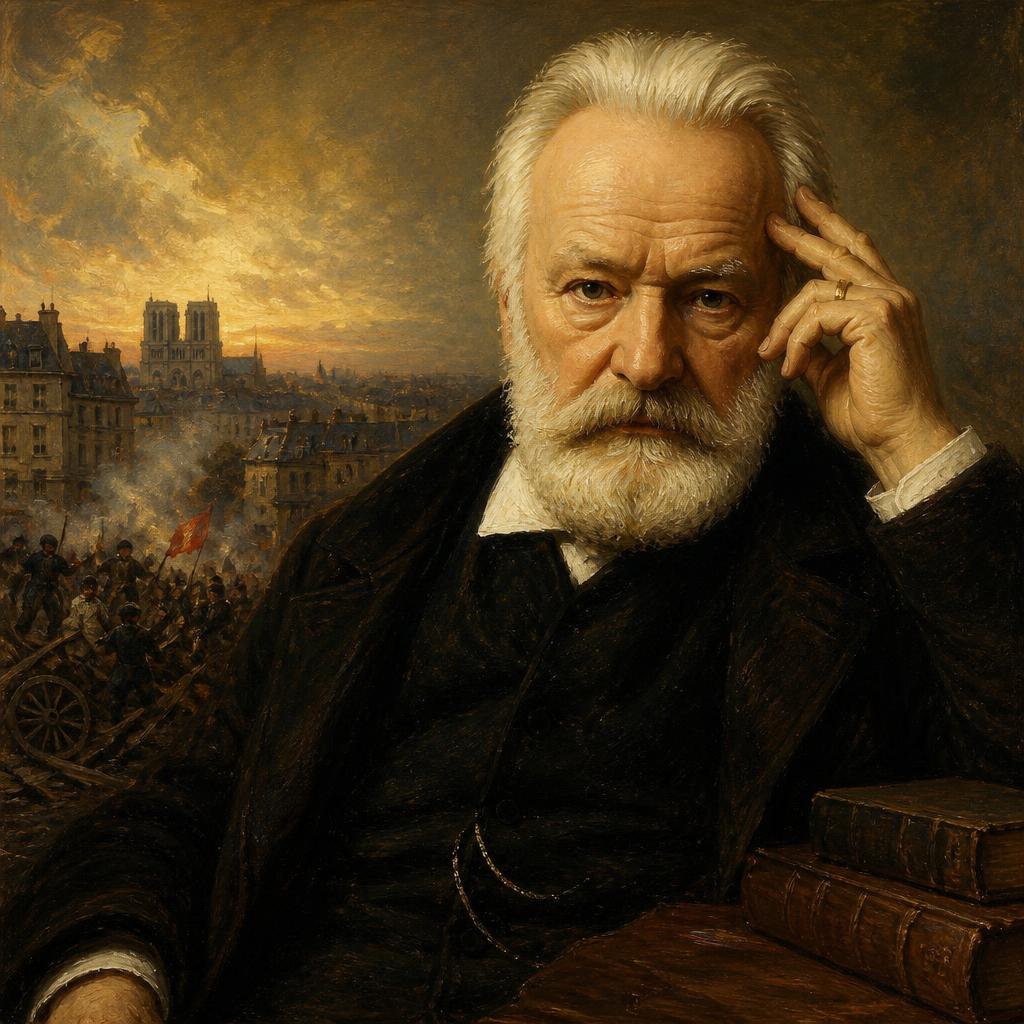
Quick Facts
- Years
- 1802 – 1885
- Category
- Writers & Poets
- Subcategory
- Novelists
- Nationality
- French
- Occupation
- Novelist & Poet
Victor Hugo
1802 – 1885 · French · Novelist & Poet
Audiobook

Life Lessons from Victor Hugo
Marcus Alden · 48 min
Introduction
Victor Hugo was one of the central figures of nineteenth-century European culture: a poet, novelist, dramatist, visual artist, political campaigner and public intellectual whose career extended from the final years of Napoleon Bonaparte’s empire to the early decades of the French Third Republic. Born in 1802 and active for more than sixty years, Hugo witnessed repeated revolutions, restorations, coups and wars. His writing both reflected those upheavals and helped shape how later generations understood them.
Internationally, Hugo is best known for the novels Notre-Dame de Paris—often titled The Hunchback of Notre-Dame in English—and Les Misérables. Yet novels formed only one part of an enormous body of work. Hugo transformed French lyric poetry, helped establish Romantic drama, produced political pamphlets against authoritarian rule and created thousands of drawings. His verse collections, including Les Contemplations and La Légende des siècles, remain landmarks of French literature.
Hugo’s political development was as dramatic as his literary career. A royalist in youth, he gradually became a liberal, republican and outspoken opponent of capital punishment, censorship, poverty and the regime of Napoleon III. His resistance to the coup d’état of 1851 forced him into nearly nineteen years of exile, principally on the Channel Island of Guernsey. Rather than silencing him, exile gave Hugo an international platform and produced many of his greatest works.
By the time of his death in Paris on May 22, 1885, Hugo had become more than a celebrated author. To admirers, he embodied the moral conscience of France. His state funeral drew an immense crowd, and his remains were placed in the Panthéon alongside those of other figures honored by the French nation.
Quick Facts
| Category | Details |
|---|---|
| Full name | Victor-Marie Hugo |
| Born | February 26, 1802 |
| Birthplace | Besançon, France |
| Died | May 22, 1885 |
| Place of death | Paris, France |
| Nationality | French |
| Occupations | Poet, novelist, dramatist, essayist, artist and politician |
| Literary movement | French Romanticism |
| Best-known novels | Notre-Dame de Paris and Les Misérables |
| Major poetry collections | Les Orientales, Les Châtiments, Les Contemplations and La Légende des siècles |
| Major plays | Cromwell, Hernani, Le roi s’amuse, Lucrèce Borgia and Ruy Blas |
| Parents | Joseph Léopold Sigisbert Hugo and Sophie Trébuchet |
| Spouse | Adèle Foucher |
| Long-term companion | Juliette Drouet |
| Children | Léopold, Léopoldine, Charles, François-Victor and Adèle |
| Political roles | Peer of France, deputy and senator |
| Years in exile | 1851–1870 |
| Principal exile residence | Hauteville House, Guernsey |
| Resting place | Panthéon, Paris |
Early Life & Background
Victor-Marie Hugo was born on February 26, 1802, in Besançon, a city in eastern France. He was the youngest of three sons. His father, Joseph Léopold Sigisbert Hugo, was an officer who rose through the ranks of Napoleon Bonaparte’s army and served in Italy and Spain. His mother, Sophie Trébuchet, came from Nantes and held royalist and Catholic sympathies that contrasted with her husband’s military and political associations.
The family’s movements followed Léopold Hugo’s assignments. Victor therefore spent parts of his childhood in Paris, Italy and Spain. In 1811 he lived for several months in Madrid, where his father served the Napoleonic regime established under Joseph Bonaparte. These journeys exposed the future writer to dramatic landscapes, architecture, political conflict and cultural difference. Spain in particular later supplied settings and imagery for works such as Hernani and Ruy Blas.
His parents’ troubled marriage also shaped his early life. Sophie lived largely apart from Léopold and raised the boys chiefly in Paris. For a time they occupied a former convent on the rue des Feuillantines, whose large, overgrown garden remained vivid in Hugo’s memory. The conflicting influence of a royalist mother and a father associated with the Napoleonic state contributed to the political complexity of Hugo’s later development.
Hugo studied in Paris, including at the Pension Cordier and the Lycée Louis-le-Grand. Although his father hoped he might pursue a practical or technical profession, Hugo resolved while still young to become a writer. He and his brothers Abel and Eugène founded the literary journal Le Conservateur littéraire in 1819. The publication allowed Victor to print poems, reviews and essays while participating in contemporary debates.
His precocious verse attracted recognition. He received honors from the Académie des Jeux Floraux in Toulouse and submitted poems to the Académie française. His earliest writing was traditional in form and strongly royalist in sentiment. It praised the restored Bourbon monarchy and Catholic order, positions encouraged by his mother’s influence and by the political climate after Napoleon’s defeat.
In 1821, Sophie Hugo died. The following year Victor published Odes et poésies diverses, his first major collection. Its royalist character earned official approval and a pension from King Louis XVIII. At only twenty, Hugo had gained entry into the French literary world.
Rise to Prominence
On October 12, 1822, Hugo married his childhood friend Adèle Foucher at the Church of Saint-Sulpice in Paris. The marriage deeply distressed his brother Eugène, who was also emotionally attached to Adèle and soon suffered a severe mental breakdown. This family tragedy cast a shadow over the beginning of Hugo’s married life.
During the 1820s, Hugo moved steadily away from literary conservatism and emerged as a leader of French Romanticism. Romantic writers resisted the rigid conventions associated with French neoclassical theater. They sought greater freedom of form, historical settings, emotional intensity and the coexistence of beauty with violence, comedy and the grotesque.
Hugo’s play Cromwell, published in 1827, was too long and elaborate for practical staging, but its preface became a manifesto of Romantic drama. Hugo rejected strict separation between tragic and comic modes and argued that modern art should represent the full range of human existence. The “Preface to Cromwell” established him as a major literary theorist.
His breakthrough in the theater came with Hernani. Its premiere at the Comédie-Française on February 25, 1830, became famous as the “Battle of Hernani.” Young Romantics, including admirers such as Théophile Gautier, confronted defenders of classical theatrical conventions. Applause, jeering and argument accompanied the early performances. The controversy made the play—and Hugo—symbols of a new artistic generation.
In 1831 Hugo published Notre-Dame de Paris, set in Paris in 1482. The novel intertwined the lives of the cathedral bell-ringer Quasimodo, the Romani dancer Esmeralda, Archdeacon Claude Frollo and Captain Phoebus. More than a melodrama, it examined fatal desire, social exclusion, architecture and historical change. Hugo’s loving attention to Notre-Dame Cathedral helped awaken public concern for France’s neglected medieval monuments and contributed to the preservation movement that culminated in the cathedral’s nineteenth-century restoration.
Hugo also became one of France’s leading poets. Les Orientales appeared in 1829, drawing on contemporary European fascination with Greece, Spain and the eastern Mediterranean. Later collections, including Les Feuilles d’automne and Les Voix intérieures, developed a more personal, reflective voice.
His dramatic successes continued with Le roi s’amuse in 1832, Lucrèce Borgia and Marie Tudor in 1833, Angelo, tyran de Padoue in 1835 and Ruy Blas in 1838. In 1841, after several unsuccessful candidacies, he was elected to the Académie française, confirming his position at the center of national literary life.
Major Achievements
Hugo’s greatest achievement was the breadth and endurance of his literary production. He worked across poetry, fiction, drama, criticism, political writing, travel literature and visual art, frequently reshaping the conventions of each form.
Notre-Dame de Paris helped establish the historical novel in France while turning medieval architecture into an active force within the narrative. The cathedral is not merely a backdrop: it represents collective memory, artistic labor and a civilization threatened by neglect and technological change.
Les Misérables, published in 1862, was the result of decades of thought and revision. Hugo began an early version in the 1840s under the title Les Misères, then returned to it during exile. The novel follows the former convict Jean Valjean, relentlessly pursued by Inspector Javert after breaking parole. Their conflict unfolds alongside the stories of Fantine, Cosette, Marius Pontmercy, the Thénardiers and the revolutionary students at the barricade of June 1832.
The novel combines melodrama, social criticism, theology, history and lengthy essays on subjects including Waterloo, convents, sewers and criminal justice. Hugo’s purpose was moral as well as artistic: he wished to expose the systems that turned poverty into degradation and punishment into lifelong exclusion. Initially criticized by some reviewers for excess, sentimentality and political radicalism, Les Misérables became an international phenomenon.
Hugo’s poetic accomplishments were equally significant. Les Châtiments, published in 1853, used satire, invective and prophetic anger against Napoleon III. Les Contemplations followed in 1856. Organized as a spiritual autobiography, the collection is divided by the death of Hugo’s daughter Léopoldine into “formerly” and “today.” Its poems move from youthful memory and love to grief, metaphysical questioning and partial reconciliation.
The first series of La Légende des siècles appeared in 1859, with later installments in 1877 and 1883. Through poems set in different historical eras, Hugo attempted to portray humanity’s long passage from violence and oppression toward moral enlightenment.
Hugo also created more than 3,000 surviving drawings. Often made with brown or black ink, washes, charcoal and unconventional materials, they depict castles, cliffs, imaginary cities and mysterious landscapes. Their experimental techniques and dreamlike atmosphere later impressed artists associated with Symbolism and Surrealism.
His public achievements were substantial. Hugo opposed capital punishment, defended freedom of expression, supported republican government and advocated universal education. At the International Peace Congress in Paris in 1849, he imagined a future “United States of Europe,” anticipating later movements for European cooperation.
Defining Moments
The first great defining moment of Hugo’s public career was the premiere of Hernani in 1830. The conflict surrounding the play established him as the leading dramatist of French Romanticism and demonstrated that literary disputes could become broader struggles over authority, tradition and generational change.
A far more painful turning point came on September 4, 1843. Hugo’s eldest surviving daughter, Léopoldine, and her husband, Charles Vacquerie, drowned in the Seine at Villequier when their boat capsized. Hugo was traveling in southwestern France and reportedly learned of the tragedy from a newspaper. His grief profoundly affected his writing. The poem “Demain, dès l’aube,” later included in Les Contemplations, describes a solitary journey to Léopoldine’s grave.
The Revolution of February 1848 drew Hugo more deeply into politics. He was elected to the Constituent Assembly and then, in 1849, to the Legislative Assembly. Initially associated with conservative forces and the Party of Order, he gradually broke with them over poverty, education, press freedom and the increasing authoritarianism of President Louis-Napoléon Bonaparte.
When Bonaparte seized power in the coup of December 2, 1851, Hugo attempted to encourage resistance in Paris. After the coup succeeded, he fled France under a false identity. He first went to Brussels, then to Jersey in 1852 and finally to Guernsey in 1855. His denunciations of the new emperor appeared in Napoléon le Petit and Les Châtiments.
Exile transformed Hugo into an international symbol of resistance. In 1859 Napoleon III offered an amnesty to political exiles, but Hugo refused to return while the imperial regime remained in power. He declared that when liberty returned, he would return as well.
The collapse of the Second Empire during the Franco-Prussian War made that return possible. Hugo arrived in Paris on September 5, 1870, one day after the proclamation of the Third Republic. A large crowd welcomed him at the Gare du Nord. His return united his identities as writer, exile and republican patriot.
Timeline
| Year | Event |
|---|---|
| 1802 | Born in Besançon on February 26 |
| 1811 | Lives in Madrid during his father’s service in Napoleonic Spain |
| 1819 | Founds Le Conservateur littéraire with his brothers |
| 1822 | Publishes Odes et poésies diverses and marries Adèle Foucher |
| 1827 | Publishes Cromwell and its influential Romantic preface |
| 1829 | Publishes Les Orientales |
| 1830 | Hernani premieres at the Comédie-Française |
| 1831 | Publishes Notre-Dame de Paris |
| 1833 | Lucrèce Borgia premieres; relationship with Juliette Drouet begins |
| 1838 | Ruy Blas premieres |
| 1841 | Elected to the Académie française |
| 1843 | Léopoldine Hugo and Charles Vacquerie drown at Villequier |
| 1845 | Appointed a Peer of France |
| 1848 | Elected to the Constituent Assembly after the February Revolution |
| 1849 | Elected to the Legislative Assembly; addresses the Paris Peace Congress |
| 1851 | Opposes Louis-Napoléon Bonaparte’s coup and flees France |
| 1852 | Publishes Napoléon le Petit; settles on Jersey |
| 1853 | Publishes Les Châtiments |
| 1855 | Leaves Jersey and settles on Guernsey |
| 1856 | Publishes Les Contemplations and acquires Hauteville House |
| 1859 | Publishes the first series of La Légende des siècles and refuses amnesty |
| 1862 | Publishes Les Misérables |
| 1866 | Publishes Les Travailleurs de la mer |
| 1869 | Publishes L’Homme qui rit |
| 1870 | Returns to Paris after the fall of Napoleon III |
| 1871 | Elected to the National Assembly but soon resigns |
| 1874 | Publishes Quatrevingt-treize |
| 1876 | Elected senator for the Seine |
| 1882 | Paris celebrates his eightieth birthday; avenue d’Eylau becomes avenue Victor-Hugo |
| 1883 | Juliette Drouet dies |
| 1885 | Dies on May 22; receives a state funeral and burial in the Panthéon |
Personal Life
Victor and Adèle Hugo had five children. Their first child, Léopold, died in infancy. Léopoldine was born in 1824, Charles in 1826, François-Victor in 1828 and Adèle in 1830. The family’s history was marked by repeated loss: Léopoldine died in 1843, Adèle Hugo died in 1868, Charles died in 1871 and François-Victor in 1873.
Hugo’s marriage was emotionally complicated. Adèle formed a close relationship, apparently romantic, with the critic Charles-Augustin Sainte-Beuve, once Hugo’s friend. Hugo, in turn, had numerous affairs.
His most enduring extramarital relationship was with the actress Juliette Drouet, whom he met in 1833 during the production of Lucrèce Borgia. Drouet abandoned her theatrical career and devoted much of her life to Hugo, accompanying him during his travels and exile. She wrote him thousands of letters and remained his intimate companion for fifty years, although he continued to have other relationships.
In 1845 Hugo was discovered with Léonie d’Aunet, a married woman. Adultery was then a criminal offense. Hugo avoided arrest because of his status as a Peer of France, while d’Aunet was detained and later imprisoned. The episode was suppressed in much of the contemporary press but remains a significant example of the unequal legal and social consequences faced by men and women.
Hugo was affectionate toward his family but could also be controlling, self-dramatizing and unfaithful. His daughter Adèle developed a severe mental illness and became obsessively attached to the British officer Albert Pinson. After pursuing him abroad, she was eventually institutionalized and outlived her father, dying in 1915.
During exile Hugo purchased Hauteville House in Saint Peter Port, Guernsey. He personally supervised its elaborate decoration, filling it with carved furniture, mirrors, tapestries and symbolic inscriptions. The house became both a family home and a carefully constructed expression of his artistic imagination.
Beliefs & Philosophy
Hugo’s political and religious ideas changed considerably over his lifetime. His youthful royalism gave way first to constitutional liberalism and then to republicanism. He increasingly viewed history as a struggle between oppression and freedom, ignorance and education, punishment and redemption.
He believed literature carried a social responsibility. In Les Misérables, poverty is not presented simply as individual failure but as the consequence of institutions that deny people education, dignity and opportunity. Jean Valjean’s transformation illustrates Hugo’s conviction that mercy can succeed where punishment fails.
Opposition to capital punishment was among his most consistent causes. His early novel Le Dernier Jour d’un condamné (The Last Day of a Condemned Man, 1829) depicts the inner experience of a prisoner awaiting execution. Hugo later intervened publicly in particular death-penalty cases and treated abolition as an essential measure of civilization.
Although raised Catholic, Hugo grew critical of clerical authority and dogmatism. He retained a powerful belief in God, immortality, moral progress and the spiritual dimension of existence. During his years on Jersey, he participated in séances at Marine Terrace. The supposed communications—with spirits ranging from the dead to abstract entities—reflected both the spiritualist culture of the period and Hugo’s grief-driven search for meaning.
Hugo supported freedom of the press, secular education and political amnesty. He also promoted international peace and European unity. His confidence in historical progress, however, was not simple optimism. His work repeatedly acknowledges cruelty, catastrophe and failed revolutions while insisting that humanity retains the possibility of moral advancement.
Challenges & Controversies
Hugo endured censorship throughout his career. Le roi s’amuse was banned after its first performance in 1832 because authorities considered its treatment of royal immorality politically dangerous. Under Napoleon III, Hugo’s political works had to be published outside France and circulated clandestinely.
Exile imposed separation, uncertainty and financial complications, though Hugo’s literary success eventually allowed him to live comfortably. He also faced criticism for refusing the 1859 amnesty: supporters saw an act of principle, while opponents regarded it as theatrical self-promotion.
His political record was not always consistent. In 1848 he initially aligned with conservative politicians and showed anxiety about revolutionary disorder before becoming a prominent republican voice. His positions evolved, but later admirers sometimes presented that evolution as more straightforward than it actually was.
Hugo’s private conduct has also complicated his heroic image. His numerous sexual relationships existed alongside public celebrations of family and fidelity. The Léonie d’Aunet affair particularly exposed the gendered privilege attached to his political status.
Some of Hugo’s statements on empire and race are troubling from a modern perspective. At an 1879 banquet commemorating the abolition of slavery, he portrayed European intervention in Africa as a civilizing mission and encouraged France to take a leading role. Although he opposed slavery and expressed humanitarian ideals, such rhetoric participated in assumptions later used to justify colonial expansion.
His writing itself attracted criticism for digression, emotional excess and grandiosity. Yet the characteristics dismissed by some contemporaries as uncontrolled—vast scale, tonal contrast and rhetorical force—are also central to his lasting appeal.
Famous Quotes
“Those who live are those who struggle.”
—“Les Châtiments,” in Les Châtiments; translated from “Ceux qui vivent, ce sont ceux qui luttent.”
“There are no bad plants or bad men. There are only bad cultivators.”
—Les Misérables
“He who opens a school door closes a prison.”
—Widely attributed to Hugo in English; the exact formulation and original source are disputed.
“One resists the invasion of armies; one does not resist the invasion of ideas.”
—Histoire d’un crime
“Tomorrow, at dawn, at the hour when the countryside whitens, / I shall leave. You see, I know that you await me.”
—“Demain, dès l’aube,” Les Contemplations
“Waterloo! Waterloo! Waterloo! Gloomy plain!”
—“L’Expiation,” Les Châtiments
“I am a force that moves!”
—Hernani
“To love another person is to see the face of God.”
—A popular English rendering associated with Les Misérables, though best known from the stage musical rather than as a verbatim quotation from Hugo’s novel.
Legacy & Influence
Hugo’s death from pneumonia on May 22, 1885, became a national event. He had requested a simple burial, writing that he wished to be carried in the hearse used for the poor. The French government nevertheless organized a state funeral. His coffin lay beneath the Arc de Triomphe before the procession to the Panthéon on June 1. Contemporary estimates claimed that more than two million people participated or watched from the streets.
His influence on literature is immense. French poets and novelists inherited his expanded vocabulary, rhythmic freedom, historical imagination and conviction that art could address social injustice. Writers far beyond France responded to his combination of epic scale and sympathy for outcasts.
Notre-Dame de Paris has inspired operas, films, ballets, stage productions and animated adaptations. It also contributed to the nineteenth-century revaluation of Gothic architecture. Les Misérables has been adapted repeatedly for cinema, radio and television. The musical by Claude-Michel Schönberg and Alain Boublil, based on an original French production first staged in Paris in 1980, became one of the most successful theatrical works in the world.
Hugo’s political legacy remains important. Campaigners against capital punishment continue to cite The Last Day of a Condemned Man. Advocates of European unity recall his 1849 vision of a “United States of Europe.” His defense of political refugees, press freedom and amnesty helped define the modern idea of the writer as a public moral witness.
His visual art received less attention during his lifetime but has since been exhibited by major museums. Its experiments with abstraction, chance effects and uncanny architecture reveal that Hugo’s imagination was not confined to language.
Above all, Hugo endures because he joined vast historical themes to intimate human emotion. His works ask whether law is always just, whether the rejected can be redeemed, how societies create poverty and how grief can be transformed into memory. Those questions remain recognizable across cultures and generations.
Interesting Facts
- Hugo’s middle name was Marie, a common element in French Catholic naming traditions regardless of gender.
- As a teenager, he reportedly wrote of his ambition to become “Chateaubriand or nothing.”
- The notorious premiere of Hernani became a defining episode in the victory of French Romanticism over neoclassical theatrical rules.
- Public interest generated by Notre-Dame de Paris strengthened efforts to preserve France’s medieval architecture.
- Hugo produced thousands of drawings, often using ink blots, stencils, soot and other experimental techniques.
- He wrote while standing at a small desk in the glass-roofed lookout of Hauteville House.
- The main period of table-turning and séances in Hugo’s household took place on Jersey between 1853 and 1855.
- He dedicated Les Travailleurs de la mer to Guernsey, describing the island as severe yet gentle and as his “present asylum” and probable tomb.
- Hugo returned from exile only after the fall of Napoleon III in 1870.
- During the siege of Paris, animals from the city’s zoo were sold for food; a menu preserved among Hugo-related materials records that he ate unusual meats, although colorful retellings should be treated cautiously.
- Avenue d’Eylau in Paris was renamed avenue Victor-Hugo while he was still alive.
- His final home was at 50 avenue Victor-Hugo, giving him the rare distinction of living on a street named after himself.
- His funeral helped transform the Panthéon permanently into a secular mausoleum honoring distinguished French figures.
- Though inseparable from French national culture, several of his masterpieces were completed while he was living outside France.
Frequently Asked Questions
What is Victor Hugo most famous for?
Hugo is best known internationally for Notre-Dame de Paris and Les Misérables. In France, he is equally important as a poet and dramatist, particularly for Les Contemplations, Les Châtiments, La Légende des siècles and Hernani.
Why was Victor Hugo exiled?
He opposed Louis-Napoléon Bonaparte’s coup d’état of December 2, 1851. After trying to organize resistance, Hugo fled France. He remained abroad during most of Napoleon III’s reign, living in Brussels, Jersey and Guernsey.
How long did Victor Hugo live in exile?
His exile lasted from December 1851 until September 1870, nearly nineteen years. Although offered amnesty in 1859, he refused to return while Napoleon III remained in power.
When did Victor Hugo write Les Misérables?
Hugo began an early version in the 1840s, suspended the project and resumed it during exile. The completed novel was published in 1862 in a carefully coordinated international release.
Was Les Misérables based on a true story?
It is a work of fiction, but Hugo drew on real social conditions and historical events. Jean Valjean was influenced in part by stories associated with the former convict Eugène-François Vidocq. The barricade sequence is set during the republican uprising in Paris on June 5–6, 1832.
What happened to Victor Hugo’s daughter Léopoldine?
Léopoldine and her husband, Charles Vacquerie, drowned near Villequier on September 4, 1843, after their boat capsized on the Seine. Her death became the central personal tragedy of Hugo’s life and inspired some of his most moving poetry.
Did Victor Hugo design or restore Notre-Dame Cathedral?
No. The major nineteenth-century restoration was directed by architects Eugène Viollet-le-Duc and Jean-Baptiste Lassus. Hugo’s novel helped create the public enthusiasm and awareness that supported preservation of the cathedral.
What political offices did Hugo hold?
He became a Peer of France in 1845, served in the Constituent and Legislative assemblies after 1848, was elected to the National Assembly in 1871 and became a senator for the Seine in 1876.
What did Victor Hugo believe about the death penalty?
He strongly opposed it. The Last Day of a Condemned Man presents execution from the prisoner’s perspective, while his speeches, letters and interventions repeatedly called for abolition.
Where is Victor Hugo buried?
He is buried in the Panthéon in Paris. His remains were transferred there following his state funeral on June 1, 1885.
Lessons from Victor Hugo
- Art can challenge injustice. Hugo used fiction, poetry and political prose to expose poverty, censorship and cruel punishment.
- Beliefs can evolve. His movement from royalism to republicanism shows that political convictions may change through experience and reflection.
- Private grief can become universal art. The poems written after Léopoldine’s death transform personal mourning into an enduring meditation on loss.
- Principles often carry a cost. Hugo’s opposition to Napoleon III required nearly nineteen years of exile.
- Mercy can be more powerful than punishment. Jean Valjean’s moral rebirth begins with an act of compassion rather than legal coercion.
- Cultural heritage requires public attention. Notre-Dame de Paris demonstrated how literature can inspire preservation of threatened monuments.
- Great figures remain imperfect. Hugo’s humanitarian achievements coexist with personal contradictions and historically troubling assumptions.
- Creative work need not remain within one medium. Hugo’s drawings reveal an experimental visual imagination alongside his literary genius.
- Hope does not require ignoring suffering. His works confront cruelty directly while maintaining faith in human dignity and progress.
Further Reading
- Victor Hugo, Notre-Dame de Paris (1831)
- Victor Hugo, Les Misérables (1862)
- Victor Hugo, The Last Day of a Condemned Man (1829)
- Victor Hugo, Les Contemplations (1856)
- Victor Hugo, Les Châtiments (1853)
- Victor Hugo, La Légende des siècles (1859–1883)
- Victor Hugo, Les Travailleurs de la mer (1866)
- Victor Hugo, L’Homme qui rit (1869)
- Victor Hugo, Quatrevingt-treize (1874)
- Graham Robb, Victor Hugo (1997)
- David Bellos, The Novel of the Century: The Extraordinary Adventure of “Les Misérables” (2017)
- Bradley Stephens, Victor Hugo (2019)
- Maison de Victor Hugo, Paris, collections and educational resources
- Hauteville House, Guernsey, preserved by Paris Musées as Hugo’s principal home in exile
Watch and Learn
Related Historical Figures