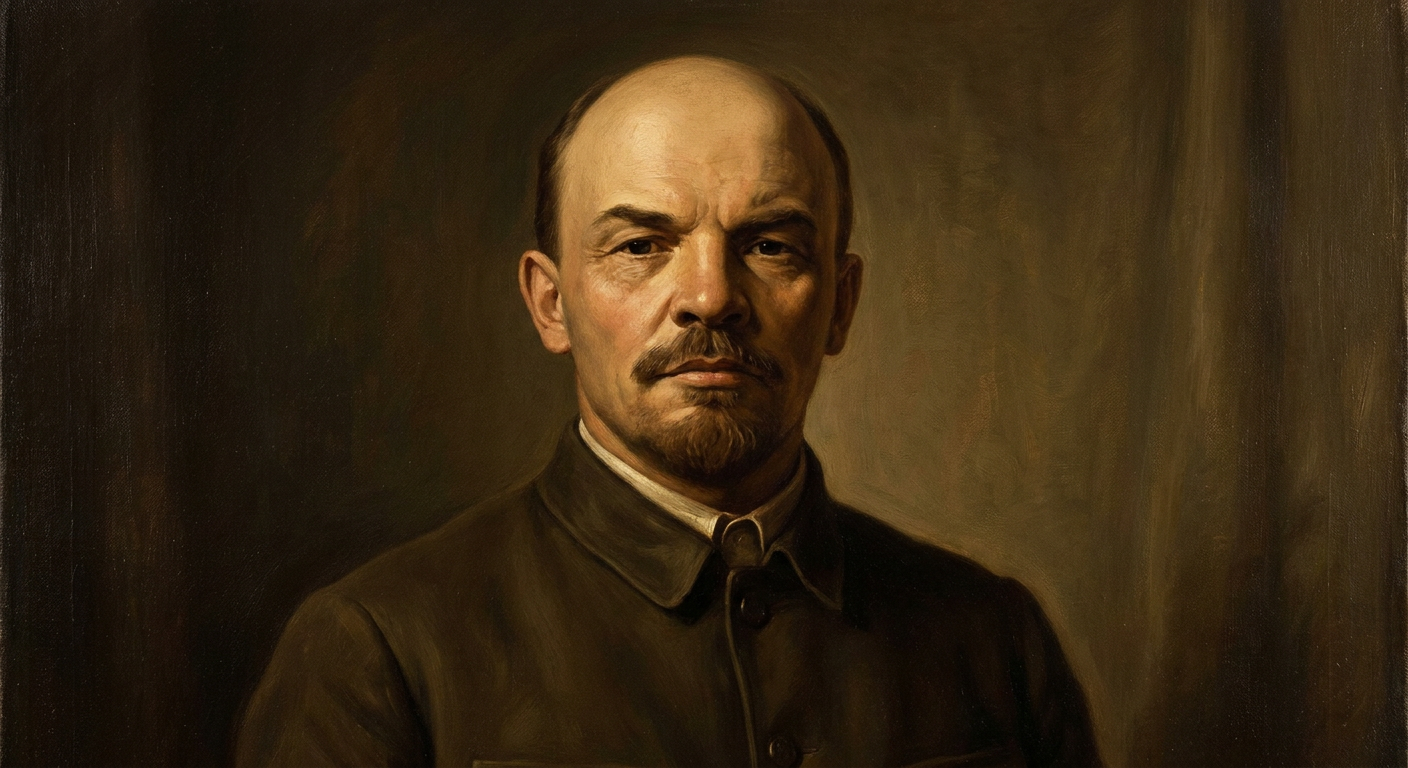
Quick Facts
- Years
- 1870 – 1924
- Category
- World Leaders & Revolutionaries
- Nationality
- Russian
- Occupation
- Revolutionary, political theorist, and head of government
Vladimir Lenin
1870 – 1924 · Russian · Revolutionary, political theorist, and head of government
Recommended Audiobooks
Listen next from Marcus Alden

Life Lessons from Simon Bolivar
Marcus Alden · 55 min

Life Lessons from George Washington
Marcus Alden · 54 min
Vladimir Lenin was the revolutionary strategist who led the Bolsheviks to power in Russia and helped create the world’s first durable communist state. Born into an educated provincial family, he became radicalized after the execution of his elder brother and devoted most of his adult life to overthrowing the Russian imperial system. In October 1917, amid war, hunger, and political collapse, Lenin’s party seized control of the capital and began a transformation that reshaped the twentieth century.
To supporters, Lenin was a disciplined thinker who promised workers and peasants an escape from exploitation, aristocratic privilege, and war. To critics, he destroyed Russia’s brief experiment with pluralist democracy and established institutions of dictatorship, censorship, political policing, and coercion that later expanded under Joseph Stalin. Both interpretations reflect important parts of the historical record.
Lenin’s government withdrew Russia from the First World War, redistributed landed estates, survived a devastating civil war, founded the Communist International, and laid the institutional foundations of the Soviet Union. His writings influenced revolutions and independence movements across the world. Yet his rule was also marked by terror, famine, repression, and the concentration of power in one party. Lenin remains essential to understanding communism, modern revolution, and the dangerous relationship between idealistic goals and coercive political methods.
Quick Facts
| Field | Details |
|---|---|
| Full Name | Vladimir Ilyich Ulyanov |
| Common Name(s) | Vladimir Lenin; V. I. Lenin |
| Born | 22 April 1870 |
| Died | 21 January 1924 |
| Age at Death | 53 |
| Birthplace | Simbirsk, Russian Empire, now Ulyanovsk, Russia |
| Nationality | Russian |
| Occupation | Revolutionary, Marxist theorist, party leader, head of government |
| Historical Era | Late Russian Empire; Russian Revolution; early Soviet period |
| Famous For | Leading the Bolshevik Revolution and founding the Soviet state |
| Political Affiliation | Russian Social Democratic Labour Party; Bolsheviks; Russian Communist Party |
| Religion | Baptized Russian Orthodox; became an atheist and militant critic of religion |
| Education | Studied law independently through Saint Petersburg Imperial University |
| Parents | Ilya Nikolayevich Ulyanov and Maria Alexandrovna Ulyanova |
| Spouse(s) | Nadezhda Krupskaya, married 1898 |
| Children | None |
| Major Works | What Is to Be Done?, Imperialism, the Highest Stage of Capitalism, The State and Revolution |
| Major Achievements | Bolshevik seizure of power; Soviet government; withdrawal from World War I; New Economic Policy; role in creating the USSR |
Early Life
Vladimir Ulyanov was born in Simbirsk, a town on the Volga River. His father, Ilya, rose from a modest background to become a senior official responsible for public education. His mother, Maria, was well educated and encouraged reading, languages, and music. The family was culturally Russian but had a mixed ancestry typical of the empire’s diverse educated classes.
Vladimir performed exceptionally well at school. His childhood was materially comfortable, although two events transformed the family. His father died in 1886. The following year, Vladimir’s elder brother Alexander was executed for participating in a plot to assassinate Emperor Alexander III.
Alexander’s death did not instantly turn Vladimir into the mature Marxist he later became, but it intensified his hostility to autocracy. Lenin eventually rejected individual terrorism—the assassination of officials by small conspiratorial groups—as ineffective. He came to believe that revolution required political theory, organization, and a mass social base.
In 1887, Kazan Imperial University expelled him after he joined a student protest. Authorities placed him under police supervision. He continued studying independently, encountered the works of Karl Marx and Russian revolutionary writers, and qualified in law through examinations at Saint Petersburg Imperial University in 1891.
Lenin briefly practiced law in Samara, often handling minor cases. More importantly, he joined Marxist discussion circles. Russia was industrializing rapidly, creating concentrated communities of factory workers while leaving most people in impoverished villages. Lenin concluded that these tensions could produce a socialist revolution, although orthodox Marxists usually expected industrial capitalism to develop much further first.
Rise to Prominence
Lenin moved to Saint Petersburg in 1893 and became active among Marxist organizers. He helped establish the League of Struggle for the Emancipation of the Working Class, which connected socialist arguments with workers’ economic demands. Police arrested him in 1895. After imprisonment, he was exiled for three years to Shushenskoye in Siberia.
Nadezhda Krupskaya, a fellow Marxist organizer, joined him there, and they married in 1898. Their partnership was both personal and political: Krupskaya handled correspondence, organization, publications, and contacts throughout Lenin’s career.
After exile, Lenin spent many years abroad. He helped produce Iskra—“The Spark”—a newspaper designed to unite scattered Russian Marxists. He adopted “Lenin” as one of several underground names; the precise reason for that choice remains uncertain.
At the Russian Social Democratic Labour Party’s 1903 congress, the movement divided. Lenin’s faction became known as the Bolsheviks, from a word meaning “majority,” while Julius Martov’s opponents became the Mensheviks, or “minority.” These labels originated in a temporary congress vote and did not consistently reflect actual numbers.
Lenin favored a tightly organized party of committed revolutionaries. The Mensheviks generally envisioned a broader membership and expected Russia to pass through a prolonged liberal-capitalist phase before socialism. The disagreement became a lasting political split.
During the Revolution of 1905, Lenin returned to Russia but failed to gain decisive influence. After the uprising’s defeat, he again lived abroad. He wrote extensively, fought internal party rivals, raised funds, and defended Bolshevik independence. His uncompromising manner won devoted followers while alienating many fellow socialists.
The First World War created Lenin’s great opportunity. He denounced the conflict as a struggle among empires and called for soldiers to turn imperial war into revolution. Most European socialist parties supported their national governments, leaving Lenin initially isolated—but Russia’s military and economic collapse soon made his position more relevant.
Major Achievements
Turning the 1917 crisis into a socialist revolution
The February Revolution of 1917 overthrew Emperor Nicholas II and created a Provisional Government alongside workers’ and soldiers’ councils, known as soviets. Germany permitted Lenin and other exiles to cross its territory in a sealed railway arrangement, hoping they would weaken Russia’s war effort. This does not prove Lenin was a German agent, although Germany did assist his return for strategic reasons.
Arriving in Petrograd in April, Lenin demanded “peace, land, and bread” and “all power to the soviets.” He rejected cooperation with the Provisional Government. His April Theses redirected the Bolsheviks toward an immediate struggle for power.
In October, the Bolsheviks organized an armed takeover of key points in Petrograd and displaced the government. The event involved relatively limited fighting in the capital, but it initiated a much larger national conflict. Lenin’s ability to recognize the government’s weakness and press his hesitant colleagues to act was central to the outcome.
Establishing a new government
Lenin became chairman of the Council of People’s Commissars. His government issued decrees endorsing land redistribution and workers’ control, proclaimed national self-determination in principle, and began dismantling the legal and social structures of the empire.
When elections produced a Constituent Assembly in which the Bolsheviks lacked a majority, the government dissolved it in January 1918. Lenin argued that soviet government represented a higher form of democracy. Opponents saw the closure as the decisive destruction of democratic choice.
Leaving the First World War
The Treaty of Brest-Litovsk, signed with Germany in March 1918, removed Russia from the war at enormous territorial cost. Many Bolsheviks opposed it, but Lenin insisted that the exhausted revolutionary government needed time to survive. Germany’s defeat later nullified much of the settlement.
Surviving the Russian Civil War
From 1918 to 1921, the Red Army fought anti-Bolshevik White forces, nationalist movements, peasant armies, and foreign interventions. Leon Trotsky organized the Red Army, while Lenin maintained political direction from Moscow.
Victory preserved Bolshevik rule and enabled Moscow to recover much of the former empire. It also militarized political life. Both Red and White forces committed atrocities, but the Soviet government deliberately institutionalized political terror through the Cheka secret police, executions, hostage-taking, and prison camps.
Introducing the New Economic Policy
Civil war policies, forced grain seizures, economic breakdown, and drought contributed to catastrophe. After peasant uprisings and the Kronstadt sailors’ rebellion, Lenin introduced the New Economic Policy in 1921. It restored limited private trade and replaced many grain requisitions with a tax.
The retreat offended communist purists but helped revive markets and agricultural production. It demonstrated Lenin’s tactical flexibility: he was willing to compromise economically to preserve one-party political control.
Helping found the Soviet Union
The Union of Soviet Socialist Republics was formally created in December 1922. Lenin opposed Stalin’s preference for absorbing non-Russian republics directly into Russia and supported a federal structure, at least formally. In practice, power remained highly centralized in the Communist Party.
Leadership or Work
Lenin led through argument, publication, organization, and relentless attention to tactics. He read widely, wrote quickly, and treated political disputes as contests with immediate practical consequences. He could reverse policy when survival demanded it, as shown by Brest-Litovsk and the New Economic Policy.
His strengths included strategic focus, clarity of purpose, organizational discipline, and an ability to exploit rapidly changing circumstances. His weaknesses were equally consequential. He was intolerant of organized dissent, reduced opponents to political enemies, and accepted coercion as a legitimate instrument of transformation.
Lenin relied on capable colleagues, including Trotsky, Yakov Sverdlov, Grigory Zinoviev, Lev Kamenev, Nikolai Bukharin, and Stalin. Yet Bolshevik leadership was never free of conflict. Lenin often used sharp personal attacks, and his insistence on unity increasingly meant obedience to party decisions.
Personal Life
Lenin and Krupskaya had no children. Their marriage rested heavily on shared revolutionary work. Inessa Armand, a French-Russian socialist, was also emotionally close to Lenin. Many historians believe they probably had an intimate relationship, but surviving evidence does not settle every detail.
Away from politics, Lenin enjoyed walking, cycling, swimming, chess, and mountain excursions. He appreciated classical literature and music, especially Beethoven, though recollections about music making him “soft” should be treated cautiously because they come through later testimony.
He lived comparatively simply by the standards of rulers, but this did not remove the privileges and protection attached to high office. An assassination attempt by Fanny Kaplan in August 1918 left him seriously wounded. Beginning in 1922, he suffered several strokes, losing speech and mobility. Scholars have debated the precise underlying illness; vascular disease is well established, while additional diagnoses remain uncertain.
Philosophy or Beliefs
Lenin adapted Marxism to an empire with a small industrial working class and a vast peasantry. He argued that workers needed a disciplined revolutionary party to develop political consciousness and defeat a centralized state. This idea became known as the vanguard party.
In Imperialism, the Highest Stage of Capitalism, he argued that advanced capitalist powers exported capital, divided the world, and used imperial profits to stabilize themselves. The theory influenced anticolonial activists, although economists dispute parts of its analysis.
Lenin regarded the state as an instrument of class domination. In The State and Revolution, he predicted that a workers’ state would suppress the former ruling class before the state eventually withered away. Under his actual government, however, state power expanded dramatically.
He was an atheist and viewed organized religion as connected to exploitation and political passivity. Soviet policy separated church and state but also confiscated church property and persecuted clergy, especially during moments of crisis.
Lenin’s ethics were revolutionary rather than liberal: he judged institutions largely by whether they advanced or obstructed class revolution. That outlook encouraged determination and sacrifice, but it also made civil liberties and legal restraints subordinate to political objectives.
Challenges and Controversies
The greatest controversy is whether Lenin’s dictatorship was an emergency response to civil war or a central feature of Bolshevik ideology. Supporters emphasize invasion, economic collapse, assassination attempts, and violent opposition. Critics note that censorship, the Cheka, dissolution of the Constituent Assembly, and attacks on rival socialists began early and were justified in principle, not merely as temporary wartime measures.
The Red Terror of 1918 involved mass arrests and executions of alleged counterrevolutionaries, clergy, former elites, and hostages. Exact totals remain debated because records are incomplete, but the policy itself is not in doubt. Lenin endorsed terror in official communications.
War Communism centralized production and requisitioned grain from peasants. Historians debate whether it was mainly an improvised response to civil war or also an attempt to leap directly toward socialism. Its consequences included black markets, resistance, industrial collapse, and severe rural hardship.
The famine of 1921–22 killed millions. Drought was important, but war, requisitioning, transport breakdown, and earlier economic policies greatly worsened vulnerability. The government eventually accepted foreign relief, notably from the American Relief Administration, while also using the crisis to seize church valuables.
The crushing of the Kronstadt rebellion in 1921 remains especially symbolic because the naval base had once supported the revolution. Rebels demanded freer soviet elections and reduced Bolshevik control. The government portrayed the revolt as a counterrevolutionary threat; later critics regarded its suppression as proof that independent worker power was no longer tolerated.
Lenin also approved restrictions on factions inside the Communist Party. Intended to preserve unity, the 1921 ban on factions later gave Stalin a powerful tool against rivals. Scholars disagree over how directly Leninism led to Stalinism. Stalin transformed repression in scale and personal concentration, but he inherited a one-party state, political police, censorship, and coercive economic practices established under Lenin.
Legacy
Lenin’s most immediate legacy was the Soviet Union, which became an industrial and military superpower, defeated Nazi Germany at immense cost, competed with the United States in the Cold War, and supported communist and anticolonial movements worldwide.
Communist parties treated Lenin’s writings as authoritative, often combining them with Marx’s ideas under the label Marxism-Leninism. Mao Zedong, Ho Chi Minh, Fidel Castro, and many others adapted Leninist organization to different societies. Critics likewise studied Lenin as a warning about revolutionary absolutism and one-party rule.
His preserved body remains displayed in a mausoleum on Moscow’s Red Square. Statues and place names spread across the Soviet bloc; many were removed after 1989 and the Soviet collapse in 1991. His birthplace, renamed Ulyanovsk, retains memorial institutions. Debates over burial, monuments, and historical responsibility continue in Russia and other former Soviet lands.
Interesting Facts
- “Lenin” was a pseudonym; his birth surname was Ulyanov.
- He graduated first in his secondary-school class.
- Alexander Kerensky’s father was the headmaster of Lenin’s school.
- Lenin qualified in law without completing a normal residential university course.
- He spent three years in Siberian exile.
- He played chess enthusiastically.
- Iskra means “The Spark.”
- “Bolshevik” originally referred to a temporary majority at the 1903 congress.
- Lenin was not in Russia when the February Revolution began.
- Germany facilitated his 1917 journey across German territory.
- He initially had to persuade reluctant Bolsheviks to support an October uprising.
- The Soviet capital moved from Petrograd to Moscow in 1918.
- He survived a 1918 assassination attempt.
- Lenin supported monumental propaganda as a form of public education.
- He opposed Stalin’s plan simply to absorb Soviet republics into Russia.
- His final illness largely removed him from politics before his death.
- Petrograd was renamed Leningrad after his death and Saint Petersburg in 1991.
- His brain was studied after death in an unsuccessful effort to identify physical signs of genius.
Famous Quotes
- “Without revolutionary theory there can be no revolutionary movement.” — What Is to Be Done? (1902). Lenin meant that spontaneous protest required an organized political understanding.
- “Give us an organization of revolutionaries, and we will overturn Russia!” — What Is to Be Done? This expressed his confidence in disciplined organization.
- “All power to the Soviets!” — The central Bolshevik slogan of 1917, strongly championed by Lenin, though best understood as a movement slogan rather than a uniquely coined personal remark.
- “Peace, bread, land.” — A documented Bolshevik formulation closely associated with Lenin’s 1917 program; wording often appears as “Peace, Land, and Bread.”
- “Communism is Soviet power plus the electrification of the whole country.” — Speech to the Eighth Congress of Soviets, 1920. It linked political transformation with modernization.
- “Better fewer, but better.” — Title of Lenin’s 1923 article calling for higher standards in a bureaucracy he considered inefficient.
- “We are not utopians.” — The State and Revolution (1917). Lenin argued that revolutionary government had to address practical authority, not merely imagine an ideal society.
- “Who—whom?” — A compressed formula used by Lenin in discussing which class would defeat and dominate the other during the New Economic Policy.
- “Every cook must learn to govern the state.” — Commonly presented as “Every cook can govern.” Lenin’s actual 1917 argument was that ordinary workers should be trained for administration, not that governing required no skill.
- “There are decades where nothing happens; and there are weeks where decades happen.” — Frequently attributed to Lenin, but researchers have not established a reliable primary source. It should not be treated as authenticated.
Timeline
- 1870 — Born in Simbirsk on 22 April.
- 1886 — His father dies.
- 1887 — His brother Alexander is executed; Lenin is expelled from Kazan University.
- 1891 — Qualifies in law.
- 1893 — Moves to Saint Petersburg and joins Marxist circles.
- 1895 — Arrested for revolutionary activity.
- 1897 — Sent into Siberian exile.
- 1898 — Marries Nadezhda Krupskaya.
- 1900 — Leaves exile and helps establish Iskra.
- 1902 — Publishes What Is to Be Done?
- 1903 — Bolshevik–Menshevik split emerges.
- 1905 — Returns during the first Russian Revolution.
- 1912 — Bolsheviks consolidate as a separate party organization.
- 1914 — Opposes World War I.
- April 1917 — Returns to Petrograd and presents the April Theses.
- October 1917 — Bolsheviks overthrow the Provisional Government.
- 1918 — Dissolves the Constituent Assembly; signs Brest-Litovsk; survives assassination attempt; Red Terror begins.
- 1918–1921 — Bolsheviks win the main phase of the civil war.
- 1919 — Helps establish the Communist International.
- 1921 — Kronstadt rebellion suppressed; New Economic Policy introduced; party factions banned.
- 1922 — Suffers strokes; Soviet Union is formally founded.
- 1923 — Dictates final articles and political notes while increasingly incapacitated.
- 1924 — Dies at Gorki on 21 January.
Frequently Asked Questions
1. What was Lenin’s real name?
Lenin was born Vladimir Ilyich Ulyanov. Like many underground revolutionaries, he used aliases to evade police surveillance and separate legal identity from clandestine work. “Lenin” became his best-known name around the beginning of the twentieth century. Historians have proposed several explanations for its origin, including a possible connection to the Lena River, but no explanation is conclusively established.
2. Why did Lenin become a revolutionary?
His brother’s execution profoundly affected him, but it was not the sole cause. Lenin also encountered censorship, police surveillance, social inequality, peasant poverty, and the political exclusion characteristic of imperial Russia. Through intensive reading, he adopted Marxism because it appeared to offer both an explanation of these conditions and a strategy for replacing them through organized class revolution.
3. Was Lenin from a poor family?
No. His family belonged to the educated provincial middle class and enjoyed considerable security. His father was a respected education official who acquired hereditary nobility through state service. Lenin’s revolutionary politics therefore did not arise from personal destitution. His background gave him access to books, languages, schooling, and the time required for intellectual development.
4. What was the difference between Bolsheviks and Mensheviks?
Both originated within Russian Marxism. Lenin’s Bolsheviks emphasized centralized discipline and a committed revolutionary organization. Mensheviks generally favored a broader party and expected cooperation with liberal forces during a longer capitalist-democratic stage. These positions changed over time, and neither side was completely uniform, but the dispute shaped socialist politics before and during 1917.
5. Did Germany send Lenin to Russia?
Germany allowed Lenin and other exiles to cross German territory in 1917 because German leaders hoped revolution would force Russia from the war. The journey occurred under a special arrangement often called the “sealed train.” German assistance is established, but the claim that Lenin was simply a controlled German agent goes beyond the evidence; his aims were independently revolutionary.
6. Did Lenin personally lead the storming of the Winter Palace?
No. Lenin pressed the Bolshevik leadership to seize power and secretly entered Petrograd, but he did not personally command troops at the Winter Palace. The Military Revolutionary Committee, with Trotsky playing a leading role, coordinated operations. Later Soviet art exaggerated the scale and drama of the palace assault, which encountered less resistance than famous reenactments suggested.
7. Why did Lenin dissolve the Constituent Assembly?
The Bolsheviks lost the national election to the Socialist Revolutionaries, whose support was strongest among peasants. Lenin argued that the electoral lists were outdated and that soviets represented a more advanced form of class democracy. Critics answered that dissolving the assembly revealed the Bolsheviks’ refusal to accept electoral defeat. It became a foundational moment in one-party rule.
8. Why did Lenin sign the Treaty of Brest-Litovsk?
Russia’s army was disintegrating, and the Bolshevik government could not withstand a renewed German offensive. Lenin accepted severe territorial losses because he believed peace was necessary to save the revolution. Several colleagues preferred revolutionary war. Lenin prevailed, and Germany’s later defeat cancelled much of the treaty, making his gamble successful in the short term.
9. What was the Red Terror?
The Red Terror was a campaign of arrests, executions, hostage-taking, and repression conducted chiefly by the Cheka during the civil war. It intensified after attacks on Bolshevik leaders in 1918. Lenin and his government defended terror as necessary against counterrevolution. Historians debate death totals, but there is broad agreement that violence was systematic and officially authorized.
10. Was Lenin responsible for the Russian famine?
No single person or cause explains the famine of 1921–22. Drought, years of world war and civil war, transport collapse, livestock losses, and epidemic disease all mattered. However, Bolshevik grain requisitioning and economic policies worsened rural vulnerability and discouraged production. Lenin’s government therefore bears significant responsibility, although saying it deliberately created the entire famine would oversimplify the evidence.
11. What was the New Economic Policy?
The New Economic Policy, introduced in 1921, permitted small private businesses, market exchange, and peasant sale of surplus produce while the state retained major industry, banking, and foreign trade. Lenin described it as a strategic retreat. It helped economic recovery after civil war, but it also produced new inequalities and arguments over socialism’s future.
12. Did Lenin create the Soviet Union?
Lenin was a principal founder of the Soviet political system and strongly influenced the union settlement of 1922. He supported a formal federation of republics rather than Stalin’s proposal for direct incorporation into the Russian republic. Nevertheless, the Communist Party governed centrally, so constitutional federalism offered much less autonomy in practice than it appeared to provide.
13. What did Lenin think of Stalin?
Lenin valued Stalin as an organizer and appointed him to important posts. During Lenin’s final illness, however, their relationship deteriorated over bureaucratic power, nationality policy, and Stalin’s rude treatment of Krupskaya. In notes often called Lenin’s Testament, Lenin warned that Stalin was too coarse and suggested considering his removal as general secretary.
14. Did Lenin intend Stalin’s dictatorship?
There is no evidence that Lenin planned Stalin’s personal dictatorship or the mass purges of the 1930s. He criticized Stalin near the end of his life. Yet Lenin had already helped construct a one-party state with censorship, secret police, factional restrictions, and political terror. Historians therefore debate whether Stalinism was a sharp break, an extension, or both.
15. Why is Lenin’s body still displayed?
After Lenin’s death, Soviet leaders embalmed his body and placed it in a mausoleum on Red Square, turning him into a permanent symbol of the regime. Krupskaya reportedly opposed excessive personal glorification. The mausoleum remains open, although Russians continue debating whether Lenin should be buried and how the revolutionary past should be commemorated.
Lessons We Can Learn
- Organization can change history. Lenin’s small but disciplined movement gained power during state collapse; modern readers can see how preparation magnifies opportunity.
- Timing matters. His April and October decisions show the value—and danger—of recognizing when institutions are weak.
- Simple messages mobilize. “Peace, Land, and Bread” connected ideology to urgent needs without explaining every policy consequence.
- Tactical flexibility can preserve strategy. Brest-Litovsk and the NEP were retreats undertaken to protect Bolshevik rule.
- Emergency powers rarely remain temporary. Civil-war measures helped normalize censorship, police power, and political exclusion.
- Ends do not erase means. Lenin’s egalitarian goals must be evaluated alongside terror and suppression; this is a modern ethical inference grounded in documented policies.
- Destroying accountability creates succession risks. Restrictions on opposition left few peaceful checks on later leaders.
- Theory must face reality. The gap between The State and Revolution and the expanding Soviet state shows how practice can contradict expectation.
- Economic incentives matter. The NEP acknowledged that coercive requisitioning had damaged production and political support.
- Legacies escape their creators. Lenin influenced systems and movements he could neither supervise nor fully predict.
Related Historical Figures
- Karl Marx — Lenin adapted Marx’s analysis into a theory of revolutionary party leadership.
- Friedrich Engels — Co-founder of Marxism and a major source for Lenin’s political thought.
- Nadezhda Krupskaya — Lenin’s wife, collaborator, and important Bolshevik organizer.
- Alexander Ulyanov — Lenin’s executed brother, whose fate shaped his early political development.
- Julius Martov — Former colleague and leading Menshevik opponent.
- Leon Trotsky — Key organizer of the October Revolution and Red Army.
- Joseph Stalin — Bolshevik official who succeeded in dominating the Soviet system after Lenin.
- Nicholas II — The last Russian emperor, overthrown before Lenin took power.
- Alexander Kerensky — Head of the Provisional Government displaced by the Bolsheviks.
- Mao Zedong — Chinese revolutionary who adapted Leninist organization to peasant-based revolution.
Watch and Learn
“History vs. Vladimir Lenin” — TED-Ed — approximately 6 minutes
This animated educational debate introduces the central arguments surrounding Lenin’s leadership, including revolution, political repression, and historical responsibility. It is recommended as a concise starting point rather than a substitute for deeper study because its courtroom format clearly distinguishes competing interpretations.
Watch and Learn
History vs. Vladimir Lenin · TED-Ed
Related Historical Figures