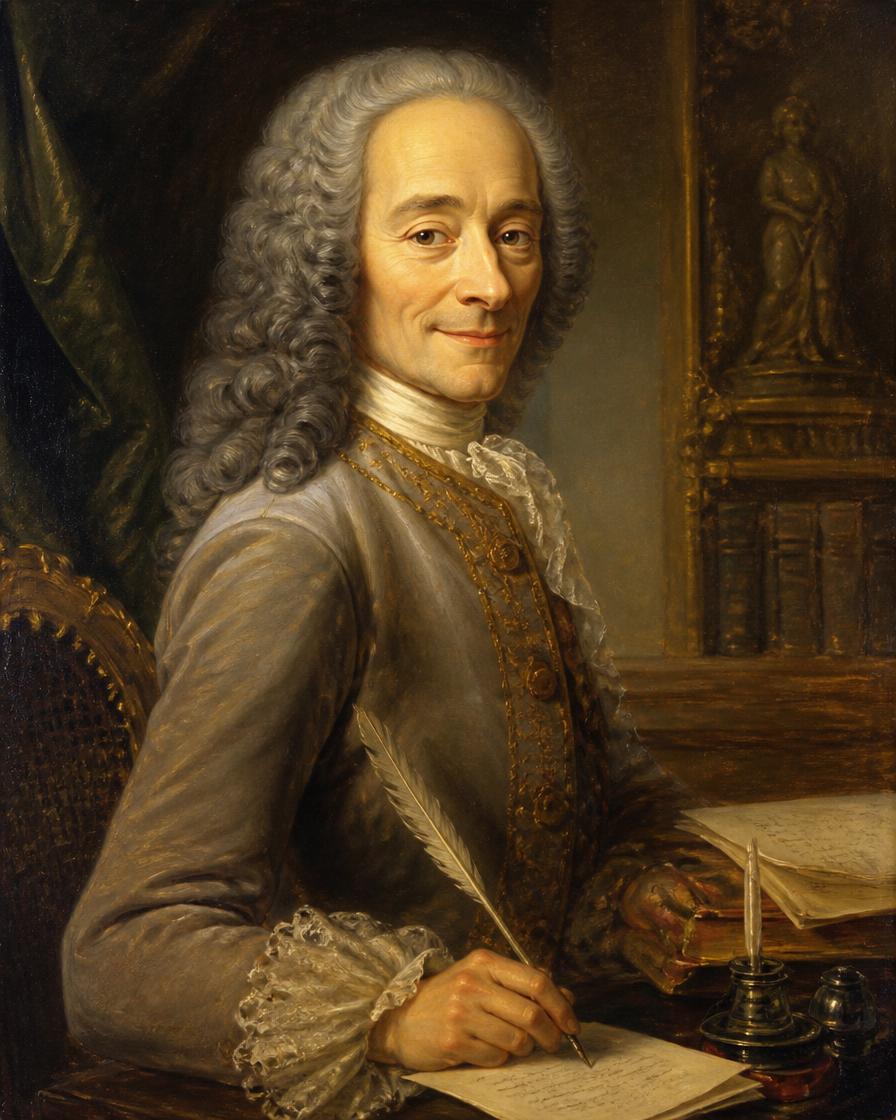
Quick Facts
- Years
- 1694 – 1778
- Category
- Philosophers & Thinkers
- Subcategory
- Enlightenment
- Nationality
- French
- Occupation
- Writer, Philosopher & Satirist
Voltaire
1694 – 1778 · French · Writer, Philosopher & Satirist
Audiobook

Life Lessons from Voltaire
Marcus Alden · 39 min
Introduction
Voltaire was the pen name of François-Marie Arouet (21 November 1694–30 May 1778), one of the most influential writers and public intellectuals of the European Enlightenment. A poet, playwright, historian, philosopher, satirist and campaigner against injustice, he became famous for the brilliance of his prose, the sharpness of his wit and his relentless criticism of fanaticism, censorship and arbitrary power.
Voltaire lived during an age in which European monarchies claimed extensive authority, established churches exercised immense cultural influence and writers could be imprisoned or exiled for offending powerful people. He did not advocate democracy in the modern sense, nor was he an egalitarian by contemporary standards. Nevertheless, his defense of religious toleration, civil justice, freedom of inquiry and intellectual independence helped transform European political and cultural debate.
Over a career spanning more than six decades, Voltaire produced plays, poems, histories, essays, letters, scientific commentaries and philosophical tales. His best-known work, Candide, or Optimism (1759), uses comedy, violence and absurdity to attack complacent philosophical explanations of suffering. His Letters Concerning the English Nation—better known as the Philosophical Letters—praised English religious pluralism, commerce and constitutional government in ways that implicitly criticized France. His historical writings helped broaden the study of the past beyond kings and battles to include commerce, customs, ideas and civilization.
Voltaire’s interventions in judicial controversies, especially the case of Jean Calas, established him as a model of the writer acting on behalf of persecuted individuals. From his estate at Ferney near Geneva, he conducted an enormous correspondence, welcomed visitors and influenced opinion across Europe. Admirers called him the “patriarch of Ferney.”
His record, however, was not uniformly progressive. His writings contain offensive stereotypes about Jews, Muslims, Africans and other peoples, and he sometimes adopted arguments that reinforced racial hierarchy. He was capable of vicious personal attacks, and his relationships with rulers were marked by both idealism and self-interest. Understanding Voltaire therefore requires holding together his extraordinary defense of toleration and justice with the prejudices, ambitions and contradictions of an eighteenth-century European intellectual.
Quick Facts
| Category | Details |
|---|---|
| Full name | François-Marie Arouet |
| Pen name | Voltaire |
| Born | 21 November 1694 |
| Birthplace | Paris, Kingdom of France |
| Died | 30 May 1778 |
| Place of death | Paris, Kingdom of France |
| Age at death | 83 |
| Nationality | French |
| Occupations | Writer, poet, playwright, historian, philosopher and public campaigner |
| Intellectual movement | The Enlightenment |
| Education | Collège Louis-le-Grand, Paris |
| Parents | François Arouet and Marie-Marguerite Daumard |
| Long-term companion | Émilie du Châtelet |
| Notable works | Philosophical Letters, Zadig, Micromégas, Candide, Treatise on Tolerance, Philosophical Dictionary |
| Central concerns | Religious toleration, civil justice, reason, freedom of inquiry and criticism of fanaticism |
| Famous residence | Ferney, near Geneva |
| Burial place | Panthéon, Paris |
Early Life & Background
François-Marie Arouet was born in Paris on 21 November 1694 and baptized the following day. He was the youngest surviving child of François Arouet, a prosperous notary who later held a financial office, and Marie-Marguerite Daumard, who came from a family with connections to the minor nobility. His mother died in 1701, when he was six. The relative comfort of his family gave him access to elite education, although his later career repeatedly placed him in conflict with the social and political order from which he emerged.
From 1704 to 1711, Arouet attended the Jesuit Collège Louis-le-Grand in Paris. The school offered rigorous training in Latin, rhetoric, literature, theater and classical history. Although Voltaire later attacked clerical intolerance and organized religion, he retained respect for the intellectual discipline of some of his Jesuit teachers. His education also cultivated the polished style, command of classical references and enthusiasm for drama that shaped his career.
His father wanted him to study law and enter a respectable profession. Arouet instead moved within aristocratic and literary circles, composing witty verses and developing a reputation for irreverence. In 1713 he briefly served as secretary to the French ambassador in The Hague. The position ended after he became involved with a young French Protestant woman, Catherine Olympe Dunoyer, known as “Pimpette.” His father intervened and had him returned to France.
Arouet’s satirical verses soon attracted official attention. In May 1717 he was imprisoned in the Bastille, probably because authorities believed he had written poems insulting the regent, Philippe II, Duke of Orléans. During nearly eleven months in prison, he worked on an epic poem about Henry IV and completed much of his first successful tragedy, Œdipe. He was released in April 1718.
Around this period he adopted the name Voltaire. Its precise origin remains uncertain. It may be an anagrammatic transformation of “Arouet le jeune”—Arouet the younger—using Latinized spelling conventions, though scholars have proposed other explanations. Whatever its derivation, the new name represented a deliberate literary identity, distancing the ambitious author from his family and allowing him to fashion himself as an independent man of letters.
Rise to Prominence
Voltaire’s tragedy Œdipe premiered at the Comédie-Française on 18 November 1718. It was a major success and established him as an important dramatist. His epic poem La Henriade, centered on Henry IV of France and the religious conflicts of the sixteenth century, further strengthened his reputation. The poem celebrated a monarch associated with political reconciliation and religious toleration, themes that would remain central to Voltaire’s work.
Literary success did not protect him from the privileges of rank. In 1725 Voltaire quarreled with Guy-Auguste de Rohan-Chabot, a member of one of France’s most powerful noble families. Rohan reportedly mocked Voltaire’s adopted name, and Voltaire answered with characteristic sharpness. Rohan’s servants later had him beaten. When Voltaire sought satisfaction and prepared to fight a duel, the Rohan family used its influence to have him confined in the Bastille without trial.
To secure his release, Voltaire agreed to leave France. He went to England in 1726 and remained there until 1729. The exile became one of the decisive periods of his intellectual development. He encountered a society with a limited constitutional monarchy, an influential Parliament, an active commercial culture and a greater degree of religious pluralism than Bourbon France. He studied the works of John Locke, admired the scientific achievements of Isaac Newton and observed the coexistence of Anglicans, dissenting Protestants, Quakers and other communities.
Voltaire also cultivated English literary figures, including Alexander Pope, Jonathan Swift and William Congreve. His Essay upon the Epick Poetry appeared in English in 1727, while an English version of La Henriade was published in 1728.
After returning to France, Voltaire transformed his English experience into the Letters Concerning the English Nation. An English edition appeared in 1733, and the French Lettres philosophiques followed in 1734. The book discussed Quakers, Parliament, commerce, inoculation, Newton, Locke and English literature. Its praise of English institutions implicitly exposed the restrictions of French society. French authorities condemned the work; copies were publicly burned, and a warrant was issued for Voltaire’s arrest.
He escaped Paris and took refuge at Cirey, a château in Champagne belonging to the family of Gabrielle Émilie Le Tonnelier de Breteuil, marquise du Châtelet. This retreat began one of the most intellectually productive partnerships of the eighteenth century.
Major Achievements
Voltaire’s achievement rests partly on the extraordinary range and volume of his writing. The standard scholarly edition of his complete works extends to more than 200 volumes. His surviving correspondence alone includes thousands of letters addressed to monarchs, ministers, scientists, writers, clergy, merchants and private citizens.
As a dramatist, he wrote more than fifty plays. Although most are rarely performed today, tragedies such as Zaïre (1732), Alzire (1736), Mahomet (1741) and Mérope (1743) were important in eighteenth-century theater. They used historical or exotic settings to examine religious conflict, political authority, love and moral responsibility.
Voltaire also played a major role in spreading Newtonian science in continental Europe. At Cirey, he and Émilie du Châtelet studied mathematics, physics and natural philosophy. His Elements of the Philosophy of Newton (1738) explained Newton’s ideas to an educated general audience. Du Châtelet’s deeper mathematical expertise was indispensable to their shared intellectual world; she later produced the first complete French translation of Newton’s Principia, published posthumously in 1759.
His historical works challenged conventional chronicles. The History of Charles XII (1731) examined the dramatic career of the Swedish king. The Age of Louis XIV (1751) presented seventeenth-century France as an era of cultural and institutional development rather than merely a sequence of military campaigns. The Essay on the Manners and Spirit of Nations (1756) attempted a broad history of civilization, giving significant attention to Asia and to cultural, religious and economic change. Although burdened by inaccuracies and European prejudices, it helped expand the scope of historical writing.
Voltaire perfected the philosophical tale, a short fictional form combining fantasy, satire and intellectual argument. Zadig (1747), Micromégas (1752) and Candide (1759) exposed human vanity, dogmatism and cruelty. In Candide, the protagonist travels through war, religious persecution, natural disaster, enslavement and exploitation while his tutor Pangloss insists that everything is for the best. The tale attacks simplistic optimism, especially the misuse of philosophical systems to explain away real suffering.
His Treatise on Tolerance (1763), inspired by the Calas affair, argued against religious fanaticism and judicial persecution. The portable, alphabetically organized Philosophical Dictionary (1764) offered provocative essays on religion, politics, history and morality. Because such books were censored, they often circulated anonymously or through publishers outside France.
Defining Moments
Voltaire’s partnership with Émilie du Châtelet was both romantic and intellectual. From 1734, Cirey became a laboratory, library and meeting place. The pair conducted experiments, studied philosophy and revised each other’s writings. Their relationship helped Voltaire move beyond literary celebrity toward serious engagement with science and metaphysics.
Du Châtelet died on 10 September 1749 after giving birth to a daughter fathered by the poet Jean François de Saint-Lambert. Voltaire was devastated. Her death ended the most important intimate and scholarly partnership of his life.
In 1750 Voltaire accepted an invitation from Frederick II of Prussia and moved to the royal court at Potsdam. Frederick admired Enlightenment culture and had corresponded with Voltaire for years. Voltaire received honors, a pension and the office of royal chamberlain. Yet the relationship deteriorated. Voltaire’s financial dealings caused controversy, and his attack on Pierre-Louis Moreau de Maupertuis, president of the Berlin Academy of Sciences, embarrassed Frederick. Voltaire left Prussia in 1753 after a bitter break.
He eventually settled near Geneva, first at Les Délices and then, in 1758, at Ferney, just inside France near the Swiss border. Ferney gave him strategic security: if threatened by French authorities, he could move toward Geneva. There he became a wealthy landowner, improved agriculture, encouraged local crafts and supported watchmaking. His household became a destination for European travelers.
The Lisbon earthquake of 1 November 1755, which killed tens of thousands and devastated the city, profoundly affected Voltaire. In his Poem on the Lisbon Disaster and later in Candide, he rejected attempts to treat catastrophe as evidence of a perfectly ordered providential plan.
His most celebrated public campaign began with the case of Jean Calas, a Protestant merchant from Toulouse. Calas’s son Marc-Antoine was found dead in the family home in October 1761. Rumors claimed that the father had murdered him to prevent conversion to Catholicism. Despite weak evidence, Jean Calas was tortured and executed on 10 March 1762. Voltaire investigated, mobilized his network and published appeals on behalf of the family. In 1765 the conviction was overturned and Calas was posthumously rehabilitated.
Voltaire also intervened in the cases of the Sirven family, wrongly accused amid anti-Protestant prejudice, and Jean-François de La Barre, a young nobleman executed in 1766 for alleged acts of impiety. These campaigns made Voltaire an early master of public advocacy through evidence, publicity and coordinated pressure.
Timeline
| Year | Event |
|---|---|
| 1694 | François-Marie Arouet is born in Paris on 21 November. |
| 1701 | His mother, Marie-Marguerite Daumard, dies. |
| 1704 | He begins studying at the Jesuit Collège Louis-le-Grand. |
| 1713 | He serves briefly with the French embassy in The Hague. |
| 1717 | He is imprisoned in the Bastille for satirical writings. |
| 1718 | He is released; Œdipe premieres, and he begins using the name Voltaire. |
| 1723 | An expanded version of La Henriade appears. |
| 1726 | After the Rohan affair and another imprisonment, he leaves for England. |
| 1729 | He returns to France after nearly three years in England. |
| 1731 | The History of Charles XII is published. |
| 1732 | The tragedy Zaïre becomes a theatrical success. |
| 1733 | Letters Concerning the English Nation appears in English. |
| 1734 | The French Philosophical Letters is condemned; Voltaire retreats to Cirey. |
| 1738 | Elements of the Philosophy of Newton is published. |
| 1746 | He is elected to the Académie française. |
| 1747 | Zadig appears in an early form. |
| 1749 | Émilie du Châtelet dies at Lunéville. |
| 1750 | Voltaire joins Frederick II’s court in Prussia. |
| 1751 | The Age of Louis XIV is published. |
| 1753 | His conflict with Frederick II culminates in his departure from Prussia. |
| 1755 | He settles at Les Délices near Geneva; the Lisbon earthquake occurs. |
| 1756 | The Essay on the Manners and Spirit of Nations is published. |
| 1758 | He acquires Ferney near the French-Swiss frontier. |
| 1759 | Candide is published anonymously. |
| 1762 | Jean Calas is executed in Toulouse. |
| 1763 | Voltaire publishes the Treatise on Tolerance. |
| 1764 | The Philosophical Dictionary first appears. |
| 1765 | Jean Calas is posthumously exonerated. |
| 1766 | Jean-François de La Barre is executed for alleged impiety. |
| 1778 | Voltaire returns to Paris, receives a public triumph and dies on 30 May. |
| 1791 | His remains are transferred to the Panthéon during the French Revolution. |
Personal Life
Voltaire never married. His most consequential relationship was with Émilie du Châtelet, who was married to the Marquis Florent-Claude du Châtelet. Their long partnership combined affection, intellectual collaboration and practical alliance. Both also had other relationships, a pattern not unusual in some elite eighteenth-century circles.
After du Châtelet’s death, Voltaire lived for many years with his widowed niece Marie-Louise Denis, born Marie-Louise Mignot. She managed much of his household, accompanied him during difficult travels and served as hostess at Ferney. Their relationship was intimate and, according to surviving evidence, probably sexual for a period, although it also functioned as a durable family and domestic partnership.
Voltaire was skilled at managing money. He invested in government finance, commercial ventures and property, and benefited from an early fortune connected to a poorly designed state lottery. His wealth gave him unusual independence from royal or aristocratic patrons. It also allowed him to maintain large households, support publishing projects, aid protégés and finance campaigns.
At Ferney he acted as a paternalistic estate owner. He rebuilt the local church, developed land, encouraged manufacturing and helped expand the village’s population and prosperity. The inscription associated with his church—“Deo erexit Voltaire,” or “Voltaire erected this to God”—captured both his theatrical ego and his insistence that belief in God need not entail submission to clerical authority.
In February 1778, after an absence of about twenty-eight years, Voltaire returned to Paris for the premiere of his tragedy Irène. Crowds celebrated him, and the Académie française and Comédie-Française honored him publicly. The exhausting visit worsened his health. He died in Paris on 30 May 1778.
Because of his conflicts with the Church, a conventional Parisian burial was uncertain. His nephew, the abbé Mignot, arranged for his body to be taken to the abbey of Scellières in Champagne, where it was buried. In 1791, during the French Revolution, his remains were transferred ceremonially to the Panthéon in Paris.
Beliefs & Philosophy
Voltaire was not an atheist. He was generally a deist, believing that reason and the order of nature supported the existence of a creator while rejecting many doctrines, miracles and institutional claims of revealed religion. He famously criticized both atheism and superstition, though his formulations changed according to context.
His principal enemy was fanaticism: the use of religious certainty to justify persecution, censorship or violence. He attacked the political power of churches, especially the Catholic Church in France, and repeatedly used the phrase “Écrasez l’infâme”—usually understood as “Crush the infamous thing”—against the combination of superstition, intolerance and clerical oppression.
Voltaire’s ideal was not unlimited liberty in every sphere. He admired constitutional checks in Britain and defended freedom of thought, but he often favored enlightened monarchy over popular rule. He hoped that educated rulers such as Frederick II or Catherine II might reform laws, reduce clerical power and promote learning. His experiences with royal patrons demonstrated the limits of this expectation.
He valued commerce as a civilizing force. In the Philosophical Letters, the London stock exchange becomes an image of people from different religions cooperating through mutual interest. Trade, in his view, could weaken sectarian hostility and hereditary prejudice.
His epistemology was shaped by Locke and by suspicion of metaphysical certainty. He preferred observation, probability and practical improvement to elaborate systems claiming to explain the whole universe. The conclusion of Candide—that “we must cultivate our garden”—is often read as an appeal to useful work, limited responsibility and concrete action rather than passive optimism.
Yet Voltaire’s universalism had severe limits. He denounced slavery in notable passages, including the Surinam episode of Candide, but his writings also contain racist speculation and degrading generalizations. Evidence concerning his possible indirect financial exposure to colonial commerce has been debated, but there is no sound basis for portraying him as a consistent abolitionist. His anti-Jewish statements were especially extensive, combining hostility to biblical religion with inherited stereotypes. These elements are essential to any complete evaluation of his thought.
Challenges & Controversies
Censorship shaped Voltaire’s career. He was imprisoned twice in the Bastille, forced into exile and repeatedly threatened by arrest. Many of his books were published anonymously, under false imprints or outside France. He used denial, pseudonyms and private distribution networks to evade prosecution.
His gift for ridicule created numerous enemies. Voltaire often answered criticism with personal abuse and could pursue feuds obsessively. His quarrels with Maupertuis and Frederick II showed how intellectual disagreement, vanity and political dependence could become dangerously entangled.
His religious criticism was similarly complex. He defended Protestants in Catholic France and condemned Christian persecution, yet he often wrote harshly about Judaism and Islam. His tragedy Mahomet used the founder of Islam as a figure through whom to attack manipulation by religious leaders, but it also reinforced misleading European images of Muhammad. Voltaire’s broad comparative approach challenged Christian exclusivity while still reproducing prejudices about non-European peoples.
Questions also surround his attitude to social hierarchy. He opposed arbitrary punishment and inherited privilege when they obstructed justice, but he distrusted the political judgment of the masses. He defended intellectual liberty more consistently than political equality.
His historical scholarship was innovative but uneven. He sought global scope and treated culture and economics as legitimate historical subjects. At the same time, he relied on unreliable reports, generalized about entire civilizations and organized human societies according to assumptions that modern scholars reject.
These contradictions do not erase his campaigns for tolerance, nor should those campaigns be used to excuse his prejudices. They reveal an Enlightenment thinker capable of extending moral criticism beyond many contemporaries while remaining constrained by hierarchy, Eurocentrism and polemical hostility.
Famous Quotes
“We must cultivate our garden.”
— Candide (1759)
“If God did not exist, it would be necessary to invent him.”
— Epistle to the Author of the Book, The Three Impostors (1769)
“Those who can make you believe absurdities can make you commit atrocities.”
— Common translation of a statement in Questions on Miracles (1765)
“The best is the enemy of the good.”
— La Bégueule (1772), expressing a proverb Voltaire helped popularize
“It is dangerous to be right in matters where established men are wrong.”
— Often translated from The Age of Louis XIV
“What is tolerance? It is the consequence of humanity. We are all formed of frailty and error; let us pardon reciprocally each other’s folly.”
— Philosophical Dictionary, article “Tolerance”
“Every man is guilty of all the good he did not do.”
— Commonly attributed to Voltaire, but no secure primary source has been established
The famous sentence “I disapprove of what you say, but I will defend to the death your right to say it” is also frequently attributed to Voltaire. It was actually written by Evelyn Beatrice Hall in The Friends of Voltaire (1906) as a summary of his attitude, not as a verbatim quotation.
Legacy & Influence
Voltaire helped define the modern role of the public intellectual. Through pamphlets, books and letters, he turned individual miscarriages of justice into international causes. His methods—collecting evidence, cultivating influential allies, shaping public opinion and maintaining pressure on authorities—anticipated later human-rights campaigns.
His demand for religious toleration influenced debates across Europe and the Atlantic world. Revolutionary leaders admired his attacks on clerical privilege and arbitrary authority, even though Voltaire himself did not advocate the radical democracy of the French Revolution. His transfer to the Panthéon in 1791 transformed him into a symbol of national enlightenment.
In literature, Candide remains one of the most widely read works of the eighteenth century. Its rapid pacing, deadpan violence and philosophical comedy have influenced satire, political fiction and absurdist literature. Voltaire’s lucid, economical prose became a model of argumentative style.
His historical writing encouraged scholars to study civilization as a whole. By examining trade, ideas, religion, manners and the arts, he contributed to the development of cultural and global history, even where his conclusions were flawed.
Voltaire’s legacy also survives in debates over freedom of expression. He opposed censorship directed by church and state, but the popular image of him as an advocate of absolutely unrestricted speech oversimplifies his views. His real importance lies in his sustained resistance to authorities that punished criticism and enforced religious conformity.
Modern assessments are necessarily mixed. Voltaire was a courageous opponent of torture, fanaticism and judicial murder, yet he was also an elitist whose work contains racism and anti-Jewish prejudice. His life demonstrates that intellectual progress is rarely pure or complete. It also shows how wit, evidence, financial independence and persistent communication can challenge institutions that appear unaccountable.
Interesting Facts
- “Voltaire” was a constructed literary name whose exact origin remains disputed.
- He spent nearly eleven months in the Bastille before achieving his first great theatrical success.
- His stay in England introduced him to Newtonian science, Lockean philosophy and British religious pluralism.
- He and Émilie du Châtelet created an extensive scientific library and laboratory at Cirey.
- Voltaire became wealthy partly through investments and participation in a state lottery whose pricing structure could be exploited mathematically.
- Candide was published anonymously and rapidly circulated across Europe despite censorship.
- Ferney became so closely associated with him that the town was renamed Ferney-Voltaire in 1878.
- He exchanged letters with Frederick II of Prussia and Catherine II of Russia.
- His correspondence includes more than 20,000 surviving letters.
- Voltaire’s body was moved to the Panthéon in 1791, thirteen years after his death.
- He wrote across nearly every major prose and dramatic genre of his age.
- The quotation most often used to symbolize his defense of free speech was written by Evelyn Beatrice Hall more than a century after his death.
Frequently Asked Questions
What was Voltaire’s real name?
Voltaire’s birth name was François-Marie Arouet. He began using “Voltaire” publicly around 1718, although the precise origin of the pen name remains uncertain.
Why was Voltaire important?
Voltaire was important because he used literature, history, satire and public advocacy to challenge religious persecution, censorship, torture and arbitrary justice. He also helped spread Newtonian science and Lockean philosophy in France and broadened the subject matter of historical writing.
Why was Voltaire imprisoned?
He was first imprisoned in the Bastille in 1717 after being suspected of writing satirical verses against the French regent. He was imprisoned again in 1726 following his conflict with the aristocrat Guy-Auguste de Rohan-Chabot. In both cases, royal authority could detain him without an ordinary public trial.
What is Voltaire’s most famous book?
His most famous book is Candide, or Optimism, published anonymously in 1759. The philosophical tale mocks the idea that all events, including terrible suffering, necessarily form part of the best possible world.
Did Voltaire believe in God?
Yes, generally. Voltaire was usually a deist: he believed in a rational creator but rejected many traditional doctrines, miracles and claims of clerical authority. He criticized institutional religion far more consistently than he rejected belief in God.
Did Voltaire support democracy?
Not in the modern sense. He criticized absolutism and admired aspects of Britain’s constitutional system, but he often distrusted popular government. He generally preferred the idea of an educated, reforming monarch advised by philosophers.
What was Voltaire’s relationship with Émilie du Châtelet?
Du Châtelet was Voltaire’s long-term lover, closest intellectual partner and scientific collaborator. At Cirey they studied Newtonian physics, philosophy and mathematics. Her expertise significantly influenced Voltaire’s scientific work.
What did Voltaire do in the Calas affair?
Voltaire investigated the conviction of Jean Calas, publicized weaknesses in the prosecution and organized a European campaign for rehabilitation. Calas, a Protestant, had been executed in 1762 amid religious prejudice. His conviction was annulled in 1765.
Did Voltaire say, “I disapprove of what you say”?
No. Evelyn Beatrice Hall wrote the sentence in 1906 to summarize Voltaire’s principles. It should not be presented as a direct quotation from him.
Why is Voltaire controversial today?
Voltaire remains controversial because his defense of tolerance coexisted with elitism and offensive statements about Jews, Africans, Muslims and other groups. Scholars therefore examine both his contribution to civil liberty and the serious limitations of his universalism.
Lessons from Voltaire
- Question comforting explanations: Intellectual systems should not be used to dismiss real suffering.
- Demand evidence: Voltaire’s most effective judicial campaigns depended on investigating facts rather than merely expressing outrage.
- Defend toleration consistently: Civil peace requires legal protection for people whose beliefs differ from those of the majority.
- Use communication strategically: Letters, networks, satire and concise arguments can bring distant abuses to public attention.
- Preserve intellectual independence: Voltaire’s wealth and mobility helped him resist dependence on a single patron.
- Prefer practical action to empty theory: The command to “cultivate our garden” emphasizes useful work and concrete responsibility.
- Recognize the limits of heroes: A thinker may advance liberty in one area while perpetuating prejudice in another.
- Treat power skeptically: Monarchs, courts and religious institutions should be judged by their actions, not their claims to authority.
- Combine courage with persistence: The Calas campaign succeeded through years of sustained effort.
- Apply criticism to one’s own assumptions: Voltaire’s failures remind readers that skepticism must also confront inherited bias.
Further Reading
- Voltaire, Candide, or Optimism, translated by Theo Cuffe, Penguin Classics.
- Voltaire, Letters on England, translated by Leonard Tancock, Penguin Classics.
- Voltaire, Treatise on Tolerance, translated by Brian Masters, Cambridge University Press.
- Voltaire, Philosophical Dictionary, translated by Theodore Besterman, Penguin Classics.
- Voltaire, The Age of Louis XIV, translated by Martyn P. Pollack.
- Nicholas Cronk, Voltaire: A Very Short Introduction, Oxford University Press.
- Ian Davidson, Voltaire: A Life, Profile Books.
- Roger Pearson, Voltaire Almighty: A Life in Pursuit of Freedom, Bloomsbury.
- René Pomeau, Voltaire in His Time, Voltaire Foundation.
- Émilie du Châtelet, Selected Philosophical and Scientific Writings, edited by Judith P. Zinsser.
- Œuvres complètes de Voltaire / Complete Works of Voltaire, Voltaire Foundation.
- Oxford University’s Electronic Enlightenment, a scholarly database containing Voltaire’s correspondence and that of his contemporaries.
Watch and Learn
Related Historical Figures