Quick Facts
- Years
- 1867 – 1912
- Category
- Scientists & Inventors
- Nationality
- American
- Occupation
- Aviation pioneer, inventor, printer, and bicycle manufacturer
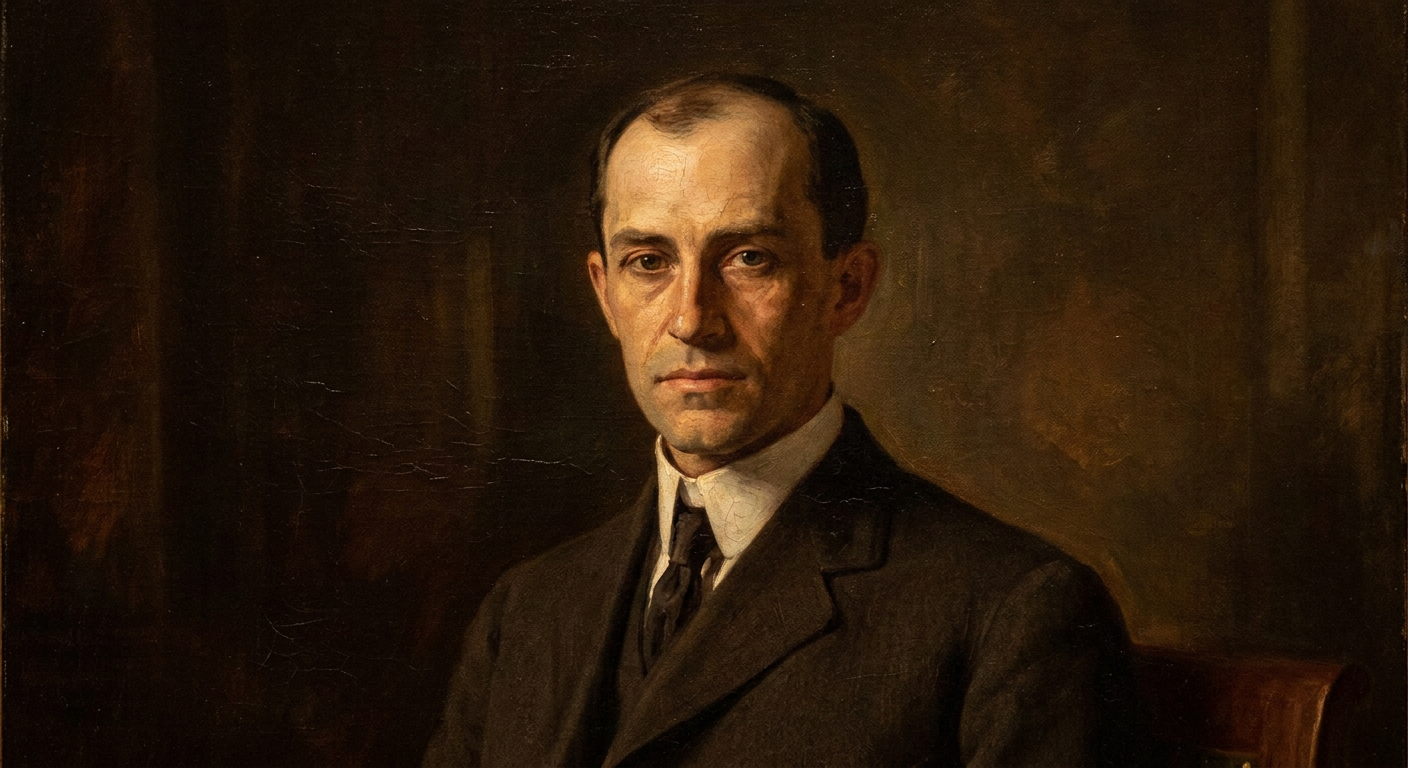
Wilbur Wright
1867 – 1912 · American · Aviation pioneer, inventor, printer, and bicycle manufacturer
Recommended Audiobooks
Listen next from Marcus Alden

Life Lessons from James Clerk Maxwell
Marcus Alden · 42 min

Life Lessons from Archimedes
Marcus Alden · 48 min
Wilbur Wright helped turn one of humanity's oldest dreams into a practical technology. Working closely with his younger brother Orville, he developed the first successful powered, controlled, sustained flight of a heavier-than-air machine. Their breakthrough at Kitty Hawk, North Carolina, on December 17, 1903, lasted only seconds, yet it opened the age of aviation.
The achievement was not a lucky leap into the air. Wilbur and Orville studied earlier experiments, observed birds, built gliders, constructed a wind tunnel, tested hundreds of wing shapes, designed their own propellers, and created an effective system for controlling an aircraft in three dimensions. Their greatest contribution was arguably not the engine but the ability to keep a flying machine balanced and steer it reliably.
Wilbur was the more public-facing member of an unusually close partnership. Serious, disciplined, and intellectually bold, he became a gifted pilot, persuasive writer, and formidable defender of the brothers' patents. His spectacular flights in France in 1908 finally convinced much of the world that practical powered flight had arrived.
His life was brief: he died of typhoid fever in 1912 at age 45. Nevertheless, Wilbur's rigorous experimental methods and insistence on control helped establish the foundations of modern aeronautical engineering. He remains important not merely because he flew, but because he showed how systematic evidence, skilled craftsmanship, and persistent teamwork could solve a problem many experts considered nearly impossible.
Quick Facts
| Field | Details |
|---|---|
| Full Name | Wilbur Wright |
| Common Name(s) | Wilbur Wright |
| Born | April 16, 1867 |
| Died | May 30, 1912 |
| Age at Death | 45 |
| Birthplace | Near Millville, Indiana, United States |
| Nationality | American |
| Occupation | Inventor, aviation pioneer, printer, bicycle manufacturer, pilot |
| Historical Era | Second Industrial Revolution; early aviation age |
| Famous For | Co-developing the first successful powered, controlled airplane |
| Political Affiliation | No significant formal affiliation documented |
| Religion | Raised in the Church of the United Brethren in Christ |
| Education | Dayton public schools; no college degree or high-school diploma |
| Parents | Milton Wright and Susan Catherine Koerner Wright |
| Spouse(s) | Never married |
| Children | None |
| Major Works | 1901 address on gliding experiments; U.S. Patent No. 821,393; Wright gliders and Flyers |
| Major Achievements | First controlled powered flights; three-axis control; pioneering wind-tunnel research; public demonstration of practical aviation |
Early Life
Wilbur was born near Millville, Indiana, the third surviving child of Milton Wright, a United Brethren bishop, and Susan Catherine Koerner Wright. Because Milton's church duties required travel and relocation, the family lived in several places before settling permanently in Dayton, Ohio.
The Wright household encouraged reading, debate, and mechanical curiosity. Susan, who had grown up around her father's carriage workshop, was skilled with tools and made toys and household devices. Wilbur and Orville later credited her mechanical ability as an important family influence. Their father maintained a substantial library and encouraged his children to investigate competing ideas rather than accept authority automatically.
A small toy helicopter, brought home by Milton and based on designs associated with French aviation experimenter Alphonse Pénaud, fascinated the brothers during childhood. It did not single-handedly cause their later work, as simplified stories sometimes suggest, but it provided an early example of a machine lifting itself through the air.
Wilbur was an excellent student and planned to attend Yale. Those plans changed after a serious injury during an ice-hockey game in the winter of 1885–1886. He lost several front teeth and experienced prolonged physical and emotional difficulties. While recovering, he remained at home, read extensively, and cared for his mother, who died from tuberculosis in 1889. Because his family had moved during his final school year, he never formally received a high-school diploma despite completing the academic requirements.
Rise to Prominence
Wilbur gradually emerged from his period of isolation by joining Orville's printing business. The brothers published newspapers, including the short-lived West Side News, and designed and built printing equipment. In 1892 they opened a bicycle sales and repair shop, later manufacturing bicycles under names such as the Van Cleve and St. Clair.
The bicycle business gave them money, workshop skills, and practical experience with lightweight structures, chains, gears, balance, and careful machining. It also taught them to diagnose mechanical failures systematically.
Their attention shifted decisively toward flight after German glider pioneer Otto Lilienthal died in an 1896 crash. Wilbur read available aeronautical literature and contacted the Smithsonian Institution in 1899 for further publications. He concluded that the central unsolved problem was control. Engines and wings mattered, but a pilot also needed to balance and steer an unstable machine.
The brothers developed wing warping, in which cables twisted the wings to produce different amounts of lift on either side. Combined with an elevator for pitch and, later, a movable rudder for yaw, this became their system of three-axis control.
They selected the windy sand dunes near Kitty Hawk for experiments. Glider tests in 1900 and 1901 were disappointing, particularly because published lift data proved unreliable. Instead of abandoning the project, they built a wind tunnel in Dayton and tested many wing shapes. Their corrected measurements transformed the performance of the 1902 glider and prepared the way for powered flight.
Major Achievements
Solving the Problem of Aircraft Control
The Wrights' most fundamental achievement was an integrated method for controlling roll, pitch, and yaw. Earlier experimenters often emphasized raw lifting power or automatic stability. Wilbur and Orville treated an aircraft more like a bicycle: inherently unstable, but controllable by a trained operator.
Their coordinated wing-warping and rudder system allowed pilots to bank through turns without dangerous sideways slipping. Modern aircraft use ailerons rather than warped wings, but they still operate around the same three axes.
Creating Reliable Aerodynamic Data
After poor results in 1901, the brothers questioned accepted lift tables derived from earlier authorities. Their homemade wind tunnel and balances allowed them to compare numerous wing profiles. This work yielded better estimates of lift, drag, and suitable wing curvature.
The episode mattered because it demonstrated a defining feature of engineering: when theory and results conflict, measurements must be checked rather than protected out of respect for famous experts.
First Powered, Controlled Flights
On December 17, 1903, at Kill Devil Hills near Kitty Hawk, Orville piloted the first flight of the Wright Flyer. It covered about 120 feet in 12 seconds. Wilbur made the fourth and longest flight, traveling 852 feet in 59 seconds. Five local witnesses were present.
Other machines had briefly left the ground before 1903, and historians distinguish between hops, uncontrolled launches, and sustained flight. The Wright claim rests on the Flyer's combination of powered takeoff, sustained movement, onboard piloting, and effective control. The machine launched from a rail into strong wind rather than using wheels, but it carried its own engine and propulsive system.
Demonstrating Practical Aviation
Improved Wright aircraft made circles and remained aloft for extended periods near Dayton in 1904 and 1905. Because the brothers guarded their invention while seeking contracts and patent protection, many outsiders remained skeptical.
Wilbur ended much of that skepticism at Le Mans, France, in 1908. His smooth turns and increasingly long flights astonished European pilots and spectators. Orville simultaneously demonstrated an aircraft to the U.S. Army. Aviation had moved from experiment to practical public reality.
Leadership or Work
Wilbur and Orville described their discoveries as shared work, and separating their individual contributions is often impossible. Wilbur tended to take the lead in theoretical argument, formal correspondence, public demonstrations, and European negotiations. Orville was equally essential as a mechanic, experimenter, and pilot.
Their working method relied on intense discussion. Family members recalled that arguments could sound fierce, but the purpose was to expose weak reasoning. Once convinced, either brother could adopt the other's position without treating the change as defeat.
Their strengths included patience, manual skill, careful recordkeeping, courage, and willingness to test authority. Their secrecy and determination to control their patents protected their business interests, but eventually consumed time and damaged relationships within the growing aviation community.
Personal Life
Wilbur never married and had no children. He lived with Orville and their sister Katharine, who managed much of the household and later assisted the brothers socially and publicly. Wilbur was close to his family, although work frequently kept him abroad after 1907.
Contemporaries generally described him as reserved, serious, self-controlled, and exceptionally focused. In France, however, he proved capable of diplomacy and dry humor. He dressed plainly and had little interest in personal luxury.
Wilbur enjoyed reading, intellectual debate, long observation, and practical workshop activity. Flying itself demanded physical courage: early aircraft were fragile, exposed, and unforgiving. His health appeared generally sound during his successful years, but typhoid fever struck suddenly in 1912.
Philosophy or Beliefs
Wilbur was raised in a deeply religious household, but surviving evidence does not show him becoming a public theologian or formally joining his father's denomination. His conduct reflected values common to his upbringing: discipline, honesty, duty, modest living, and loyalty to family.
Intellectually, he combined confidence with skepticism. He believed human flight was possible but refused to trust claims simply because respected authorities had published them. He treated knowledge as cumulative, deliberately learning from Lilienthal, Octave Chanute, Samuel Langley, and others while correcting their errors.
No major partisan political role defined his life. His worldview was primarily practical and technological: difficult problems could be divided into parts, tested, measured, and solved through persistent work.
Challenges and Controversies
The brothers endured repeated crashes, damaged gliders, incorrect data, weak engines, harsh weather, insects, isolation, and the danger of serious injury. Their 1901 glider was so disappointing that Wilbur briefly expressed deep pessimism, although later retellings probably exaggerated his supposed prediction that flight was centuries away.
Recognition also came slowly. Sparse press coverage in 1903 and the brothers' reluctance to demonstrate without contracts encouraged skepticism. Their secrecy was commercially understandable, but it limited independent verification.
The most important controversy involved U.S. Patent No. 821,393, granted in 1906. It broadly protected the Wright method of controlling an aircraft by changing the relative lift on its sides in coordination with a rudder. The brothers sued competitors, most notably Glenn Curtiss, arguing that ailerons performed the patented function even though they did not warp the wings.
Supporters maintain that the Wrights deserved payment for the control system that made practical flight possible. Critics argue that aggressive litigation slowed American aviation, diverted the brothers from further innovation, and claimed too much of a rapidly developing field. Courts generally upheld the Wright position, but historians continue debating how much the patent conflict hindered progress. The U.S. government eventually encouraged a patent pool in 1917, after Wilbur's death.
There was also a later priority dispute between Orville and the Smithsonian over claims associated with Samuel Langley's Aerodrome. That feud largely developed after Wilbur died, so it should not be attributed to him directly.
Legacy
Wilbur Wright helped establish controlled powered flight as a practical reality. Within a decade of Kitty Hawk, aircraft were being used for transport, reconnaissance, sport, and warfare. Over subsequent generations, aviation reshaped migration, commerce, diplomacy, tourism, military strategy, and people's understanding of distance.
The 1903 Flyer is displayed at the Smithsonian's National Air and Space Museum in Washington, D.C. The Wright Brothers National Memorial stands at Kill Devil Hills, while Dayton Aviation Heritage National Historical Park preserves sites connected with the family and their work. The brothers' bicycle shop was moved to Greenfield Village at The Henry Ford in Michigan.
Wilbur's name appears on schools, streets, awards, monuments, and aviation institutions. North Carolina and Ohio both celebrate the Wright story: one hosted the first flights, while the other was where the aircraft were conceived and built. National Aviation Day is observed in the United States on August 19, Orville's birthday.
Interesting Facts
- Wilbur was born in Indiana but spent most of his productive life in Dayton, Ohio.
- He and Orville had no college degrees.
- Wilbur completed high-school coursework but never received a diploma.
- His planned education at Yale ended after an injury and family responsibilities.
- The brothers built printing machinery before constructing aircraft.
- Their bicycle business financed much of their aviation research.
- Neither brother married.
- Wilbur initiated contact with the Smithsonian about aviation literature in 1899.
- The Wright wind tunnel was only about six feet long.
- They tested hundreds of wing configurations.
- A coin toss determined who would make the first powered-flight attempt; Wilbur won but stalled on December 14, 1903.
- Orville therefore piloted the first successful flight three days later.
- Wilbur piloted the longest flight of December 17.
- The 1903 Flyer was damaged by wind shortly after its fourth flight and never flew again.
- Wilbur's 1908 demonstrations made him a celebrity in France.
- King Edward VII of Britain was among the notable people he took flying.
- Wilbur served as president of the Wright Company.
- He died nine years after the first powered flights.
Famous Quotes
- “For some years I have been afflicted with the belief that flight is possible to man.” — Letter to the Smithsonian Institution, May 30, 1899. Wilbur presented flight as an intellectual conviction demanding investigation.
- “I am an enthusiast, but not a crank in the sense that I have some pet theories as to the proper construction of a flying machine.” — The same 1899 letter, emphasizing evidence over obsession.
- “I wish to avail myself of all that is already known.” — Smithsonian letter, expressing his desire to build upon earlier research.
- “The difficulties which obstruct the pathway to success in flying-machine construction are of three general classes.” — Western Society of Engineers address, 1901, introducing his analysis of wings, power, and control.
- “The best dividends on the labor invested have invariably come from seeking more knowledge rather than more power.” — 1901 address. It summarized the brothers' emphasis on aerodynamic understanding.
- “Men already know how to construct wings or airplanes which when driven through the air at sufficient speed will not only sustain themselves but also that of the engine and of the engineer as well.” — 1901 address, identifying control rather than lift as the main obstacle.
- “We have met the enemy and they are ours.” — Telegram to Katharine Wright after the successful 1902 glider tests, playfully adapting Oliver Hazard Perry's famous message.
- “There is no sport equal to that which aviators enjoy while being carried through the air on great white wings.” — Published under Wilbur's name in 1908 accounts of flight; it conveys the exhilaration of gliding, though wording varies among reproductions.
- “It is possible to fly without motors, but not without knowledge and skill.” — Commonly attributed to Wilbur and consistent with his writings, but a secure original occasion is difficult to establish; it should be treated cautiously.
- “No bird soars in a calm.” — Frequently credited to Wilbur, but reliable primary-source documentation is lacking. Its attribution is disputed.
Timeline
- 1867 — Born near Millville, Indiana, on April 16.
- 1870s–1880s — Family moves several times before settling in Dayton.
- 1885–1886 — Injured during an ice-hockey game; plans for Yale fade.
- 1889 — Mother dies; Wilbur joins Orville's printing activities.
- 1892 — Brothers open a bicycle business.
- 1896 — Lilienthal's death intensifies their interest in flight.
- 1899 — Wilbur requests aviation literature from the Smithsonian and tests a wing-warping kite.
- 1900 — First experiments at Kitty Hawk.
- 1901 — Second glider performs poorly; Wilbur addresses the Western Society of Engineers.
- 1901–1902 — Brothers conduct wind-tunnel experiments.
- 1902 — Successful three-axis-control glider tested at Kill Devil Hills.
- 1903 — First powered, controlled flights on December 17.
- 1904 — Improved flights conducted at Huffman Prairie, Ohio.
- 1905 — Wright Flyer III demonstrates sustained, practical flight.
- 1906 — U.S. patent for the control system is granted.
- 1908 — Wilbur gives celebrated demonstrations in France.
- 1909 — Wright Company is incorporated; major public honors follow.
- 1910 — Wilbur becomes deeply involved in patent litigation and company affairs.
- 1912 — Dies of typhoid fever in Dayton on May 30.
Frequently Asked Questions
1. What is Wilbur Wright best known for?
Wilbur is best known for developing, with Orville Wright, the first successful powered airplane with effective pilot control. On December 17, 1903, their Flyer completed four flights near Kitty Hawk. Wilbur piloted the longest, covering 852 feet in 59 seconds. His importance extends beyond that day: he helped create three-axis control, improve aerodynamic measurements, design efficient propellers, and demonstrate practical flight publicly in Europe.
2. Did Wilbur or Orville make the first flight?
Orville piloted the first successful flight on December 17, 1903. It lasted 12 seconds and traveled about 120 feet. Wilbur had won a coin toss and attempted the first powered launch on December 14, but he pulled up too sharply and damaged the aircraft after a brief stall. Once repairs were completed, it was Orville's turn. Both brothers alternated as pilots throughout the successful day.
3. Did the Wright brothers truly invent the airplane?
“Invented the airplane” is convenient shorthand, but it requires definition. Many people contributed earlier work on wings, gliders, engines, and propellers. Claims have also been made for other early powered machines. The Wrights' strongest historical claim is that they produced the first well-documented, sustained, powered, piloted heavier-than-air flights using a practical system of control. Their achievement built on earlier research rather than emerging in isolation.
4. Why did the brothers experiment at Kitty Hawk?
They needed steady winds, soft sand, open space, privacy, and tall dunes suitable for gliding. Wilbur contacted the U.S. Weather Bureau for information and selected the Outer Banks of North Carolina. The location's winds helped their machines reach flying speed, while sand reduced—but did not eliminate—the danger of crashes. Its remoteness also allowed them to work without large crowds or constant press attention.
5. What was Wilbur's individual contribution?
Because the brothers worked so closely, precise credit is difficult to divide. Wilbur began the formal aviation correspondence, made important observations about birds and wing warping, delivered their major 1901 technical address, and led many negotiations. He was also the principal pilot during the decisive French demonstrations of 1908. Orville contributed equally important mechanical, experimental, and piloting skills. Both consistently presented the achievement as a partnership.
6. Why was aircraft control so important?
A machine might generate enough lift yet remain useless if the pilot could not maintain balance or choose a direction. The Wrights controlled pitch with an elevator, roll through wing warping, and yaw with a movable rudder. Coordinating roll and yaw permitted safer turns. Modern airplanes use different mechanisms, especially ailerons, but pilots still control movement around the same three axes established in the Wright system.
7. How did a bicycle shop help them build an airplane?
The shop provided income, tools, workspace, and mechanical experience. Bicycle construction required lightweight but strong structures, precise chains and sprockets, careful alignment, and an understanding of balance. The brothers could also manufacture specialized aircraft components themselves. Although a bicycle does not balance exactly like an airplane, cycling encouraged their broader conviction that an unstable vehicle could remain manageable through active human control.
8. Did the Wrights use an automobile engine?
No. Available automobile engines were generally too heavy or unsuitable for their needs. Their employee and mechanic Charlie Taylor constructed a lightweight four-cylinder gasoline engine in the Dayton workshop according to the brothers' requirements. It produced roughly 12 horsepower in its early performance. The Wrights also designed and carved their own propellers after realizing that an aerial propeller should be understood as a rotating wing.
9. Why did people initially doubt their achievement?
The first flights occurred in a remote location before only five local witnesses, and early reports were incomplete or inaccurate. The brothers then avoided unrestricted demonstrations while pursuing patents and sales contracts. Their later flights near Dayton received limited reliable coverage. With exaggerated aviation claims already common, skepticism was understandable. Wilbur's controlled public flights in France during 1908 finally provided convincing evidence before large crowds and experienced observers.
10. Was the 1903 Flyer practical?
The original Flyer was a breakthrough rather than a practical transport aircraft. It was difficult to control, required a launching rail, carried only its pilot, and flew successfully for less than a minute. The brothers continued development. By 1905, the Wright Flyer III could remain airborne for more than half an hour, turn repeatedly, and land under control. That later machine better demonstrated the practical potential of their system.
11. What happened during Wilbur's French demonstrations?
At Le Mans beginning in August 1908, Wilbur flew before European aviators, officials, journalists, and large crowds. He made controlled circles, set endurance records, and carried passengers. His calm precision overturned widespread doubts and transformed him into an international celebrity. French observers who had previously dismissed the brothers now praised their skill. The demonstrations also secured business opportunities and accelerated European interest in powered aviation.
12. What was the Wright patent dispute?
The Wright patent covered their method of lateral control, including changing the relative lift of an aircraft's sides and coordinating that action with a rudder. They argued that Glenn Curtiss's ailerons infringed the patent because they achieved the same function. Courts largely agreed. Defenders view enforcement as legitimate protection of a fundamental invention; critics believe prolonged lawsuits burdened American aviation and distracted the Wrights from technical development.
13. Did Wilbur attend college?
No. Wilbur was academically talented and intended to study at Yale, but his hockey injury, recovery, and responsibilities at home altered his path. He did not receive a formal high-school diploma because the family's relocation disrupted the administrative requirements, even though he had completed the expected studies. His advanced education was self-directed through books, correspondence, technical papers, observation, calculation, and repeated experimentation.
14. How did Wilbur Wright die?
Wilbur became ill with typhoid fever in Dayton in spring 1912. His condition fluctuated for several weeks before he died on May 30 at age 45. Typhoid is a bacterial disease commonly spread through contaminated food or water; it was far more dangerous before antibiotics and modern sanitation. He was buried at Woodland Cemetery in Dayton. His death left Orville to manage their business and historical reputation.
15. Where can people learn about Wilbur Wright today?
Major sites include the Wright Brothers National Memorial in North Carolina, Dayton Aviation Heritage National Historical Park in Ohio, the National Air and Space Museum in Washington, and The Henry Ford in Dearborn, Michigan. The Smithsonian displays the original 1903 Flyer. Collections of family papers, photographs, technical notes, and correspondence are also available through the Library of Congress and other research institutions, many with digitized materials online.
Lessons We Can Learn
- Define the real problem. The Wrights recognized that control, not merely lift, was the central obstacle. Modern lesson: diagnose before designing a solution.
- Question respected data. Their wind-tunnel tests corrected accepted aerodynamic tables. Evidence shows the value of verifying assumptions.
- Break complexity into parts. They studied wings, control, power, and propulsion separately before integrating them.
- Use failure as information. The poor 1901 glider led to better measurements rather than abandonment.
- Build affordable experiments. Kites, gliders, balances, and a small wind tunnel allowed rapid learning before powered flight.
- Combine theory with craftsmanship. Their calculations mattered because they could also construct and repair precise machines.
- Choose collaborators carefully. Wilbur and Orville's complementary abilities made the partnership stronger than either alone.
- Debate ideas without making disagreement personal. Family evidence shows that rigorous argument improved their decisions.
- Protecting ideas involves trade-offs. Patent enforcement defended their rights but consumed energy and generated hostility.
- Public proof matters. Wilbur's 1908 flights succeeded where private claims could not. The broader modern interpretation is that credible demonstrations build trust.
Related Historical Figures
- Orville Wright — Wilbur's brother, lifelong collaborator, and co-creator of the Wright aircraft.
- Katharine Wright — Their sister, household organizer, teacher, and important public supporter.
- Milton Wright — Their father, whose library and intellectual encouragement shaped the family.
- Susan Catherine Koerner Wright — Their mechanically skilled mother and early practical influence.
- Otto Lilienthal — German glider pioneer whose research and fatal crash influenced the Wrights.
- Octave Chanute — Engineer who shared aviation information and initially supported their work.
- Charlie Taylor — Mechanic who built the Flyer's lightweight engine.
- Samuel Pierpont Langley — Smithsonian scientist and rival early powered-flight experimenter.
- Glenn Curtiss — Aviation pioneer and principal opponent in the Wright patent litigation.
- Alberto Santos-Dumont — Brazilian-French pioneer whose public European flights contributed to debates over aviation priority.
Watch and Learn
The Wright Brothers, First Successful Airplane (1903) — Simple History — approximately 5 minutes.
This concise animated overview explains the brothers' experimental path, the design of the Flyer, and the events at Kitty Hawk in accessible language. It is a useful visual introduction for students, although viewers should pair its simplified narrative with museum or primary-source materials when studying disputed priority claims.
Watch and Learn
The Wright Brothers, First Successful Airplane (1903) · Simple History
Related Historical Figures