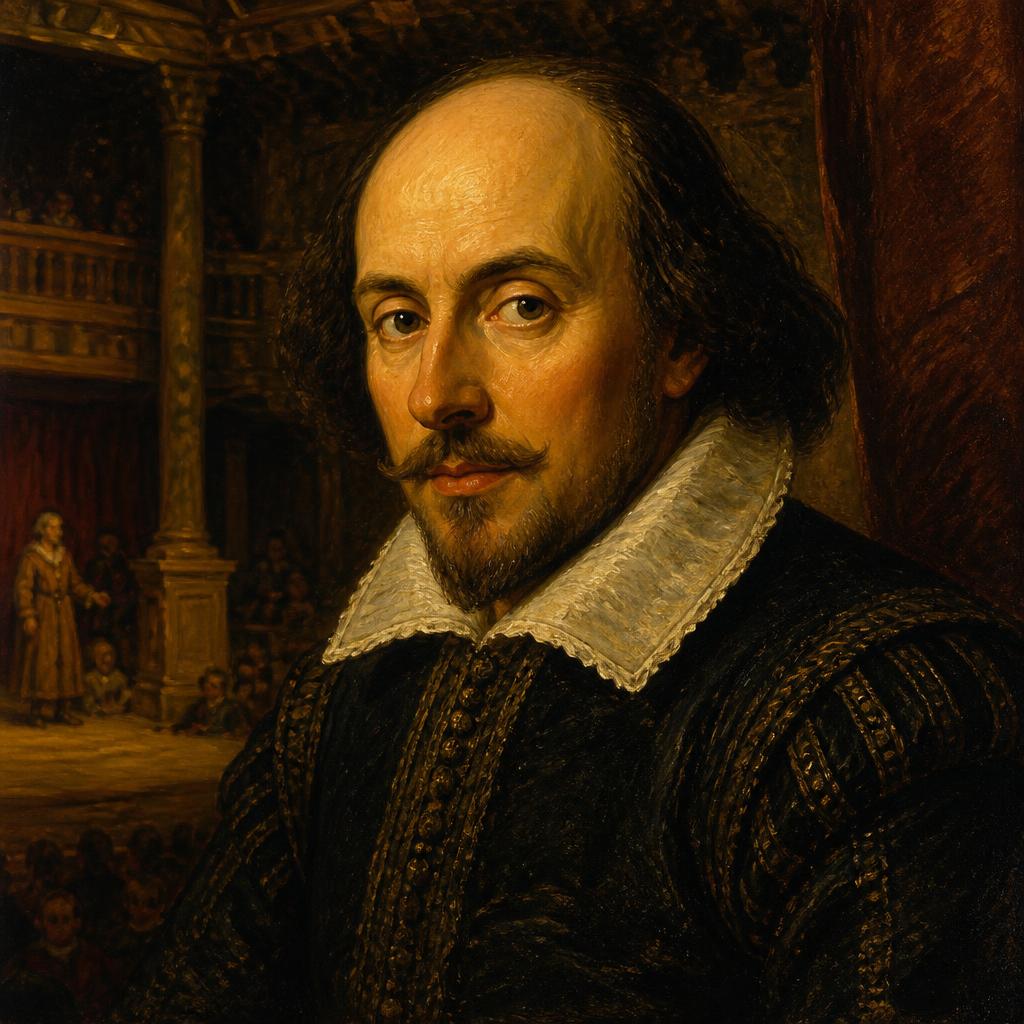
Quick Facts
- Years
- 1564 – 1616
- Category
- Writers & Poets
- Subcategory
- Playwrights
- Nationality
- English
- Occupation
- Playwright & Poet
William Shakespeare
1564 – 1616 · English · Playwright & Poet
Audiobook

Life Lessons from William Shakespeare
Marcus Alden · 48 min
Introduction
William Shakespeare was an English playwright, poet, actor and shareholder in a theatrical company whose works transformed world literature. Born in Stratford-upon-Avon in 1564, he built his career in London during the reigns of Elizabeth I and James I. His surviving canon includes approximately 39 plays—depending on disputed attributions and collaborations—154 sonnets, two long narrative poems and several shorter poems. His writing ranges from comedies such as A Midsummer Night’s Dream to tragedies such as Hamlet, Othello, King Lear and Macbeth, and histories including Richard III and the two parts of Henry IV.
Shakespeare’s importance rests not simply on the number of works he produced, but on their extraordinary dramatic and verbal range. His plays examine political power, ambition, love, jealousy, family conflict, identity, aging, prejudice, violence and mortality. They move easily between courtly rhetoric and everyday speech, philosophical reflection and physical comedy. Characters such as Hamlet, Falstaff, Lady Macbeth, Rosalind and King Lear remain compelling because they are psychologically complex without being reducible to a single interpretation.
The documentary record of Shakespeare’s life is incomplete. Surviving evidence consists largely of parish registers, legal documents, property transactions, printed books and references by contemporaries. No personal diary or undisputed collection of letters survives. As a result, historians can describe the broad outline of his life with confidence while remaining cautious about his private beliefs, relationships and creative methods.
During his lifetime, Shakespeare gained recognition as a successful professional dramatist and businessman. After his death in 1616, fellow actors John Heminges and Henry Condell preserved 36 of his plays in the 1623 volume now known as the First Folio. That publication became the foundation of Shakespeare’s enduring international reputation.
Quick Facts
| Category | Details |
|---|---|
| Full name | William Shakespeare |
| Born | Traditionally 23 April 1564 |
| Baptized | 26 April 1564, Holy Trinity Church, Stratford-upon-Avon |
| Birthplace | Stratford-upon-Avon, Warwickshire, England |
| Parents | John Shakespeare and Mary Arden |
| Education | Probably King’s New School, Stratford-upon-Avon |
| Occupations | Playwright, poet, actor, theatrical shareholder and property owner |
| Spouse | Anne Hathaway, married in 1582 |
| Children | Susanna; twins Hamnet and Judith |
| Principal company | Lord Chamberlain’s Men, renamed the King’s Men in 1603 |
| Major theatres | The Theatre, the Curtain, the Globe and the Blackfriars |
| Notable works | Hamlet, Macbeth, King Lear, Othello, Romeo and Juliet, A Midsummer Night’s Dream |
| Poetry | Venus and Adonis, The Rape of Lucrece, 154 sonnets and shorter poems |
| Died | 23 April 1616, traditionally accepted |
| Buried | 25 April 1616, Holy Trinity Church, Stratford-upon-Avon |
| Literary period | English Renaissance; Elizabethan and Jacobean eras |
| First Folio | Published in 1623 |
Early Life & Background
William Shakespeare was the third of eight recorded children born to John Shakespeare and Mary Arden, and the eldest surviving son. His precise birth date is unknown, but the parish register records his baptism at Holy Trinity Church on 26 April 1564. Because infants were commonly baptized within several days of birth, 23 April has traditionally been observed as his birthday.
Stratford-upon-Avon was a prosperous market town approximately 100 miles northwest of London. John Shakespeare worked as a glover and dealt in wool and agricultural products. He held several municipal offices, becoming an alderman and, in 1568, bailiff—the equivalent of the town’s mayor. Mary Arden came from a well-established Warwickshire farming family and inherited land from her father, Robert Arden.
The family’s fortunes later declined. From the late 1570s, John Shakespeare accumulated debts, stopped attending council meetings and became involved in legal and financial disputes. The reasons remain uncertain, although historians have suggested commercial difficulties, illegal wool dealing, religious pressures or some combination of these factors.
No school record naming William survives, but as the son of a leading townsman he was entitled to attend the King’s New School. Its curriculum would have emphasized Latin grammar, rhetoric and classical authors such as Ovid, Virgil, Plautus, Terence, Seneca and Cicero. Shakespeare’s works reveal extensive familiarity with these writers, though he probably had little or no Greek. Ben Jonson’s later remark that Shakespeare had “small Latin and less Greek” was comparative rather than proof of ignorance.
In late 1582, at the age of 18, Shakespeare married Anne Hathaway, who was about 26. Anne came from Shottery, a village near Stratford. A marriage bond dated 28 November allowed the ceremony to proceed after a single reading of the banns. Their first child, Susanna, was baptized on 26 May 1583. Twins, Hamnet and Judith, were baptized on 2 February 1585.
The period between the twins’ baptism and Shakespeare’s emergence in London is often called the “lost years.” Later traditions claimed that he worked as a schoolmaster, joined travelling actors or fled Stratford after poaching deer from the estate of Sir Thomas Lucy. None of these stories is securely documented. What is clear is that by 1592 Shakespeare was established enough in London’s theatrical world to attract hostile public attention.
Rise to Prominence
The earliest surviving reference to Shakespeare as a London dramatist appears in Greene’s Groats-Worth of Wit, published in September 1592 shortly after the death of writer Robert Greene. Its author attacked an “upstart Crow” who believed himself “the only Shake-scene in a country.” The passage probably mocked Shakespeare as an actor who had begun writing plays despite lacking a university education. The insult indicates that he was already prominent and commercially successful.
London’s theatres were dynamic but unstable institutions. Companies performed in purpose-built playhouses, inn yards, royal residences and provincial towns. Epidemics of plague repeatedly forced public theatres to close. During an extended closure from 1592 to 1594, Shakespeare concentrated on poetry. He dedicated Venus and Adonis in 1593 and The Rape of Lucrece in 1594 to Henry Wriothesley, third Earl of Southampton. Venus and Adonis became one of the most frequently reprinted poems of its era.
By 1594, Shakespeare was a founding shareholder, actor and principal dramatist of the Lord Chamberlain’s Men. The company included leading tragedian Richard Burbage and comic performer Will Kempe. Its stable organization gave Shakespeare unusual professional security: he earned money not only for writing and acting, but also from a share of company profits.
His early plays included English histories, comedies and the revenge tragedy Titus Andronicus. The three parts of Henry VI and Richard III dramatized civil conflict, disputed succession and the Wars of the Roses. Comedies such as The Comedy of Errors, The Taming of the Shrew and Love’s Labour’s Lost displayed his command of wordplay, mistaken identity and theatrical structure.
By the mid-1590s, Shakespeare’s writing had become more ambitious. Romeo and Juliet combined romantic comedy with tragedy, while A Midsummer Night’s Dream brought together aristocratic lovers, Athenian craftsmen and supernatural beings. The Merchant of Venice mixed romance and courtroom drama with a troubling portrayal of religious prejudice through Shylock, a Jewish moneylender in a society that excludes him.
In 1599, members of the company built the Globe Theatre on the south bank of the Thames using timber from an earlier playhouse called the Theatre. Shakespeare became a shareholder. The Globe’s large open-air stage encouraged direct contact between performers and spectators and became closely associated with his mature work.
When James VI of Scotland became James I of England in 1603, the new king granted royal patronage to Shakespeare’s company. Renamed the King’s Men, it became the leading theatrical organization in the country. Royal status brought prestige, regular court performances and greater financial stability.
Major Achievements
Shakespeare’s greatest achievement was the creation of a dramatic canon remarkable for its variety. Although scholars continue to debate chronology and attribution, his career is often divided into overlapping phases: early comedies and histories, mature comedies, major tragedies, and late romances or tragicomedies.
His English history plays helped shape popular ideas about the national past. The two four-play sequences extending from Richard II through Henry V, and from Henry VI through Richard III, explored legitimacy, rebellion, civil war and kingship. These works were not neutral historical records. Shakespeare adapted chronicles by Raphael Holinshed, Edward Hall and others to create compelling drama suited to Tudor political culture.
In comedy, he expanded conventional plots through sophisticated characterization and thematic depth. Rosalind in As You Like It, Viola in Twelfth Night and Beatrice in Much Ado About Nothing use intelligence and verbal skill to navigate societies constrained by gender, rank and custom. Disguise allows characters to test identities, cross social boundaries and reveal truths that ordinary circumstances conceal.
Between roughly 1600 and 1606, Shakespeare produced several of his most influential tragedies. Hamlet examines grief, revenge, conscience and uncertainty. Othello portrays jealousy and manipulation, with Iago turning racial and social vulnerabilities against Othello. King Lear presents political disintegration, family betrayal and exposure to suffering. Macbeth, probably written soon after James I’s accession, investigates ambition, prophecy, guilt and the destruction of moral order.
His Roman plays—including Julius Caesar, Antony and Cleopatra and Coriolanus—draw heavily on Sir Thomas North’s English translation of Plutarch. They explore republican politics, imperial ambition, public reputation and the conflict between personal loyalty and civic duty.
Shakespeare’s later plays, especially Cymbeline, The Winter’s Tale and The Tempest, combine danger and loss with reunion, forgiveness and renewal. These works exploit spectacle, music and the possibilities of the indoor Blackfriars Theatre, which the King’s Men began using around 1609. In The Tempest, Prospero’s renunciation of magic has often been interpreted as Shakespeare’s farewell to the stage, although the identification is speculative.
Shakespeare also wrote major nondramatic poetry. His 154 sonnets, published in 1609—possibly without his direct supervision—consider love, desire, betrayal, beauty, procreation, time and poetic immortality. Their relationships among the speaker, a young man, a rival poet and a woman traditionally called the “Dark Lady” have generated extensive debate, but the poems cannot be treated as a straightforward autobiography.
His achievement was collaborative as well as individual. Early modern theatre depended upon actors, bookkeepers, musicians, costume makers, scribes, printers and fellow dramatists. Modern scholarship generally accepts that Shakespeare collaborated with George Peele on Titus Andronicus, Thomas Middleton on Timon of Athens, George Wilkins on Pericles, and John Fletcher on Henry VIII, The Two Noble Kinsmen and possibly the lost Cardenio.
Defining Moments
One defining moment was Shakespeare’s decision—or necessity—to leave Stratford and enter the London theatre. Although its timing and circumstances are unknown, the move placed him within one of Europe’s fastest-growing cities and a flourishing commercial entertainment industry.
The plague closures of 1592–1594 were another turning point. With the theatres shut, Shakespeare established himself as a poet through Venus and Adonis and The Rape of Lucrece. Their dedications to the Earl of Southampton associated him with aristocratic literary patronage.
His membership in the Lord Chamberlain’s Men from 1594 was crucial. Unlike freelance dramatists who sold scripts for one-time payments, Shakespeare held a financial stake in the organization that performed his works. This structure helped him accumulate wealth and maintain a long-term relationship with a skilled acting ensemble.
In August 1596, his only son, Hamnet, died at the age of 11 and was buried in Stratford. No document reveals Shakespeare’s response. Attempts to connect the death directly to Hamlet—whose source story already contained the name Amleth—remain conjectural, though parental loss and grief recur powerfully in his plays.
In 1597, Shakespeare purchased New Place, one of Stratford’s largest houses, demonstrating his growing prosperity. His family also received increased social standing when a coat of arms was granted to his father in 1596, allowing Shakespeare to identify himself as a gentleman.
The opening of the Globe in 1599 provided a permanent home for the company and coincided with Shakespeare’s mature period. Royal patronage in 1603 then transformed the Lord Chamberlain’s Men into the King’s Men. Shakespeare’s professional identity became tied not only to public theatre but also to the Jacobean court.
Around 1613, he appears to have retired largely to Stratford, though he continued to invest in property and may have collaborated on plays. On 29 June 1613, the Globe burned down after a theatrical cannon ignited the thatched roof during a performance of Henry VIII. No deaths were recorded, and the theatre was rebuilt the following year.
The publication of the First Folio in 1623, seven years after Shakespeare’s death, was the decisive posthumous event. Without it, approximately half of his plays—including Macbeth, Julius Caesar, Twelfth Night and The Tempest—might not have survived.
Timeline
| Year | Event |
|---|---|
| 1564 | Shakespeare is born in Stratford-upon-Avon and baptized on 26 April. |
| 1568 | His father, John Shakespeare, becomes bailiff of Stratford. |
| 1582 | William marries Anne Hathaway. |
| 1583 | Their daughter Susanna is baptized on 26 May. |
| 1585 | Twins Hamnet and Judith are baptized on 2 February. |
| 1585–1592 | The poorly documented period known as the “lost years.” |
| 1592 | Robert Greene’s attack shows that Shakespeare is active and successful in London theatre. |
| 1593 | Venus and Adonis is published. |
| 1594 | The Rape of Lucrece appears; Shakespeare becomes a leading member of the Lord Chamberlain’s Men. |
| 1596 | Hamnet Shakespeare dies; the Shakespeare family is granted a coat of arms. |
| 1597 | Shakespeare purchases New Place in Stratford. |
| 1598 | Francis Meres praises Shakespeare as a leading playwright and poet. |
| 1599 | The Globe Theatre opens; Shakespeare is one of its shareholders. |
| c. 1600–1601 | Hamlet is probably written and first performed. |
| 1603 | James I grants royal patronage; the company becomes the King’s Men. |
| 1604–1606 | Approximate period of Othello, King Lear and Macbeth. |
| 1608 | The King’s Men gain regular access to the indoor Blackfriars Theatre. |
| 1609 | Shakespeare’s Sonnets is published. |
| 1611 | The Tempest is performed at court; it may have been written around 1610–1611. |
| 1613 | The Globe burns during Henry VIII; Shakespeare purchases the Blackfriars Gatehouse property. |
| 1616 | Shakespeare signs his will in March, dies on 23 April and is buried on 25 April. |
| 1623 | Heminges and Condell publish the First Folio. |
Personal Life
Shakespeare’s marriage to Anne Hathaway lasted until his death, but the couple’s emotional relationship cannot be reconstructed from surviving documents. Anne probably remained in Stratford while Shakespeare spent substantial periods in London. Such arrangements were not unusual for men whose work required long absences.
Their eldest daughter, Susanna, married physician John Hall in 1607. Their daughter Elizabeth became Shakespeare’s only grandchild. Judith married Thomas Quiney, a Stratford vintner, in February 1616. The marriage caused difficulty because it took place during Lent without the required licence, and Quiney had recently fathered an illegitimate child with another woman.
Shakespeare appears to have managed his money carefully. In addition to New Place, he acquired land, invested in Stratford tithes and bought a gatehouse near the Blackfriars precinct in London. Legal records show him pursuing debts and defending property interests. These documents complicate the romantic image of the poet detached from practical affairs.
His will, dated 25 March 1616, left most of his estate to Susanna and her heirs. Anne received the “second best bed with the furniture,” a phrase that has inspired speculation about marital unhappiness. In early modern households, however, the best bed might be reserved for guests, while the second-best bed could have been the marital bed. Anne may also have had legal rights independent of the will.
No fully authenticated portrait painted from life survives with absolute certainty. The engraved image by Martin Droeshout in the First Folio and the funerary monument in Holy Trinity Church are the principal early likenesses accepted by scholars.
Beliefs & Philosophy
Shakespeare did not write a systematic statement of his beliefs. The opinions voiced by his characters frequently contradict one another, and dramatic speeches should not automatically be read as the author’s personal philosophy.
His plays nevertheless show sustained interest in ethical choice, political authority and human self-deception. They repeatedly ask what makes a ruler legitimate, whether revenge can be just, how language disguises motives and whether individuals control their destinies. Fortune, providence, astrology and personal agency coexist in productive tension.
Religiously, Shakespeare lived through the English Reformation and the enforcement of Protestant worship under Elizabeth I and James I. Some members of his extended family may have retained Catholic sympathies, and a disputed spiritual testament attributed to his father is Catholic in character. Scholars have argued for Catholic, Protestant, skeptical and religiously ambiguous readings of Shakespeare. The evidence does not justify certainty about his private affiliation.
His works reveal sympathy for human vulnerability without offering simple moral reassurance. Mercy is celebrated in The Merchant of Venice and Measure for Measure, but its application is complicated by power and prejudice. Forgiveness becomes central in the late romances, yet reconciliation does not erase previous suffering. Shakespeare’s dramatic philosophy is therefore less a fixed doctrine than a method of presenting competing perspectives with unusual depth.
Challenges & Controversies
Theatre itself was controversial in Shakespeare’s England. Puritan critics associated playhouses with idleness, disease, disorder and moral corruption. Companies also faced censorship from the Master of the Revels. Political or religious material could be altered, prohibited or punished.
Plague was a constant professional threat. London outbreaks repeatedly closed theatres, depriving actors and writers of income. Shakespeare’s company survived partly through touring, court performance and strong internal organization.
The 1601 rebellion of Robert Devereux, second Earl of Essex, created a dangerous political association. Supporters of Essex paid the Lord Chamberlain’s Men to perform Richard II—apparently including its deposition scene—on the eve of the failed uprising. Augustine Phillips testified about the performance, but the company was not punished and performed at court soon afterward.
Shakespeare’s authorship has been questioned since the nineteenth century by advocates of candidates such as Francis Bacon, Christopher Marlowe and Edward de Vere, Earl of Oxford. Mainstream scholarship rejects these theories. Contemporary testimony, title pages, official records, the First Folio and references by fellow writers consistently identify William Shakespeare of Stratford as the author. Collaboration and uncertain attribution in individual plays do not undermine the broader evidence.
Modern readers also debate representations of race, religion, gender and colonialism in the plays. The Merchant of Venice uses antisemitic conventions while giving Shylock some of the drama’s most forceful language. Othello depicts racism while making a Black military leader its tragic protagonist. The Taming of the Shrew remains controversial for its treatment of marriage and female obedience. The Tempest has become central to postcolonial interpretations through the relationship between Prospero and Caliban.
The texts themselves present challenges. Shakespeare’s manuscripts do not survive, with the possible exception of several disputed pages in the collaborative play Sir Thomas More. Early quartos and the First Folio sometimes differ significantly. Editors must decide among variant readings, printing errors, theatrical revisions and possible memorial reconstructions.
Famous Quotes
“To be, or not to be: that is the question.”
—Hamlet, Hamlet, Act 3, Scene 1
“All the world’s a stage,
And all the men and women merely players.”
—Jaques, As You Like It, Act 2, Scene 7
“The course of true love never did run smooth.”
—Lysander, A Midsummer Night’s Dream, Act 1, Scene 1
“If music be the food of love, play on.”
—Orsino, Twelfth Night, Act 1, Scene 1
“We are such stuff
As dreams are made on.”
—Prospero, The Tempest, Act 4, Scene 1
“What’s in a name? That which we call a rose
By any other word would smell as sweet.”
—Juliet, Romeo and Juliet, Act 2, Scene 2
“The quality of mercy is not strained.”
—Portia, The Merchant of Venice, Act 4, Scene 1
“Cowards die many times before their deaths;
The valiant never taste of death but once.”
—Julius Caesar, Julius Caesar, Act 2, Scene 2
“We know what we are, but know not what we may be.”
—Ophelia, Hamlet, Act 4, Scene 5
“Tomorrow, and tomorrow, and tomorrow,
Creeps in this petty pace from day to day.”
—Macbeth, Macbeth, Act 5, Scene 5
These lines are spoken by fictional characters in particular dramatic situations. They should not necessarily be treated as direct statements of Shakespeare’s own beliefs.
Legacy & Influence
Shakespeare’s immediate reputation was substantial. Francis Meres praised him in 1598 as a leading writer of both comedy and tragedy. Ben Jonson’s tribute in the First Folio called him “not of an age, but for all time.” Yet Shakespeare’s later status developed gradually through publication, performance, adaptation, education and criticism.
The First Folio preserved his dramatic canon and divided the plays into comedies, histories and tragedies. Three more folio editions appeared during the seventeenth century. After the Restoration of the monarchy in 1660, Shakespeare’s plays returned to the stage, often in heavily adapted forms. Nahum Tate’s version of King Lear, which gave the story a happy ending, dominated performances for generations.
The eighteenth century elevated Shakespeare as a national literary figure. Editors such as Samuel Johnson attempted to establish reliable texts, while actor-manager David Garrick promoted Shakespeare through influential performances and the 1769 Stratford Jubilee. Romantic writers later celebrated his imagination, creative freedom and psychological insight.
Shakespeare profoundly influenced English vocabulary and expression, though claims that he “invented” thousands of words are often exaggerated. The fact that a word first appears in surviving Shakespearean texts does not prove that he coined it. His memorable formulations nevertheless helped popularize many phrases, including “break the ice,” “wild-goose chase,” “foregone conclusion” and “in a pickle.”
His influence extends across languages and artistic forms. Johann Wolfgang von Goethe, Victor Hugo, Herman Melville, Charles Dickens, James Joyce and countless other writers engaged with his works. Giuseppe Verdi transformed Macbeth, Othello and The Merry Wives of Windsor into operas. Pyotr Ilyich Tchaikovsky, Sergei Prokofiev and Leonard Bernstein drew inspiration from Romeo and Juliet. Akira Kurosawa relocated Macbeth and King Lear to feudal Japan in Throne of Blood and Ran.
Modern theatre continually reinterprets Shakespeare through contemporary settings, diverse casting and new political contexts. His plays have been staged in prisons, schools, refugee communities, reconstructed theatres and major national institutions. Film adaptations range from Laurence Olivier’s mid-twentieth-century productions to works by Orson Welles, Franco Zeffirelli, Kenneth Branagh, Baz Luhrmann and Joel Coen.
The plays survive because they support multiple interpretations. Hamlet can be approached as a revenge tragedy, a study of depression, a political drama or an exploration of theatrical performance. The Tempest can appear as a romance of reconciliation, a meditation on art or a drama of colonial domination. Shakespeare’s continuing authority therefore rests not on one fixed meaning, but on the capacity of his works to generate argument, adaptation and discovery.
Interesting Facts
- Shakespeare’s traditional birthday and accepted date of death are both 23 April.
- “Shakespeare” appears in several spellings in surviving documents; standardized spelling was not yet established.
- Only six signatures generally accepted as Shakespeare’s survive, and none is a full literary manuscript.
- He acted as well as wrote. A 1598 list names him among the principal performers in Ben Jonson’s Every Man in His Humour.
- Tradition associates him with the role of the Ghost in Hamlet, but the evidence is late and uncertain.
- The Globe could accommodate thousands of spectators from different social classes.
- Female roles were performed by boys or young men because women did not appear professionally on the English public stage.
- A performance of Macbeth was recorded at Hampton Court in 1606 by Simon Forman, providing valuable evidence about the play’s early staging.
- The title page of the 1609 sonnets includes a mysterious dedication to “Mr. W. H.,” whose identity remains unknown.
- Shakespeare left theatrical colleagues Richard Burbage, John Heminges and Henry Condell money to buy memorial rings.
- The epitaph on his Stratford grave warns against moving his bones.
- The First Folio contains 36 plays but excludes Pericles and The Two Noble Kinsmen, both now generally included in the canon.
- Two plays associated with Shakespeare, Love’s Labour’s Won and Cardenio, are lost or survive under another unknown form.
- The Globe operating in London today is a modern reconstruction inspired by early modern evidence, not the original building.
- No direct descendants of Shakespeare survive; his last descendant, granddaughter Elizabeth Hall, died childless in 1670.
Frequently Asked Questions
When and where was William Shakespeare born?
Shakespeare was born in Stratford-upon-Avon, Warwickshire, in 1564. His exact birth date is not documented. He was baptized on 26 April, and 23 April is traditionally celebrated as his birthday.
How many plays did Shakespeare write?
Approximately 39 plays are wholly or partly attributed to Shakespeare, although the total depends on how scholars count collaborations, disputed works and lost plays. The First Folio contains 36 plays.
Did Shakespeare attend university?
No evidence indicates that he attended Oxford or Cambridge. He probably studied at Stratford’s King’s New School, where he would have received intensive instruction in Latin grammar, rhetoric and classical literature.
Why are some years of his life called the “lost years”?
There is little reliable documentation of Shakespeare’s activities between 1585, when his twins were baptized, and 1592, when he was mentioned as a London playwright. Stories about poaching, teaching and travelling with actors remain unproven.
Was Shakespeare wealthy?
By the standards of a professional writer, he became prosperous. His earnings came from acting, writing and holding shares in the Lord Chamberlain’s Men, the Globe and probably the Blackfriars operation. He invested in houses, land and tithes.
Did Shakespeare invent thousands of English words?
The claim is overstated. Many words first recorded in his works may already have existed in speech or in lost texts. He was, however, exceptionally inventive in combining words, shifting their grammatical functions and creating memorable expressions.
Who was the “Dark Lady” of the sonnets?
Her identity is unknown. Various historical candidates have been proposed, but none has been conclusively established. The sonnets should not be assumed to provide a literal record of Shakespeare’s private relationships.
Did Shakespeare really write the works attributed to him?
The overwhelming scholarly consensus is yes. Contemporary publications, testimony from colleagues, legal and theatrical records, and the First Folio connect the works to William Shakespeare of Stratford. Alternative authorship theories lack comparable documentary support.
What was Shakespeare’s last play?
There is no completely certain answer. The Tempest is often described as his final independently written play, probably composed around 1610–1611. He subsequently collaborated with John Fletcher on Henry VIII and The Two Noble Kinsmen.
How did William Shakespeare die?
The cause of his death is unknown. A later Stratford tradition claimed that he became ill after drinking with Ben Jonson and Michael Drayton, but this report is not contemporary and cannot be verified.
Lessons from William Shakespeare
- Observe human complexity: Shakespeare’s strongest characters possess mixed motives, virtues and weaknesses rather than simple moral identities.
- Use language precisely: His work demonstrates how imagery, rhythm, metaphor and word choice can shape emotion and argument.
- Adapt creatively: Shakespeare borrowed plots from chronicles, poems and earlier plays, transforming familiar material through structure and characterization.
- Collaborate effectively: His career depended on actors, fellow writers, patrons, printers and business partners.
- Balance art with practical judgment: Shakespeare combined creative achievement with company ownership, property investment and financial planning.
- Question appearances: Disguise, performance and deception throughout the plays remind audiences that public identity may conceal private intention.
- Consider multiple viewpoints: Shakespeare rarely reduces difficult political or ethical problems to one uncontested answer.
- Recognize the cost of ambition: Characters such as Macbeth, Richard III and Coriolanus show how the pursuit of power can destroy judgment and relationships.
- Value mercy without ignoring justice: The plays repeatedly test whether reconciliation is possible after betrayal or violence.
- Preserve creative work: The First Folio demonstrates how editing, publication and institutional care can determine whether art survives.
Further Reading
- Stephen Greenblatt, Will in the World: How Shakespeare Became Shakespeare
- Peter Ackroyd, Shakespeare: The Biography
- Stanley Wells, Shakespeare: A Life in Drama
- James Shapiro, 1599: A Year in the Life of William Shakespeare
- James Shapiro, 1606: William Shakespeare and the Year of Lear
- Katherine Duncan-Jones, Ungentle Shakespeare: Scenes from His Life
- Samuel Schoenbaum, William Shakespeare: A Compact Documentary Life
- Jonathan Bate, Soul of the Age: The Life, Mind and World of William Shakespeare
- Eric Rasmussen, The Shakespeare First Folios: A Descriptive Catalogue
- William Shakespeare, The First Folio, edited in a modern scholarly facsimile or edition
- The Oxford Shakespeare: The Complete Works, edited by Stanley Wells, Gary Taylor and others
- The Arden Shakespeare Complete Works, edited by Richard Proudfoot, Ann Thompson and David Scott Kastan
Watch and Learn
Related Historical Figures