Quick Facts
- Years
- 1759 – 1833
- Category
- Social Reformers & Humanitarians
- Subcategory
- Abolitionism
- Nationality
- British
- Occupation
- Politician and Philanthropist
William Wilberforce
1759 – 1833 · British · Politician and Philanthropist
Audiobook

Life Lessons from William Wilberforce
Marcus Alden · 50 min
Introduction
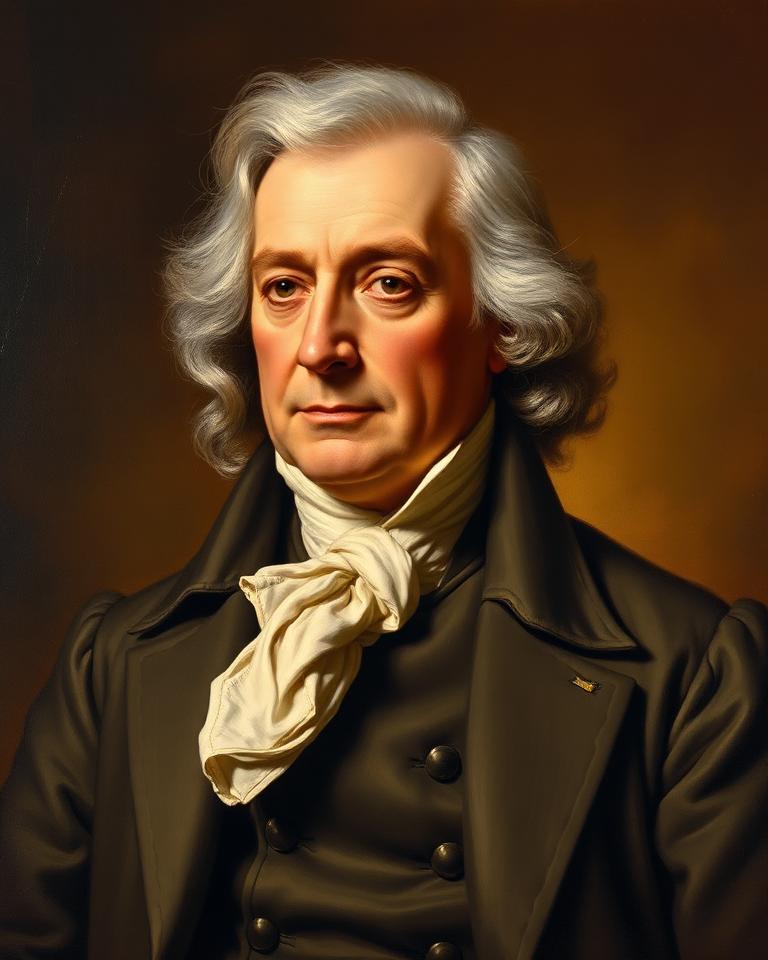
William Wilberforce was a British parliamentarian, social reformer, and leading campaigner against the transatlantic slave trade. Born into a prosperous merchant family in Hull in 1759, he entered the House of Commons at the age of twenty-one and remained in Parliament for nearly forty-five years. His name became inseparable from the long political struggle that culminated in the Slave Trade Act of 1807, which prohibited British participation in the Atlantic slave trade.
Wilberforce did not act alone. The abolitionist movement depended on the testimony of formerly enslaved Africans such as Olaudah Equiano, the investigative work of Thomas Clarkson, the organizing abilities of Granville Sharp, the activism of women’s associations, religious networks, petitioners, and sympathetic politicians. Wilberforce’s distinctive role was to serve as the movement’s principal parliamentary advocate. He repeatedly introduced abolition measures, assembled evidence, cultivated alliances, and kept the issue before Parliament despite defeats, war, political resistance, and powerful commercial interests.
His public life extended far beyond abolition. Influenced by evangelical Christianity, Wilberforce supported missionary societies, prison reform, education, animal welfare, and what contemporaries called the “reformation of manners”—a campaign to improve public morality and social conduct. He helped establish organizations including the Church Missionary Society and supported the creation of the Society for the Prevention of Cruelty to Animals.
Wilberforce remains a complex historical figure. He displayed remarkable persistence in opposing the slave trade, but his politics were generally conservative. He resisted some democratic reforms, feared revolutionary upheaval, and often emphasized gradual change and social order. His paternalistic attitudes and support for coercive measures during periods of domestic unrest have therefore drawn criticism. A balanced assessment recognizes both his major contribution to abolition and the wider collective struggle in which it occurred.
Quick Facts
| Category | Details |
|---|---|
| Full name | William Wilberforce |
| Born | 24 August 1759 |
| Birthplace | Hull, Yorkshire, England |
| Died | 29 July 1833 |
| Place of death | London, England |
| Nationality | British |
| Education | St John’s College, Cambridge |
| Occupation | Member of Parliament, abolitionist, social reformer |
| Parliamentary constituencies | Kingston upon Hull, Yorkshire, Bramber |
| Political alignment | Independent; generally associated with reform-minded and later conservative causes |
| Religious outlook | Evangelical Anglican |
| Spouse | Barbara Ann Spooner |
| Children | Six |
| Best known for | Parliamentary leadership of the campaign to abolish the British slave trade |
| Major legislation associated with his work | Slave Trade Act 1807 |
| Key publication | A Practical View of the Prevailing Religious System of Professed Christians (1797) |
| Major associates | Thomas Clarkson, Granville Sharp, Henry Thornton, Hannah More, Charles James Fox, William Pitt the Younger |
| Reform network | Commonly known as the Clapham Sect |
| Burial place | Westminster Abbey, London |
Early Life & Background
William Wilberforce was born on 24 August 1759 in Hull, a thriving port town in Yorkshire. He was the only son of Robert Wilberforce, a wealthy merchant, and Elizabeth Bird Wilberforce. The family had accumulated considerable wealth through Baltic trade, and its commercial standing gave the young Wilberforce financial independence and access to influential social circles.
His father died in 1768, when William was still a child. For a period he lived near London with his uncle William Wilberforce and aunt Hannah. They were influenced by the evangelical revival associated with the Methodist preacher George Whitefield and the Anglican clergyman John Newton, a former slave-ship captain who later became a prominent evangelical minister and abolitionist.
Wilberforce’s mother and grandfather worried that these relatives were making him too religious and brought him back to Hull. He attended Hull Grammar School and later studied at Pocklington School. Although intelligent and sociable, he was not known in youth for strict academic discipline. He possessed a small physical stature but developed a reputation for warmth, wit, conversation, and an unusually expressive speaking voice.
In 1776 Wilberforce entered St John’s College, Cambridge. His inheritance allowed him to live comfortably, and he spent much of his university life socializing rather than studying intensively. At Cambridge he formed a close friendship with William Pitt the Younger, the son of former prime minister William Pitt the Elder. The relationship profoundly shaped both men’s careers.
Wilberforce received his Bachelor of Arts degree in 1781 and a Master of Arts degree in 1788. By the time he completed his undergraduate education, however, he had already entered national politics.
Rise to Prominence
In the general election of 1780, the twenty-one-year-old Wilberforce stood for one of Hull’s two parliamentary seats. Elections in eighteenth-century Britain were expensive, personal, and often dominated by local patronage. Wilberforce reportedly spent thousands of pounds cultivating support, but he successfully presented himself as an independent candidate and was elected to the House of Commons.
He quickly became known for his eloquence and personal charm. The diarist James Boswell described hearing “the shrimp” speak like a whale, a remark that captured the contrast between Wilberforce’s slight appearance and the force of his oratory.
His friendship with Pitt strengthened his position. When Pitt became prime minister in December 1783, at the age of twenty-four, Wilberforce was among his trusted political associates. Yet Wilberforce did not simply become a government follower. He valued his independence and did not accept ministerial office.
In 1784, Wilberforce contested the prestigious county constituency of Yorkshire. He won after an energetic campaign and became one of the representatives of the largest county electorate in England. Holding the Yorkshire seat gave him far greater national stature than representing Hull.
A decisive transformation occurred during 1784 and 1785. While traveling in Europe, Wilberforce read religious works with Isaac Milner, a Cambridge scholar and clergyman. He underwent an evangelical conversion, becoming convinced that Christianity required a deep personal commitment rather than merely conventional observance.
Wilberforce initially wondered whether he should leave politics. He consulted John Newton, who advised him to remain in Parliament and use his position for public service. Pitt similarly encouraged him not to withdraw. Wilberforce gradually concluded that political life could be a religious vocation.
By 1787 he had identified two central purposes: the suppression of the slave trade and the moral improvement of British society. These aims would dominate the rest of his career.
Major Achievements
Leadership of the parliamentary abolition campaign
Wilberforce’s greatest achievement was his sustained leadership in Parliament against the British slave trade. In the eighteenth century, British ships transported hundreds of thousands of captive Africans across the Atlantic under brutal conditions. British merchants, ports, insurers, manufacturers, plantation owners, and consumers were deeply connected to an economic system dependent on enslaved labor.
The organized abolition campaign emerged in the 1780s. In 1787 Quaker activists and Anglican allies established the Society for Effecting the Abolition of the Slave Trade. Thomas Clarkson traveled across Britain collecting evidence from sailors, surgeons, merchants, and others familiar with slave ships. Granville Sharp provided legal expertise. Olaudah Equiano’s autobiography and public lectures offered influential testimony about enslavement and the Atlantic world.
Wilberforce became the movement’s principal representative in the House of Commons. On 12 May 1789, he delivered his first major parliamentary speech for abolition. Speaking for more than three hours, he described the trade’s violence, high mortality, and destructive effects. He argued that Parliament could no longer plead ignorance.
He introduced abolition bills or motions repeatedly. Early proposals failed because of opposition from West Indian planters, merchants, shipowners, and politicians who claimed the trade was essential to imperial prosperity. Some opponents also warned that Britain’s rivals would continue trafficking even if Britain stopped.
The outbreak of war with revolutionary France in 1793 made abolition more difficult. Reform movements were increasingly associated in the public mind with radicalism and revolution. Nevertheless, Wilberforce continued to press the issue. An abolition bill was narrowly defeated in the Commons in 1796, partly because several supporters were absent.
Political conditions changed in the early nineteenth century. The death of Pitt in January 1806 was a personal and political blow, but the new “Ministry of All the Talents” was more receptive to abolition. In 1806 Parliament prohibited British subjects from participating in the slave trade to foreign colonies, weakening much of the trade before full abolition.
The Slave Trade Act passed the House of Commons on 23 February 1807 by 283 votes to 16. The Lords also approved it, and it received royal assent on 25 March 1807. The act made participation in the slave trade illegal throughout the British Empire.
The law did not abolish slavery itself, and illegal trafficking continued. Enforcement initially proved difficult, though the Royal Navy’s West Africa Squadron later intercepted slave ships and pressured other states to suppress the trade. Even so, the 1807 act represented a historic change in British imperial law and policy.
Campaign against slavery
After 1807, Wilberforce supported efforts to end slavery in Britain’s colonies. He recognized that ending the trade had not liberated people already enslaved on Caribbean and other plantations.
In 1823 he helped inspire the formation of the Society for the Mitigation and Gradual Abolition of Slavery Throughout the British Dominions, commonly called the Anti-Slavery Society. He published An Appeal to the Religion, Justice, and Humanity of the Inhabitants of the British Empire in Behalf of the Negro Slaves in the West Indies that year.
By this stage, younger activists—especially Thomas Fowell Buxton—were assuming parliamentary leadership. Wilberforce retired from Parliament in 1825 but continued to support emancipation.
The Slavery Abolition Act 1833 passed through Parliament shortly before Wilberforce’s death. He learned that the measure had made decisive progress but died on 29 July, before it received royal assent on 28 August. The act abolished slavery in most British colonies, though it imposed a coercive “apprenticeship” system and excluded territories administered by the East India Company, Ceylon, and St Helena at first. It also compensated slave owners rather than the enslaved.
Moral and social reform
In 1787 Wilberforce encouraged King George III to issue a Proclamation for the Encouragement of Piety and Virtue and for the Preventing and Punishing of Vice, Profaneness, and Immorality. The resulting movement became known as the Proclamation Society.
Wilberforce believed that Britain’s public life had been damaged by excessive drinking, gambling, cruelty, sexual exploitation, and disregard for religion. His campaign for a “reformation of manners” sought to change both individual conduct and social institutions.
Some aspects of this program encouraged valuable reforms, including better education, more humane treatment of prisoners, and opposition to cruelty. Other aspects reflected the paternalism of upper-class evangelicals who sought to regulate the behavior of poorer people while leaving economic inequalities largely intact.
Religious, educational, and humanitarian institutions
Wilberforce belonged to an influential evangelical network later called the Clapham Sect, named after the south London community where several members lived. Its leading figures included Henry Thornton, Hannah More, Zachary Macaulay, James Stephen, and John Venn.
He supported or helped establish numerous organizations, including:
- The Church Missionary Society, founded in 1799.
- The British and Foreign Bible Society, founded in 1804.
- Educational initiatives associated with Hannah More.
- Campaigns for prison and criminal-law reform.
- The organization founded in 1824 that became the Royal Society for the Prevention of Cruelty to Animals.
- Efforts to permit Christian missionary activity in British-controlled India.
Through these causes, Wilberforce helped shape the culture of nineteenth-century British humanitarian and evangelical activism.
Defining Moments
Evangelical conversion
Wilberforce’s religious awakening in 1784–1785 transformed his understanding of ambition and duty. Before his conversion, politics had offered social distinction and intellectual excitement. Afterward, he interpreted public service as a moral obligation before God.
His decision to remain in Parliament was crucial. Had he entered the clergy or withdrawn into private life, the abolition movement would have lost an advocate with exceptional political access and speaking ability.
The decision to champion abolition
In 1787 abolitionists approached Wilberforce about leading their cause in Parliament. He did not invent British abolitionism, but he possessed the wealth, status, connections, and parliamentary skill needed to carry the campaign into the legislature.
His collaboration with Clarkson became especially important. Clarkson gathered information across the country; Wilberforce converted that evidence into parliamentary argument. Their partnership illustrates how political reform often depends on cooperation between public organizers and legislators.
The speech of 12 May 1789
Wilberforce’s first major abolition speech was a defining display of moral and political advocacy. He carefully avoided presenting the issue simply as a personal attack on slave traders. Instead, he argued that the nation as a whole bore responsibility because the trade had been protected by law.
The speech laid out a method he would use repeatedly: documentary evidence, witness testimony, economic argument, Christian morality, and an appeal to national honor.
Repeated parliamentary defeats
The campaign’s failures during the 1790s tested Wilberforce’s persistence. Abolition proposals were delayed, weakened, or rejected. War with France allowed opponents to portray reformers as dangerous radicals.
Wilberforce’s willingness to return to the issue year after year became one of his defining qualities. At the same time, the focus on his perseverance should not obscure the mass movement outside Parliament, which generated petitions, organized consumer boycotts of slave-grown sugar, published evidence, and changed public opinion.
Passage of the 1807 act
The overwhelming Commons vote in February 1807 marked the peak of Wilberforce’s parliamentary career. After the result was announced, members gave him an extraordinary tribute. He sat with his head bowed as the chamber applauded his efforts.
Yet 1807 was a beginning as well as an end. The act prohibited trafficking but did not free enslaved people. Wilberforce and his allies therefore faced the longer challenge of enforcement and emancipation.
Final campaign for emancipation
Declining health forced Wilberforce to reduce his political activity and retire in 1825. He entrusted parliamentary leadership to Buxton while continuing to encourage the movement.
In July 1833, he was informed that the government’s emancipation bill would pass. He died three days later. His proximity to the measure’s success gave his death symbolic significance, although the final act reflected decades of resistance by enslaved people and the work of many British and colonial campaigners.
Timeline
| Year | Event |
|---|---|
| 1759 | Born in Hull, Yorkshire, on 24 August |
| 1768 | His father dies; Wilberforce later spends part of his childhood with evangelical relatives |
| 1776 | Enters St John’s College, Cambridge |
| 1780 | Elected Member of Parliament for Hull at the age of twenty-one |
| 1781 | Receives his Bachelor of Arts degree |
| 1784 | Elected MP for Yorkshire; travels with Isaac Milner |
| 1785 | Experiences an evangelical conversion |
| 1786 | Consults John Newton about his future in politics |
| 1787 | Commits himself to abolition and the “reformation of manners” |
| 1788 | Parliament begins formally examining the slave trade; Wilberforce is temporarily prevented by illness from leading the debate |
| 1789 | Delivers his first major parliamentary speech against the slave trade on 12 May |
| 1791 | His first abolition bill is decisively defeated |
| 1792 | Commons supports gradual abolition, but the measure does not become effective law |
| 1793 | War with revolutionary France weakens the political prospects of abolition |
| 1796 | An abolition measure is narrowly defeated in the Commons |
| 1797 | Marries Barbara Ann Spooner; publishes A Practical View |
| 1799 | Helps support the foundation of the Church Missionary Society |
| 1804 | Supports the British and Foreign Bible Society |
| 1806 | Parliament restricts British involvement in the slave trade to foreign colonies |
| 1807 | Slave Trade Act receives royal assent on 25 March |
| 1812 | Leaves the Yorkshire seat and becomes MP for Bramber |
| 1823 | Publishes an appeal for emancipation and supports the formation of the Anti-Slavery Society |
| 1824 | Supports the organization later known as the RSPCA |
| 1825 | Retires from Parliament because of ill health |
| 1833 | Dies in London on 29 July; Slavery Abolition Act receives royal assent on 28 August |
| 1833 | Buried in Westminster Abbey near William Pitt the Younger |
Personal Life
Wilberforce married Barbara Ann Spooner on 30 May 1797. Their courtship was unusually brief, but the marriage was affectionate and produced six children: William, Barbara, Elizabeth, Robert, Samuel, and Henry.
His domestic life was deeply religious. Prayer, Bible reading, and charitable activity structured the household. Wilberforce was fond of his children, though frequent political and reform obligations placed pressure on his time and finances.
He struggled throughout his adult life with poor health. His ailments included digestive problems, eye trouble, and periods of exhaustion. Doctors prescribed opium, a common medical treatment at the time, and he used it in controlled medicinal doses for many years. Historical evidence does not support simplistic portrayals of him as an opium addict in the modern recreational sense.
Despite inheriting wealth, Wilberforce experienced financial difficulties later in life. He donated generously to charitable causes and helped support relatives and acquaintances. Financial problems involving his eldest son also reduced the family’s security. In his final years, he and Barbara lived with their sons.
Wilberforce died at a relative’s home in London on 29 July 1833, aged seventy-three. He had expressed a preference for a modest burial, but national leaders arranged for him to be interred in Westminster Abbey, close to Pitt.
Beliefs & Philosophy
Wilberforce’s worldview was grounded in evangelical Anglican Christianity. He believed that authentic faith required an inward transformation demonstrated through outward conduct. In his influential 1797 book, A Practical View of the Prevailing Religious System of Professed Christians, he criticized nominal Christianity and urged readers to adopt a serious, active faith.
Several principles defined his thought:
- Human equality before God: Wilberforce argued that Africans could not morally be treated as commodities. Christian belief, in his view, contradicted the degradation inherent in the slave trade.
- Personal responsibility: He believed individuals and nations were accountable for tolerated injustice, even when wrongdoing was lawful or customary.
- Moral reform through persuasion and law: Wilberforce combined public education with legislation. He sought to alter both institutions and individual behavior.
- Providence and vocation: He interpreted his political opportunities as responsibilities assigned by God.
- Gradualism: He usually favored incremental reform over sudden structural change.
- Social order: He feared that revolutionary upheaval would produce violence and irreligion. This made him cautious about popular democracy and labor agitation.
- Philanthropy: He believed wealth and influence should be used for charitable and public purposes.
His philosophy contained a persistent tension. The doctrine of shared humanity helped motivate his opposition to the slave trade, but his social conservatism limited his sympathy for certain demands for political equality at home. He wished to reform society morally without fundamentally overturning its class hierarchy.
Challenges & Controversies
Wilberforce faced formidable opposition from interests connected to slavery. West Indian planters and merchants disputed abolitionist evidence, defended slavery as economically necessary, and warned that reform would strengthen rival empires. The campaign also had to overcome public indifference and Parliament’s reluctance to interfere with profitable commerce.
War created another obstacle. After 1793, British authorities repressed radical organizations and restricted political dissent. Abolitionists could be accused of weakening the empire during a national emergency.
Wilberforce’s own political choices have also attracted criticism. Although independent, he frequently supported Pitt’s government and later conservative administrations. He backed some measures restricting civil liberties during wartime and was alarmed by radical movements. Critics argue that his concern for enslaved Africans coexisted with insufficient support for impoverished British workers.
His response to the Peterloo Massacre of 1819, in which cavalry attacked a large reform meeting in Manchester, was especially controversial. Wilberforce did not endorse the radical parliamentary reform movement and supported the government’s repressive Six Acts. His position reflected his fear of revolution but damaged his reputation among advocates of civil liberty.
The “reformation of manners” campaign can likewise appear intrusive and class-conscious. Efforts to suppress vice often focused heavily on the habits and recreation of the poor. Wilberforce’s charitable approach generally sought to improve conduct rather than redistribute political or economic power.
His abolitionism was also shaped by the paternalistic assumptions of his time. He sometimes portrayed Africans as people to be protected, civilized, or Christianized rather than as autonomous political actors. The disastrous abolitionist colony of Sierra Leone, which he supported as part of a wider philanthropic vision, revealed conflicts between idealistic intentions, commercial interests, colonial governance, and African agency.
Finally, popular accounts have sometimes credited Wilberforce almost single-handedly with ending the slave trade and slavery. This “great man” interpretation is misleading. Abolition depended on Black writers and activists, resistance and rebellion by enslaved people, Quaker organizers, women campaigners, working-class petitioners, lawyers, clergy, politicians, and international developments. Wilberforce’s role was indispensable in Parliament, but it was part of a much larger movement.
Famous Quotes
“God Almighty has set before me two great objects, the suppression of the Slave Trade and the Reformation of Manners.”
— Journal entry, 28 October 1787
“I mean not to accuse any one, but to take the shame upon myself, in common indeed with the whole Parliament of Great Britain, for having suffered this horrid trade to be carried on under their authority.”
— Speech to the House of Commons, 12 May 1789
“So enormous, so dreadful, so irremediable did the trade’s wickedness appear that my own mind was completely made up for abolition.”
— Speech to the House of Commons, 12 May 1789
“Let true Christians then, with becoming earnestness, strive in all things to recommend their profession, and to put to silence the vain scoffs of ignorant objectors.”
— A Practical View of the Prevailing Religious System of Professed Christians, 1797
“The grand radical defect in the practical system of these nominal Christians is their forgetfulness of all the peculiar doctrines of the religion which they profess.”
— A Practical View, 1797
Some phrases widely attributed to Wilberforce—particularly “You may choose to look the other way, but you can never say again that you did not know”—lack a secure primary-source attribution and should be treated cautiously.
Legacy & Influence
Wilberforce’s most enduring legacy is his contribution to making the slave trade a central question of national morality and parliamentary policy. His persistence helped transform abolition from a marginal cause into a legislative reality.
The 1807 act also influenced British foreign policy. Britain later used diplomacy, treaties, naval patrols, and mixed commissions to suppress Atlantic trafficking. These measures rescued some captives and constrained parts of the trade, although they were inconsistently applied and could also serve British strategic and imperial interests.
His methods became a model for later pressure-group politics. Abolitionists gathered data, published eyewitness accounts, circulated images, held meetings, organized boycotts, coordinated petitions, and worked with sympathetic legislators. Similar techniques were later used by movements for factory reform, women’s rights, temperance, animal welfare, and other causes.
Wilberforce’s religious activism contributed to the rise of Victorian evangelical humanitarianism. Institutions he supported continued missionary, educational, and charitable work long after his death. His descendants also entered religious and public life: his son Samuel Wilberforce became a prominent Anglican bishop, while Robert and Henry Wilberforce became associated with the Oxford Movement and later converted to Roman Catholicism.
Memorials to Wilberforce include his tomb and statue in Westminster Abbey and the Wilberforce Monument in Hull. His birthplace, Wilberforce House, became a museum devoted to slavery, abolition, and social justice.
Modern scholarship places him within a broader, more international history. His achievements are now examined alongside the Haitian Revolution, Caribbean slave rebellions, African resistance, Black abolitionist writing, consumer activism, and changes in imperial economics. This expanded perspective does not erase his contribution; it explains why abolition succeeded and restores recognition to participants previously pushed to the margins.
Wilberforce’s reputation therefore rests on two connected truths. He was a determined and highly effective parliamentary abolitionist. He was also a man of his class, religion, and age, whose humanitarianism coexisted with political conservatism and paternalism. Understanding both is essential to understanding his historical significance.
Interesting Facts
- Wilberforce entered Parliament at only twenty-one, the minimum age permitted at the time.
- He and William Pitt the Younger were close friends before either achieved national prominence.
- He possessed a notably powerful speaking voice despite being short and physically slight.
- The nickname “the Clapham Sect” was applied to his evangelical circle by others and was not originally its formal name.
- His first major abolition speech in 1789 lasted more than three hours.
- He campaigned against the slave trade for roughly two decades before the 1807 act became law.
- He kept extensive journals and lists of personal resolutions as part of his religious discipline.
- His 1797 religious book became a bestseller and appeared in several editions.
- He supported vaccination during a period when the practice faced public suspicion.
- His interests included animal welfare, and he supported the 1824 foundation of the society that became the RSPCA.
- He knew John Newton, the former slave-ship captain who wrote the hymn “Amazing Grace.”
- He retired from the House of Commons in 1825 after nearly forty-five years in Parliament.
- He died three days after hearing that the government’s emancipation measure had passed a crucial parliamentary stage.
- Four of his sons later wrote a multi-volume biography of him, shaping his public image for generations.
- The Slavery Abolition Act of 1833 compensated slave owners, not formerly enslaved people—a limitation central to modern assessments of British emancipation.
Frequently Asked Questions
What was William Wilberforce famous for?
Wilberforce was famous for leading the parliamentary campaign against the British slave trade. He repeatedly introduced abolition proposals and helped secure passage of the Slave Trade Act in 1807.
Did William Wilberforce abolish slavery?
Not by himself, and not in 1807. The 1807 act abolished British participation in the slave trade but did not abolish slavery. Slavery in most British colonies was abolished by the Slavery Abolition Act of 1833, passed shortly after Wilberforce’s death. Both achievements resulted from collective movements involving many activists and resistance by enslaved people.
Who worked with Wilberforce?
His principal allies included Thomas Clarkson, Granville Sharp, Henry Thornton, Hannah More, Zachary Macaulay, James Stephen, Charles James Fox, and Thomas Fowell Buxton. Black abolitionists such as Olaudah Equiano also played a major role in changing public opinion.
Why did abolition take so long?
The slave trade generated profits for powerful merchants, plantation owners, ports, and related industries. Its defenders possessed substantial influence in Parliament. War with France, fear of revolution, racism, imperial competition, and political delay also slowed reform.
What was the Clapham Sect?
The Clapham Sect was an informal network of wealthy evangelical Anglicans active in political, religious, and humanitarian reform. Several members lived in or near Clapham, south of London. The group supported abolition, missions, education, and moral reform.
Was Wilberforce a conservative?
In many respects, yes. He opposed the slave trade and supported several humanitarian reforms, but he feared radical democracy and revolutionary change. He backed restrictive government measures during periods of domestic unrest and usually favored gradual reform within the existing social order.
What religion was William Wilberforce?
He was an evangelical Anglican. His conversion in the mid-1780s led him to view politics as a form of Christian service and shaped nearly every aspect of his reform agenda.
Did Wilberforce know slavery was still legal after 1807?
Yes. He clearly understood the distinction between abolishing the trade and abolishing slavery. After 1807 he supported registration, enforcement, amelioration, and eventually emancipation throughout the British colonies.
When and how did he die?
Wilberforce died in London on 29 July 1833 after a period of declining health. He was seventy-three. He was buried in Westminster Abbey.
Why is Wilberforce sometimes criticized today?
Criticism focuses on his political conservatism, paternalism, resistance to democratic reform, support for repressive laws, and the tendency of older histories to exaggerate his individual role. Scholars also emphasize that Black abolitionists, women, religious minorities, ordinary petitioners, and enslaved rebels were essential to abolition.
Lessons from William Wilberforce
- Long-term reform requires persistence: Major political victories may follow years or decades of defeat.
- Evidence strengthens moral argument: The abolitionists combined ethical appeals with testimony, statistics, diagrams, and investigations.
- Coalitions matter: Wilberforce succeeded through cooperation with activists, writers, clergy, lawyers, politicians, and community organizers.
- Political access should serve public responsibility: He used wealth and status to advance a cause that challenged powerful interests.
- Legal reform is not the same as complete justice: Ending the slave trade did not end slavery, exploitation, or racial inequality.
- Historical achievements are collective: Celebrating a prominent leader should not erase less famous participants.
- Conviction can coexist with contradiction: Wilberforce’s humanitarianism was genuine, but it existed alongside conservative and paternalistic beliefs.
- Public opinion can be organized: Petitions, publications, boycotts, lectures, and visual evidence helped turn abolition into a national movement.
- Successful movements adapt: Abolitionists changed tactics in response to parliamentary defeats, war, and shifting political circumstances.
- Legacies should be examined critically: Respect for achievement is compatible with honest discussion of limitations and controversy.
Further Reading
- William Hague, William Wilberforce: The Life of the Great Anti-Slave Trade Campaigner
- John Pollock, Wilberforce
- William Wilberforce, A Practical View of the Prevailing Religious System of Professed Christians
- William Wilberforce, An Appeal to the Religion, Justice, and Humanity of the Inhabitants of the British Empire in Behalf of the Negro Slaves in the West Indies
- John Wolffe, William Wilberforce
- Stephen Tomkins, William Wilberforce: A Biography
- Adam Hochschild, Bury the Chains: Prophets and Rebels in the Fight to Free an Empire’s Slaves
- Seymour Drescher, Abolition: A History of Slavery and Antislavery
- Christopher Leslie Brown, Moral Capital: Foundations of British Abolitionism
- David Brion Davis, The Problem of Slavery in the Age of Revolution, 1770–1823
- Olaudah Equiano, The Interesting Narrative of the Life of Olaudah Equiano
- Thomas Clarkson, The History of the Rise, Progress, and Accomplishment of the Abolition of the African Slave-Trade by the British Parliament
- Michael Jordan, The Great Abolition Sham: The True Story of the End of the British Slave Trade
- House of Commons Parliamentary Papers and debates concerning the slave trade and abolition
- Wilberforce House Museum, Hull, collections on slavery, abolition, and William Wilberforce
Watch and Learn
Related Historical Figures