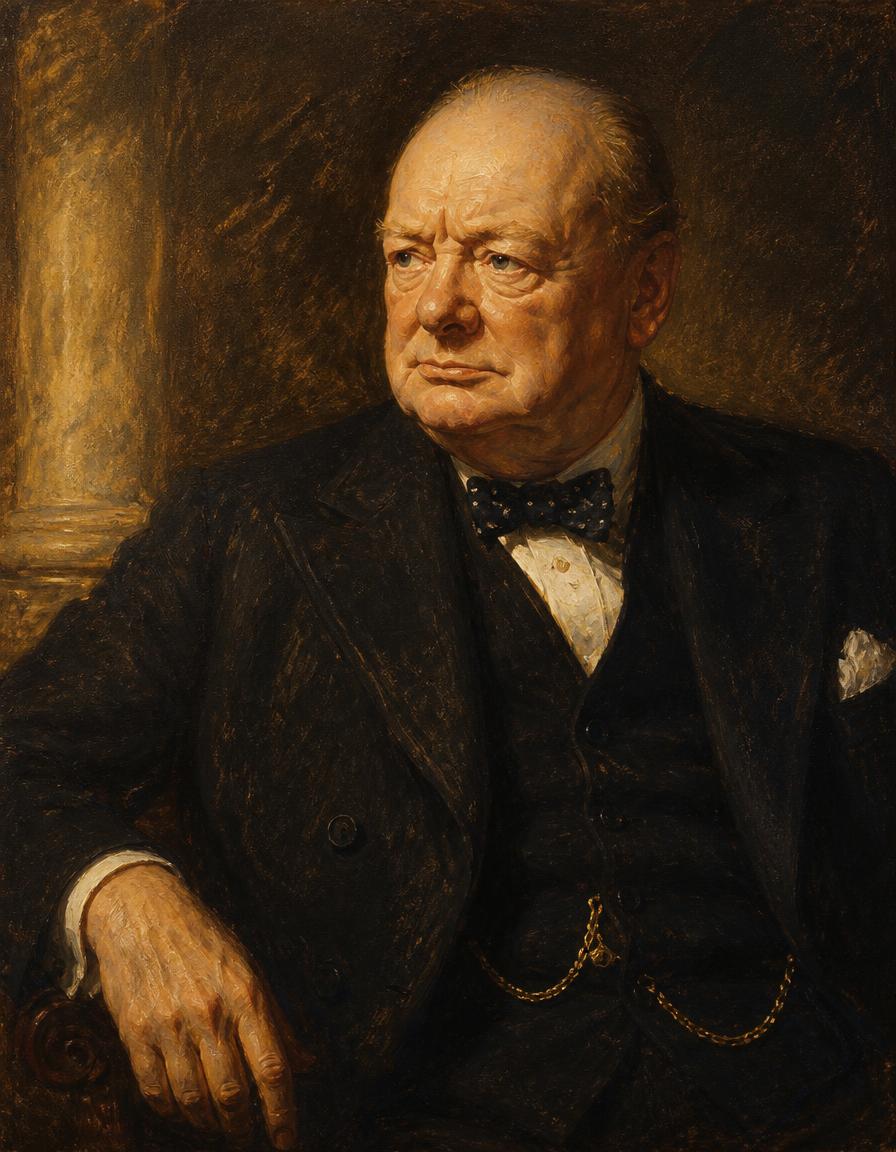
Quick Facts
- Years
- 1874 – 1965
- Category
- World Leaders & Revolutionaries
- Nationality
- British
- Occupation
- Prime Minister & Orator
Winston Churchill
1874 – 1965 · British · Prime Minister & Orator
Audiobook

Life Lessons from Winston Churchill
Marcus Alden · 52 min
Introduction
Sir Winston Leonard Spencer Churchill was a British statesman, soldier, writer, historian and orator whose career spanned the height of the British Empire, two world wars and the emergence of the Cold War. He is best remembered as prime minister of the United Kingdom during the Second World War, when his speeches and political leadership helped sustain British resistance to Nazi Germany after the fall of France in 1940.
Churchill’s reputation, however, rests on far more than the events of 1940–1945. Over six decades in Parliament, he changed parties twice, occupied many of Britain’s highest offices and participated in debates over social reform, imperial rule, military strategy, economic policy and European cooperation. Before reaching the premiership at the age of 65, he had already been a cavalry officer, war correspondent, prisoner of war, cabinet minister and First Lord of the Admiralty. He later received the 1953 Nobel Prize in Literature for his historical and biographical writing and oratory.
His life also contains serious failures and enduring controversies. He played a leading role in the disastrous Gallipoli campaign during the First World War, resisted Indian self-government, expressed racist and imperialist views, and governed during the Bengal famine of 1943. Historians continue to debate his responsibility for military decisions, colonial policy and wartime suffering.
Churchill therefore occupies a complicated place in history: celebrated as a defender of parliamentary democracy against fascism, yet inseparable from the hierarchies and violence of empire. Understanding him requires attention both to the extraordinary importance of his wartime leadership and to the limitations, prejudices and consequences of his wider political career.
Quick Facts
| Category | Details |
|---|---|
| Full name | Winston Leonard Spencer Churchill |
| Born | 30 November 1874 |
| Birthplace | Blenheim Palace, Oxfordshire, England |
| Died | 24 January 1965 |
| Place of death | London, England |
| Nationality | British |
| Parents | Lord Randolph Churchill and Jennie Jerome Churchill |
| Spouse | Clementine Hozier, married 12 September 1908 |
| Children | Diana, Randolph, Sarah, Marigold and Mary Churchill |
| Political parties | Conservative; Liberal, 1904–1924; Conservative thereafter |
| Parliamentary service | Member of Parliament, 1900–1922 and 1924–1964 |
| Prime minister | 10 May 1940–26 July 1945; 26 October 1951–5 April 1955 |
| Major wartime role | Prime minister and minister of defence during most of the Second World War |
| Notable works | The World Crisis, My Early Life, Marlborough, The Second World War, A History of the English-Speaking Peoples |
| Major honours | Nobel Prize in Literature, 1953; Knight of the Garter, 1953; honorary citizenship of the United States, 1963 |
| Burial place | St Martin’s Church, Bladon, Oxfordshire |
Early Life & Background
Winston Churchill was born on 30 November 1874 at Blenheim Palace, the ancestral home of the dukes of Marlborough. Through his father, Lord Randolph Churchill, he belonged to the aristocratic Spencer-Churchill family and was a descendant of John Churchill, 1st Duke of Marlborough, one of Britain’s most celebrated generals. His mother, Jennie Jerome, was an American-born socialite and the daughter of New York financier Leonard Jerome.
Lord Randolph was a prominent Conservative politician who served as chancellor of the Exchequer and leader of the House of Commons before his career collapsed after a misjudged resignation in 1886. Winston admired his father intensely, although their relationship was distant. His mother was glamorous and socially influential but was also often absent during his childhood. Churchill’s closest early emotional bond was with his nanny, Elizabeth Everest, whom he called “Woom.”
Churchill attended several schools before entering Harrow School in 1888. He was not consistently successful in conventional academic subjects, but he showed ability in English, history and memorization. After twice failing the entrance examination, he was admitted to the Royal Military College at Sandhurst on his third attempt. He graduated in December 1894, ranking eighth in a class of 150, and joined the 4th Queen’s Own Hussars as a cavalry officer.
Determined to gain experience and public recognition, Churchill combined military service with journalism. In 1895 he visited Cuba, where Spanish forces were fighting an independence movement, and sent reports to the Daily Graphic. He served in British India from 1896, educating himself through extensive reading while stationed in Bangalore. In 1897 he accompanied the Malakand Field Force on the North-West Frontier, now in Pakistan, and transformed his reports into his first major book, The Story of the Malakand Field Force.
In 1898 Churchill joined General Herbert Kitchener’s Sudan campaign. At the Battle of Omdurman on 2 September, he took part in what is often described as one of the British Army’s last major cavalry charges. His account, The River War, combined military history with criticism of aspects of Kitchener’s conduct.
Churchill resigned from the army in 1899 and sought a parliamentary career. After unsuccessfully contesting Oldham as a Conservative, he travelled to southern Africa to report on the Second Boer War. Captured when Boer forces attacked an armoured train near Chieveley in November 1899, he was imprisoned in Pretoria. His dramatic escape—crossing the prison fence and eventually reaching Portuguese East Africa—made him a national celebrity. Returning to the war zone, he accompanied British forces into Ladysmith and Pretoria, converting adventure and journalism into political visibility.
Rise to Prominence
Churchill was elected Conservative member of Parliament for Oldham in October 1900. From the beginning, he showed an independent temperament and a desire to speak on major national questions. He criticized elements of Conservative military spending and opposed the government’s protectionist tariff policy. In 1904 he crossed the floor of the House of Commons and joined the Liberal Party, a dramatic act that earned lasting hostility from many Conservatives.
The Liberal election victory of 1906 brought Churchill into government as under-secretary of state for the Colonies. He participated in the political settlement that granted self-government to the former Boer republics of Transvaal and the Orange River Colony. In 1908 Prime Minister H. H. Asquith promoted him to president of the Board of Trade. Working alongside Chancellor of the Exchequer David Lloyd George, Churchill supported reforms including labour exchanges, unemployment insurance and regulation of working conditions in certain industries.
Churchill became home secretary in 1910. His tenure was marked by prison reform but also by industrial conflict and public-order crises. His actions during the 1910–1911 strikes in South Wales generated the enduring “Tonypandy” controversy. Contrary to later claims, Churchill did not order troops to open fire on miners, but he did authorize military deployment in support of civil authorities, and his name became associated with state coercion. He was also criticized for his role during the January 1911 Siege of Sidney Street, when he appeared personally at the scene of an armed confrontation in London.
In October 1911 Churchill became First Lord of the Admiralty. Convinced that war with Germany was possible, he accelerated naval preparedness, encouraged the transition from coal to oil, supported the development of naval aviation and backed construction of fast Queen Elizabeth-class battleships. He also helped create a naval war staff and worked closely with Admiral Sir John Fisher, although their relationship later deteriorated.
When the First World War began in August 1914, Churchill was one of the cabinet’s most energetic ministers. His boldness could be productive, but it also encouraged risky schemes. The most consequential was the effort to force the Dardanelles, defeat the Ottoman Empire and open a maritime route to Russia. Naval attacks were followed by Allied landings on the Gallipoli peninsula in April 1915. Ottoman resistance, inadequate planning, poor command and difficult terrain produced a costly stalemate. More than 130,000 men on all sides died before the Allies withdrew.
Although responsibility was shared across the government and military leadership, Churchill became a principal political casualty. He left the Admiralty in May 1915 and resigned from the government that November. Seeking personal and political rehabilitation, he served on the Western Front as commander of the 6th Battalion, Royal Scots Fusiliers, in 1916.
Lloyd George restored Churchill to office in 1917 as minister of munitions. After the war he served as secretary of state for war and air, then as colonial secretary. He strongly supported Allied intervention against the Bolsheviks in the Russian Civil War. As colonial secretary, he participated in the 1921 Cairo Conference, which shaped British administration in the Middle East and helped establish Faisal I as king of Iraq and Abdullah as ruler of Transjordan.
Defeated in the 1922 general election, Churchill spent two years outside Parliament. He re-entered the Commons in 1924 as member for Epping and formally rejoined the Conservatives. Prime Minister Stanley Baldwin appointed him chancellor of the Exchequer, a position once held by his father.
Major Achievements
Churchill’s greatest achievement was his leadership of Britain during the crisis of 1940. When Germany invaded the Low Countries and France on 10 May, King George VI appointed him prime minister following Neville Chamberlain’s resignation. Churchill formed a coalition government that included Conservatives, Labour and Liberals, while also taking the title of minister of defence.
During the War Cabinet debates of 26–28 May 1940, Foreign Secretary Lord Halifax favoured exploring whether Benito Mussolini’s Italy might mediate terms with Germany. Churchill opposed any move that could lead toward a negotiated peace under German domination. Supported by Labour ministers Clement Attlee and Arthur Greenwood—and eventually by the wider cabinet—he maintained that Britain should continue fighting.
Churchill’s speeches gave memorable form to that policy. His addresses following the Dunkirk evacuation, the fall of France and the beginning of the Battle of Britain did not promise easy victory. Instead, they combined stark warnings with defiant confidence. Radio broadcasts and parliamentary speeches helped connect the government’s strategy with a wider national narrative of endurance.
He was also a central figure in building the Allied coalition. Churchill cultivated a close relationship with U.S. President Franklin D. Roosevelt, securing American material support before the United States formally entered the war. The Lend-Lease program, enacted in March 1941, became essential to Britain’s survival. Churchill and Roosevelt issued the Atlantic Charter in August 1941, outlining principles for the postwar order.
After Germany invaded the Soviet Union in June 1941, the intensely anti-communist Churchill immediately offered assistance to Joseph Stalin’s government. Once the United States entered the conflict in December 1941, Churchill worked to maintain cooperation among three powers with very different interests. At conferences in Casablanca, Quebec, Tehran and Yalta, he participated in decisions governing Allied strategy and the shape of postwar Europe.
His wider political achievements included early support for social insurance and labour-market reforms before 1914, important contributions to naval modernization, and sustained advocacy of Anglo-American cooperation. In opposition after 1945, he warned of Soviet domination in Eastern Europe and promoted Western unity. His “Sinews of Peace” speech at Fulton, Missouri, on 5 March 1946 popularized the phrase “iron curtain.”
Churchill also supported forms of European cooperation. In his 1946 Zurich speech he called for “a kind of United States of Europe,” though he generally imagined Britain as a sponsor and partner rather than necessarily a fully integrated member. He chaired the Congress of Europe at The Hague in 1948 and supported institutions that contributed to the creation of the Council of Europe.
As an author, Churchill produced millions of words of journalism, history, memoir and biography. Although he relied heavily on research assistants and often wrote from a personal or partisan perspective, his works reached a vast readership. The Swedish Academy awarded him the 1953 Nobel Prize in Literature “for his mastery of historical and biographical description as well as for brilliant oratory in defending exalted human values.”
Defining Moments
The Gallipoli campaign was Churchill’s most damaging early failure. Its collapse taught him, though not always permanently, about the danger of allowing strategic imagination to outrun logistics and unified command. It also strengthened his determination to recover from political disaster.
The 1930s were his so-called “wilderness years.” Excluded from government after 1929, Churchill opposed constitutional concessions to Indian nationalism and denounced Mahatma Gandhi in intemperate terms. These views isolated him from much of the political establishment. At the same time, he became one of the most persistent critics of British disarmament and German rearmament under Adolf Hitler. Assisted by official and unofficial sources, he used speeches and articles to argue that the Nazi regime presented a grave strategic threat.
Churchill’s warnings did not make every judgment correct. He initially praised aspects of Mussolini’s anti-communism and supported King Edward VIII during the 1936 abdication crisis, both politically damaging positions. Nevertheless, the German occupation of Prague in March 1939 and the invasion of Poland that September vindicated his central warning about Hitler.
Reappointed First Lord of the Admiralty on 3 September 1939, Churchill returned to government as Britain declared war on Germany. Eight months later he became prime minister. His decision to continue the war after France’s collapse became the defining choice of his life.
The evacuation of more than 338,000 Allied troops from Dunkirk between 26 May and 4 June 1940 saved much of the British Expeditionary Force, but Churchill warned Parliament that “wars are not won by evacuations.” He then prepared the country for invasion while the Royal Air Force fought the Battle of Britain. The failure of Germany to gain air superiority prevented Operation Sea Lion, the planned invasion.
Churchill’s wartime leadership also involved grim choices. He approved strategic bombing, supported the demand for Germany’s unconditional surrender and accepted operations that caused enormous civilian casualties. He authorized the July 1940 attack on the French fleet at Mers-el-Kébir in Algeria, intended to prevent powerful warships from falling into Axis hands; nearly 1,300 French sailors were killed.
Victory in Europe came on 8 May 1945, but Churchill’s coalition soon dissolved. In the July general election, voters rejected the Conservatives and elected a Labour government led by Clement Attlee. Churchill remained personally admired, yet many voters associated Labour with postwar reconstruction and social security.
He returned as prime minister in October 1951. His second administration was less dramatic, focusing on Cold War diplomacy, nuclear defence and domestic stability. Age and ill health reduced his effectiveness. After suffering a serious stroke in June 1953, concealed from much of the public, he recovered sufficiently to continue in office but retired on 5 April 1955.
Timeline
| Year | Event |
|---|---|
| 1874 | Born at Blenheim Palace on 30 November |
| 1888 | Enters Harrow School |
| 1893 | Admitted to the Royal Military College, Sandhurst |
| 1895 | Commissioned into the 4th Hussars; reports from Cuba |
| 1897 | Serves with the Malakand Field Force |
| 1898 | Participates in the Battle of Omdurman |
| 1899 | Captured during the Boer War and escapes from Pretoria |
| 1900 | Elected Conservative MP for Oldham |
| 1904 | Leaves the Conservatives and joins the Liberals |
| 1908 | Becomes president of the Board of Trade; marries Clementine Hozier |
| 1910 | Appointed home secretary |
| 1911 | Becomes First Lord of the Admiralty |
| 1915 | Leaves the Admiralty after the Gallipoli failure |
| 1916 | Commands a battalion on the Western Front |
| 1917 | Returns to government as minister of munitions |
| 1921 | Becomes colonial secretary |
| 1924 | Rejoins the Conservatives and becomes chancellor of the Exchequer |
| 1925 | Restores sterling to the gold standard |
| 1929 | Leaves government and begins his “wilderness years” |
| 1939 | Reappointed First Lord of the Admiralty |
| 1940 | Becomes prime minister on 10 May |
| 1941 | Meets Roosevelt and issues the Atlantic Charter |
| 1943 | Attends the Casablanca and Tehran conferences |
| 1945 | Celebrates victory in Europe; loses the general election; attends Potsdam before leaving office |
| 1946 | Delivers the “Iron Curtain” speech at Fulton |
| 1951 | Returns as prime minister |
| 1953 | Knighted; receives the Nobel Prize in Literature; suffers a major stroke |
| 1955 | Retires as prime minister |
| 1963 | Made an honorary citizen of the United States |
| 1964 | Leaves the House of Commons |
| 1965 | Dies on 24 January; receives a state funeral |
Personal Life
Churchill married Clementine Hozier at St Margaret’s, Westminster, on 12 September 1908. Their marriage lasted more than 56 years. Clementine was an important political and emotional partner who offered frank criticism, managed family affairs during long separations and worked in public service during both world wars.
They had five children: Diana, Randolph, Sarah, Marigold and Mary. Marigold died of septicemia in 1921 at the age of two, a devastating loss. The family’s life was affected by Winston’s prolonged absences, political pressures, financial anxieties and the difficulties experienced by several of their children.
In 1922 Churchill purchased Chartwell, a country house near Westerham in Kent. It became his principal home and a place where he wrote, painted, entertained visitors, built walls, raised animals and supervised extensive gardens. Maintaining Chartwell was expensive, and Churchill frequently depended on journalism, publishing contracts and assistance from wealthy friends to support his lifestyle.
Painting became a major recreation after his political fall in 1915. He completed hundreds of landscapes and interior scenes, working mainly in oils. He also enjoyed bricklaying, horse racing, card games, swimming and elaborate meals. His fondness for cigars and alcohol became part of his public image, although anecdotes about his drinking are often exaggerated.
Churchill referred in one essay to his “black dog,” a phrase later widely interpreted as depression. Evidence about the severity and duration of his depressive episodes remains debated. He certainly experienced periods of low mood, anxiety and exhaustion, but he also possessed exceptional energy and an ability to recover from setbacks.
Beliefs & Philosophy
Churchill’s beliefs combined parliamentary liberalism, aristocratic tradition, nationalism and imperialism. He believed strongly in the British constitution, the House of Commons, freedom of debate and government under law. These convictions underlay his opposition to Nazi totalitarianism and later to Soviet expansion.
He was not ideologically consistent. As a Liberal reformer, he supported state action to reduce unemployment and insecurity, but he opposed socialism and defended private property. He distrusted mass political movements while displaying a remarkable ability to communicate with mass audiences.
Churchill viewed the British Empire as a force for order and progress. That assumption shaped his resistance to anti-colonial nationalism and placed him at odds with peoples demanding self-government. His concept of liberty often applied more readily to Britain and European nations than to colonized populations.
Strategically, he believed that Britain should prevent any single power from dominating Europe. His policies toward imperial Germany, Nazi Germany and the Soviet Union reflected this balance-of-power tradition. He also valued the “special relationship” between Britain and the United States, rooted in strategic interest and what he regarded as shared language, law and culture.
Religion influenced his rhetoric more than his private practice. He often invoked providence and Christian civilization but was not conventionally devout. His outlook was shaped by history, personal destiny and a conviction that courageous individuals could alter events.
Challenges & Controversies
Gallipoli remains the clearest example of Churchill’s strategic overreach. He did not control every stage of the campaign, but he advocated it forcefully and underestimated its operational difficulties. The casualties suffered by British, French, Australian, New Zealand, Indian, Newfoundland and Ottoman forces made it a lasting symbol of failed leadership.
As chancellor of the Exchequer, Churchill returned Britain to the gold standard in 1925 at the prewar exchange rate. The decision contributed to an overvalued pound, pressure on exports, deflation and unemployment. Although based on establishment advice and widely supported at the time, it is generally regarded as a serious economic mistake. During the 1926 General Strike, Churchill adopted a fiercely hostile position toward organized labour and edited the government newspaper, the British Gazette.
His attitudes toward race and empire are among the most substantial criticisms of his record. Churchill expressed belief in hierarchies among peoples, used racist language and defended settler colonialism. He opposed substantial Indian self-government and attacked Gandhi and the Indian National Congress. Such views were not unique among British imperial politicians, but neither were they universal or uncontested in Churchill’s own era.
The Bengal famine of 1943 killed an estimated two to three million people through starvation and disease. Its causes included wartime inflation, crop losses, disruption associated with the Japanese conquest of Burma, market failures, colonial procurement and distribution policies, and failures by the Bengal and British governments. Churchill’s War Cabinet faced a global shipping crisis, but his government was slow and inadequate in responding to Indian requests for grain and shipping. His dismissive and prejudiced comments about Indians deepen criticism of his conduct. Historians debate the extent of his individual responsibility, but the catastrophe occurred under British rule and represents a grave failure of wartime governance.
Churchill also supported harsh imperial counterinsurgency policies at various points. His exact views on chemical weapons have sometimes been misstated: he advocated the use of nonlethal tear gas in some colonial contexts and accepted chemical warfare more broadly than later norms would permit. Claims about particular deployments require careful distinction between tear gas, lethal agents and conventional munitions.
During the Second World War, his government supported area bombing of German cities. The February 1945 bombing of Dresden, carried out by British and American aircraft, killed approximately 25,000 people and remains controversial. Churchill later questioned the destruction of cities, but he had supported the strategic bombing campaign that made such attacks possible.
His postwar reputation has also been shaped by the violent suppression of colonial movements and by his second government’s response to conflicts in Kenya and Malaya. The Mau Mau uprising began while he was prime minister, and British detention and counterinsurgency policies involved widespread abuse. These events complicate portrayals of Churchill as a universal champion of freedom.
Famous Quotes
“I have nothing to offer but blood, toil, tears and sweat.”
—Speech to the House of Commons, 13 May 1940
“We shall fight on the beaches, we shall fight on the landing grounds, we shall fight in the fields and in the streets, we shall fight in the hills; we shall never surrender.”
—Speech to the House of Commons, 4 June 1940
“Let us therefore brace ourselves to our duties, and so bear ourselves that, if the British Empire and its Commonwealth last for a thousand years, men will still say, ‘This was their finest hour.’”
—Speech to the House of Commons, 18 June 1940
“Never in the field of human conflict was so much owed by so many to so few.”
—Speech to the House of Commons, 20 August 1940
“From Stettin in the Baltic to Trieste in the Adriatic, an iron curtain has descended across the Continent.”
—“The Sinews of Peace,” Fulton, Missouri, 5 March 1946
“In war: resolution. In defeat: defiance. In victory: magnanimity. In peace: goodwill.”
—Moral of The Second World War
Many witty sayings circulated under Churchill’s name without reliable evidence. His authenticated speeches and books remain the safest sources for quotation.
Legacy & Influence
Churchill’s immediate legacy was shaped by Britain’s survival in 1940 and the Allied victory of 1945. His words became part of Britain’s national memory, while photographs of his cigar, bow tie and “V for Victory” gesture created one of the twentieth century’s most recognizable political images.
His wartime leadership influenced later ideas about crisis communication. He acknowledged danger rather than denying it, framed sacrifice within a larger purpose and used historical language to make policy emotionally intelligible. Politicians across the ideological spectrum have imitated his rhetorical methods, sometimes by invoking superficial “Churchillian” defiance in situations very different from 1940.
Churchill also helped define Britain’s postwar international orientation. His emphasis on cooperation with the United States, Western resistance to Soviet power and European reconciliation anticipated central features of British foreign policy. Yet Britain’s reduced economic power and accelerating decolonization meant that the global position he sought to preserve was already disappearing.
His historical writing has remained influential but must be used critically. Because Churchill was both participant and author, his accounts often defend his decisions and organize events around his own perspective. The saying that history would be kind to him because he intended to write it is probably apocryphal, but it captures his active role in constructing his reputation.
Public assessments have become more contested as scholarship has expanded beyond wartime Britain to examine empire, famine, race and colonial violence. Admirers argue that his resolve was indispensable when liberal democracy faced an existential threat. Critics warn that celebration of 1940 can obscure the suffering caused or neglected by imperial policy.
Both dimensions are necessary. Churchill’s leadership against Hitler was historically consequential and morally significant; it does not erase his prejudices or failures. Conversely, his imperial record does not make Britain’s resistance to Nazism unimportant. His legacy endures precisely because his life raises difficult questions about political greatness, moral responsibility and the selective nature of national memory.
Interesting Facts
- Churchill was born approximately two months prematurely while his parents were visiting Blenheim Palace.
- His legal surname was Churchill, although the family often used the aristocratic form Spencer-Churchill.
- He won fame before entering Parliament through his escape from a Boer prisoner-of-war camp.
- He was one of the earliest senior British politicians to encourage military aviation.
- He learned to fly but stopped after Clementine and friends became concerned about the risks.
- During the First World War, he served in the trenches after leaving the cabinet.
- He crossed the floor of the House of Commons twice: from Conservative to Liberal in 1904 and back toward the Conservatives in the 1920s.
- He helped popularize the “V for Victory” hand gesture during the Second World War.
- A complex of protected rooms beneath Whitehall, now the Churchill War Rooms, served as a wartime command centre.
- He published one novel, Savrola, in addition to histories, biographies, memoirs and essays.
- His Nobel Prize was for Literature, not Peace.
- He was an accomplished amateur painter whose works have been exhibited internationally.
- He became a Knight of the Garter in 1953 and thereafter was formally styled Sir Winston Churchill.
- In 1963 he became the first person to receive honorary citizenship of the United States.
- His state funeral on 30 January 1965 was the first for a non-royal figure in Britain since Lord Carson’s funeral in 1935.
- He was buried near his parents and brother in the churchyard at Bladon, close to Blenheim Palace.
Frequently Asked Questions
Why is Winston Churchill famous?
Churchill is chiefly famous for serving as British prime minister during most of the Second World War. In 1940 he rejected moves toward negotiation with Nazi Germany, led a coalition government and used speeches and broadcasts to strengthen public resolve. He was also a major author, cabinet minister and early Cold War statesman.
When was Winston Churchill prime minister?
He served two terms: from 10 May 1940 to 26 July 1945 and from 26 October 1951 to 5 April 1955. His first premiership covered Britain’s central wartime struggle, while his second focused on Cold War affairs and domestic stability.
Did Churchill win the Second World War by himself?
No. Victory depended on millions of military personnel and civilians, the resources of the British Empire and Commonwealth, resistance movements, and the enormous contributions of the Soviet Union, the United States and other Allies. Churchill’s importance lay in political leadership, coalition management, strategy and communication—not in single-handedly winning the war.
Why did Churchill lose the 1945 election?
British voters respected Churchill as a wartime leader but did not necessarily trust the Conservative Party to construct a fair postwar society. Labour offered proposals for full employment, social insurance, national health care and economic reconstruction. The election was therefore less a personal repudiation of Churchill than a demand for domestic change.
What happened at Gallipoli?
Gallipoli was a 1915 Allied campaign intended to force the Dardanelles and weaken the Ottoman Empire. Naval attacks and amphibious landings failed against determined Ottoman defence. Churchill, as First Lord of the Admiralty, was a leading advocate and lost office after the campaign stalled.
What was Churchill’s role in the Bengal famine?
Churchill headed the British government during the 1943 famine. He did not single-handedly cause it, but his War Cabinet controlled shipping and imperial priorities and failed to provide an adequate response. His hostility toward Indian nationalism and racist private remarks have intensified criticism of his leadership during the disaster.
Did Churchill suffer from depression?
Churchill used the phrase “black dog” in discussing periods of low mood, but historians disagree about whether he experienced clinical major depression. Retrospective diagnosis is uncertain. He clearly endured episodes of discouragement and strain while using work, painting and social activity as coping mechanisms.
Why did Churchill receive the Nobel Prize?
He received the 1953 Nobel Prize in Literature for his historical and biographical writing and for the power of his oratory. His major works included The World Crisis, Marlborough, The Second World War and A History of the English-Speaking Peoples.
What were Churchill’s last years like?
After retiring in 1955, Churchill continued writing, painting and travelling, although recurring strokes and declining health limited him. He remained an MP until 1964. He died in London on 24 January 1965, exactly 70 years after the death of his father.
Lessons from Winston Churchill
- Communication matters in a crisis: Churchill combined realism about danger with a persuasive explanation of why continued resistance was necessary.
- Courage is not the same as infallibility: The resolve displayed in 1940 coexisted with disastrous misjudgments such as Gallipoli.
- Preparation can make later leadership possible: Churchill’s historical study, military experience and decades in government prepared him for wartime office.
- Political careers need not follow a straight path: He changed parties, lost elections, endured exclusion and returned repeatedly to power.
- Coalitions require compromise: His wartime success depended on cooperation with domestic rivals and difficult allies.
- Words can shape collective action: Effective rhetoric can help societies understand sacrifice, but language should be evaluated alongside policy and results.
- Historical reputation must include those affected by power: Churchill’s legacy cannot be assessed solely from Westminster or wartime Europe; India, Africa and other colonial societies are essential to the account.
- Achievement does not cancel wrongdoing: Major contributions in one context do not excuse prejudice or policy failures in another.
- Self-authored narratives require scrutiny: Memoirs by powerful participants are valuable sources, but they are also arguments about how history should remember them.
- Leadership should be judged comprehensively: A balanced assessment considers intentions, circumstances, alternatives, decisions and human consequences.
Further Reading
- Martin Gilbert, Churchill: A Life
- Roy Jenkins, Churchill
- Andrew Roberts, Churchill: Walking with Destiny
- Geoffrey Best, Churchill: A Study in Greatness
- David Reynolds, In Command of History: Churchill Fighting and Writing the Second World War
- Richard Toye, Churchill’s Empire: The World That Made Him and the World He Made
- Madhusree Mukerjee, Churchill’s Secret War
- Shashi Tharoor, Inglorious Empire: What the British Did to India
- Arthur Herman, Gandhi & Churchill
- Tariq Ali, Winston Churchill: His Times, His Crimes
- Winston S. Churchill, My Early Life
- Winston S. Churchill, The World Crisis
- Winston S. Churchill, The Second World War
- Winston S. Churchill, A History of the English-Speaking Peoples
- The Churchill Archives Centre, Churchill College, Cambridge
- The International Churchill Society and the digital Churchill Archive
Watch and Learn
Related Historical Figures