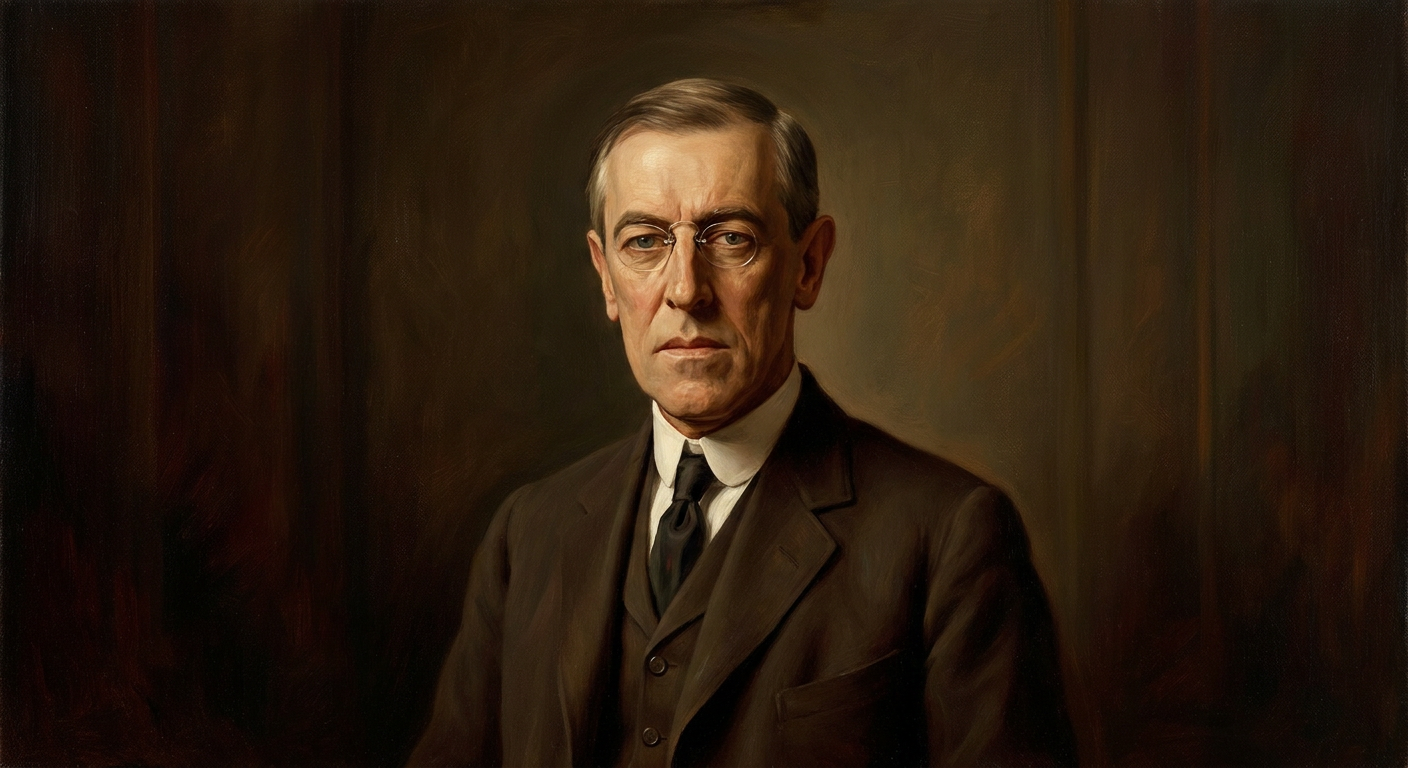
Quick Facts
- Years
- 1856 – 1924
- Category
- World Leaders & Revolutionaries
- Nationality
- American
- Occupation
- Scholar, university president, governor, and 28th U.S. president
Woodrow Wilson
1856 – 1924 · American · Scholar, university president, governor, and 28th U.S. president
Recommended Audiobooks
Listen next from Marcus Alden

Life Lessons from Simon Bolivar
Marcus Alden · 55 min

Life Lessons from George Washington
Marcus Alden · 54 min
Woodrow Wilson was a scholar-president whose ideas helped reshape both the United States and the international order. As the 28th president of the United States, serving from 1913 to 1921, he enacted major economic reforms, led the country through World War I, and promoted the League of Nations as a new way to prevent future wars. His call for national self-determination and collective security influenced diplomacy long after his own plans met defeat.
Yet Wilson's record contains profound contradictions. He spoke of democracy abroad while his administration reinforced racial segregation within the federal government. He defended constitutional government but tolerated severe restrictions on dissent during wartime. His interventions in Latin America also conflicted with his language about national sovereignty.
Wilson remains important because both his achievements and failures illuminate central questions of modern government: How should democracies regulate economic power? When should a nation intervene abroad? Can international institutions preserve peace? What happens when universal ideals are applied selectively?
His life therefore resists a simple verdict. Wilson was an influential reformer, an ambitious wartime leader, a visionary internationalist, and a president responsible for policies that caused lasting harm. Studying him means confronting all of those realities together.
Quick Facts
| Fact | Details |
|---|---|
| Full Name | Thomas Woodrow Wilson |
| Common Name(s) | Woodrow Wilson |
| Born | December 28, 1856 |
| Died | February 3, 1924 |
| Age at Death | 67 |
| Birthplace | Staunton, Virginia, United States |
| Nationality | American |
| Occupation | Political scientist, professor, university president, governor, U.S. president |
| Historical Era | Progressive Era and World War I |
| Famous For | Domestic reform, World War I leadership, Fourteen Points, League of Nations |
| Political Affiliation | Democratic Party |
| Religion | Presbyterian |
| Education | Princeton; University of Virginia School of Law; Ph.D., Johns Hopkins University |
| Parents | Joseph Ruggles Wilson and Jessie Janet Woodrow Wilson |
| Spouse(s) | Ellen Louise Axson; Edith Bolling Galt Wilson |
| Children | Margaret, Jessie, and Eleanor Wilson |
| Major Works | Congressional Government, The State, Division and Reunion, A History of the American People, Constitutional Government in the United States |
| Major Achievements | Federal Reserve, tariff and antitrust reform, wartime leadership, Fourteen Points, League of Nations proposal, Nobel Peace Prize |
Early Life
Thomas Woodrow Wilson was born in Staunton, Virginia, to a Presbyterian minister and his wife. He grew up in Georgia and South Carolina during the Civil War and Reconstruction. His father served churches in the Confederacy, and the Wilson household employed enslaved labor before emancipation. This Southern environment strongly shaped his cultural assumptions, including views about race that he retained throughout his life.
Wilson learned to read later than many children. Some modern writers have suggested dyslexia, but no retrospective diagnosis can be established with certainty. He nevertheless developed formidable powers of concentration, public speaking, and structured argument.
After briefly attending Davidson College, Wilson entered the College of New Jersey, later called Princeton University. He graduated in 1879, studied law at the University of Virginia, and practiced briefly in Atlanta. Finding legal work unrewarding, he turned to academic study.
At Johns Hopkins University, one of America's first research universities, Wilson studied history and political science. His dissertation became Congressional Government in 1885. He received a doctorate in 1886, making him the only U.S. president to earn a Ph.D.
Rise to Prominence
Wilson taught at several institutions before joining Princeton's faculty in 1890. His lectures and books made him a recognized authority on American government. He argued that constitutional systems evolved over time and that energetic leadership was necessary to coordinate modern government.
In 1902, Princeton's trustees selected him as university president. Wilson introduced academic standards, reorganized instruction around smaller discussion groups, and tried to weaken exclusive student clubs. His reform campaign won national attention but ended in bitter disputes with donors, trustees, and faculty members. The conflict revealed both his courage as a reformer and his tendency to treat compromise as surrender.
New Jersey Democrats recruited him as their gubernatorial candidate in 1910. Party bosses expected an academically distinguished but manageable nominee. Once elected, Wilson broke with the machine and secured primary-election reform, utility regulation, workers' compensation, and anti-corruption measures.
His rapid success made him a national progressive figure. In 1912, a Republican split between President William Howard Taft and former president Theodore Roosevelt allowed Wilson to win the presidency with about 42 percent of the popular vote but a decisive electoral majority.
Major Achievements
The New Freedom reforms
Wilson entered office promising to restore competition and curb concentrated economic power. The Underwood Tariff reduced import duties, while the recently ratified Sixteenth Amendment allowed revenue to be replaced through a federal income tax.
The Federal Reserve Act of 1913 created a central banking structure intended to make currency and credit more flexible and to reduce financial panics. Although amended many times, the Federal Reserve remains central to American economic policy.
The Federal Trade Commission Act established an agency to investigate unfair business practices. The Clayton Antitrust Act strengthened restrictions on monopolistic behavior and gave organized labor some protection from antitrust prosecution. Wilson also supported farm-credit legislation, an eight-hour day for interstate railroad workers, and limits on child labor; the Supreme Court later invalidated the child-labor law.
Appointment of Louis Brandeis
In 1916 Wilson nominated Louis D. Brandeis to the Supreme Court. After a contentious confirmation fight marked partly by antisemitic opposition, Brandeis became the Court's first Jewish justice and an important defender of civil liberties and progressive legal thought.
Leadership during World War I
Wilson initially proclaimed neutrality after war began in Europe in 1914. He won reelection in 1916 after a campaign emphasizing peace, although he also pursued military preparedness. Germany's renewed unrestricted submarine warfare and the Zimmermann Telegram helped convince him that neutrality was no longer sustainable.
Congress declared war on Germany in April 1917. The United States mobilized millions of service members, financed the Allied effort, and sent the American Expeditionary Forces under General John J. Pershing to Europe. American power helped break the strategic stalemate, though the Allies had already endured years of enormous sacrifice.
Fourteen Points and the League of Nations
In January 1918 Wilson proposed the Fourteen Points, including more open diplomacy, arms reduction, freer trade, adjustment of colonial claims, and a general association of nations. These principles helped frame expectations for peace, although the final Treaty of Versailles departed from them in significant ways.
Wilson personally attended the Paris Peace Conference and made creation of the League of Nations his central objective. The League became an important predecessor of the United Nations. For his peacemaking efforts, Wilson received the 1919 Nobel Peace Prize.
Support for women's suffrage
Wilson was initially cautious and resisted demands from activists who picketed the White House. In 1918 he endorsed a federal suffrage amendment as a wartime democratic measure. Congress approved the Nineteenth Amendment in 1919, and it was ratified in 1920. Suffragists' organizing—not presidential initiative—was the decisive force, but Wilson's support assisted final passage.
Leadership or Work
Wilson approached politics as both a teacher and a moral advocate. He delivered the annual presidential message personally before Congress, reviving a practice abandoned since Thomas Jefferson. He used speeches to define broad principles and expected legislators to act on them.
His strengths included intellectual preparation, command of policy, persuasive language, and willingness to challenge entrenched interests. He assembled a productive domestic-reform coalition and recognized that industrial society required stronger national institutions.
His weaknesses were equally consequential. Wilson could be rigid, self-righteous, and intolerant of disagreement. Once he interpreted an issue as a contest between right and wrong, negotiation became difficult. That trait contributed to his break with Princeton trustees, deteriorating relations with wartime critics, and the Senate's rejection of the Versailles treaty.
Personal Life
Wilson married Ellen Louise Axson in 1885. A talented artist and socially engaged first lady, Ellen supported housing reform in Washington. They had three daughters: Margaret, Jessie, and Eleanor. Ellen died of kidney disease in the White House in August 1914, leaving Wilson deeply bereaved.
In 1915 he married Edith Bolling Galt, a Washington widow. Their courtship attracted intense public interest. Edith became his closest companion and, after his disabling stroke in 1919, controlled access to him and screened official business.
Wilson enjoyed golf, cycling, theater, automobiles, and detective stories. He was capable of warmth and humor among intimates, although public photographs contributed to an austere image. His health was fragile: he experienced vascular problems before the presidency and suffered a catastrophic stroke while campaigning for the League of Nations.
Philosophy or Beliefs
Wilson's worldview combined Presbyterian moral seriousness, progressive reform, nationalism, and faith in constitutional development. He believed government should respond to changing social conditions rather than remain fixed in eighteenth-century practices.
Domestically, he sought regulated competition more often than public ownership. Internationally, he came to believe that peace required collective rules rather than a traditional balance of power. Nations, in his view, should cooperate against aggression through a League of Nations.
His language about self-government inspired people in Europe, Asia, Africa, and the Middle East. Yet he applied self-determination unevenly, generally prioritizing European territorial questions while accepting continued colonial rule elsewhere. His universal rhetoric therefore raised expectations his diplomacy did not fulfill.
Wilson's racial beliefs were a grave limitation on his democratic vision. Like many white Americans of his era—but unlike contemporary Black leaders and white racial-justice advocates—he accepted segregation and paternalistic ideas of white supremacy. Those views shaped federal policy and cannot be dismissed merely as products of his time.
Challenges and Controversies
Federal segregation and racial injustice
Wilson's administration permitted or encouraged segregation in federal offices that had previously employed Black and white workers together. Departments introduced separated workspaces, discriminatory hiring, and, in some cases, screened work areas and segregated facilities. Black civil servants lost opportunities and status.
When civil-rights leader William Monroe Trotter challenged him in 1914, their White House meeting became confrontational. Wilson defended segregation as beneficial rather than recognizing its discriminatory purpose and effects. Historians widely regard this record as one of the most damaging parts of his presidency.
Wilson also screened D. W. Griffith's The Birth of a Nation at the White House. The film glorified the Ku Klux Klan and distorted Reconstruction. The often-repeated claim that Wilson enthusiastically praised it with the phrase “history written with lightning” rests on uncertain evidence; scholars dispute the quotation's authenticity.
Civil liberties during World War I
The Espionage Act of 1917 and Sedition Act of 1918 were used against antiwar activists, socialists, labor organizers, and journalists. Socialist leader Eugene V. Debs received a prison sentence after criticizing the war. The administration's propaganda agency, the Committee on Public Information, promoted unity but also encouraged an atmosphere hostile to dissent and German American culture.
The postwar Red Scare brought the Palmer Raids, mass arrests, and deportations. Attorney General A. Mitchell Palmer directed the campaign, but it occurred under Wilson, whose illness reduced his active supervision. Administrative responsibility remains part of Wilson's record even where his personal involvement was limited.
Intervention abroad
Wilson said the United States should respect Latin American nations, yet his administration intervened repeatedly. American forces occupied Haiti in 1915 and the Dominican Republic in 1916, producing coercive rule, armed resistance, and long-lasting resentment. He also sent troops into Mexico, first at Veracruz and later in pursuit of revolutionary leader Pancho Villa.
Defenders argued that Wilson faced instability, threats to foreign nationals, and strategic pressures. Critics answer that the interventions subordinated local sovereignty to American power and economic interests.
The Treaty of Versailles defeat
Wilson refused to include leading Republican senators in the American peace delegation. Senator Henry Cabot Lodge supported international cooperation but demanded reservations limiting League obligations. Wilson feared those changes would destroy the system's credibility.
Rather than accept compromise, Wilson toured the country to appeal directly to voters. After his stroke, the administration concealed the severity of his incapacity. The Senate rejected the treaty in November 1919 and again in March 1920, and the United States never joined the League. Historians debate how much blame belongs to Wilson, Lodge, partisan hostility, or legitimate constitutional concerns, but Wilson's inflexibility clearly mattered.
Presidential incapacity
Wilson's October 1919 stroke left him partially paralyzed and impaired his ability to work. Edith Wilson, physicians, and advisers restricted information about his condition. She later described herself as a “steward,” not an acting president, but she determined which matters reached him. The episode exposed a constitutional gap later addressed more clearly by the Twenty-Fifth Amendment.
Legacy
Wilson transformed the presidency by making it a more direct center of legislative and public leadership. Institutions created during his administration—especially the Federal Reserve and Federal Trade Commission—remain pillars of the federal government.
His internationalism influenced Franklin D. Roosevelt and the architects of the United Nations, NATO, and later collective-security systems. The League of Nations failed to prevent another world war, but its agencies and principles contributed to subsequent international institutions.
Modern assessments have become more critical as institutions reconsider his racism. Princeton removed Wilson's name from its School of Public and International Affairs and a residential college in 2020, while retaining his history within educational interpretation. His Washington home is preserved by the National Trust for Historic Preservation, and his birthplace in Staunton operates as the Woodrow Wilson Presidential Library and Museum.
Wilson's legacy is neither simply heroic nor wholly disastrous. It demonstrates how far-reaching reform and exclusionary prejudice can coexist within one political career.
Interesting Facts
- Wilson was the first—and remains the only—U.S. president with an earned doctorate.
- His first name was Thomas, but he generally used Woodrow in adulthood.
- He witnessed wounded Confederate soldiers in Augusta, Georgia, as a child.
- He briefly practiced law in Atlanta before entering academic life.
- He taught at Bryn Mawr and Wesleyan before joining Princeton.
- He became Princeton's president in 1902.
- His entire career in elected office lasted only about a decade.
- He was the first sitting president to visit Europe while in office.
- He revived the custom of addressing Congress in person.
- His first inaugural took place one day after a major women's suffrage march in Washington.
- Sheep grazed on the White House lawn during World War I to reduce maintenance costs and support the Red Cross.
- Wilson used a transatlantic wireless message to help trigger the demolition of Panama's Gamboa Dike in 1913.
- He appears on the discontinued $100,000 gold certificate, intended only for official transactions.
- He appointed the Supreme Court's first Jewish justice, Louis Brandeis.
- He received the 1919 Nobel Peace Prize.
- He is buried at Washington National Cathedral, the only U.S. president interred in Washington, D.C.
- His papers and correspondence reveal that he used shorthand in his youth.
Famous Quotes
- “Government is not a machine, but a living thing.” — The New Freedom (1913). Wilson used this organic metaphor to argue that institutions must adapt to society.
- “The Constitution of the United States was not made to fit us like a strait jacket.” — Constitutional Government in the United States (1908). It summarizes his belief in an evolving constitutional system.
- “There must be, not a balance of power, but a community of power.” — “Peace Without Victory” address, January 22, 1917. He proposed collective security in place of rival alliances.
- “Only a peace between equals can last.” — The same 1917 address. Wilson warned that a punitive settlement could produce renewed conflict.
- “The world must be made safe for democracy.” — War message to Congress, April 2, 1917. It framed American intervention in explicitly ideological terms.
- “We have no selfish ends to serve. We desire no conquest, no dominion.” — War message, 1917. Later interventions and unequal wartime influence complicate this claim.
- “Open covenants of peace, openly arrived at.” — Fourteen Points address, January 8, 1918. Wilson presented transparent diplomacy as an antidote to secret agreements.
- “National aspirations must be respected; peoples may now be dominated and governed only by their own consent.” — Four Principles address, February 11, 1918. Its broad promise was applied inconsistently at Paris.
- “The ear of the leader must ring with the voices of the people.” — The New Freedom (1913). The line reflects his ideal of responsive leadership, though critics note his own limited tolerance for dissent.
- “It is like writing history with lightning.” — Frequently attributed to Wilson after The Birth of a Nation, but the evidence is disputed; it should not be treated as a securely documented quotation.
Timeline
- 1856 — Born in Staunton, Virginia.
- 1875 — Enters the College of New Jersey after attending Davidson College.
- 1879 — Graduates from Princeton.
- 1882 — Begins a brief Atlanta law practice.
- 1885 — Marries Ellen Axson; publishes Congressional Government.
- 1886 — Receives his Ph.D. from Johns Hopkins.
- 1890 — Joins Princeton's faculty.
- 1902 — Becomes president of Princeton University.
- 1910 — Elected governor of New Jersey.
- 1912 — Elected president of the United States.
- 1913 — Inaugurated; signs the Underwood Tariff and Federal Reserve Act.
- 1914 — Signs the Federal Trade Commission Act and Clayton Antitrust Act; Ellen Wilson dies; World War I begins in Europe.
- 1915 — Marries Edith Bolling Galt; orders occupation of Haiti.
- 1916 — Wins reelection; nominates Louis Brandeis to the Supreme Court.
- 1917 — Asks Congress for war against Germany.
- 1918 — Announces the Fourteen Points; supports a federal women's suffrage amendment; Germany signs the armistice.
- 1919 — Attends the Paris Peace Conference; signs the Treaty of Versailles; suffers a severe stroke; receives the Nobel Peace Prize.
- 1920 — Senate rejects the treaty again; Nineteenth Amendment is ratified.
- 1921 — Leaves office and remains in Washington.
- 1924 — Dies on February 3 and is buried at Washington National Cathedral.
Frequently Asked Questions
1. What was Woodrow Wilson best known for?
Wilson is best known for progressive economic legislation, leading the United States during World War I, and proposing the League of Nations. His Fourteen Points offered an influential vision of a rules-based peace. He is also remembered critically for federal segregation, wartime repression, interventions in Latin America, and his failure to secure U.S. membership in the League.
2. Was Woodrow Wilson a Democrat or Republican?
Wilson was a Democrat. As New Jersey governor and president, he represented the party's progressive wing while retaining support from conservative Southern Democrats. His coalition combined Southern voters, urban communities, reformers, and parts of the working class. The tensions among those groups shaped both the accomplishments and exclusions of his administration.
3. Why did Wilson initially keep America out of World War I?
Wilson believed neutrality could protect a diverse American population, preserve trade, and allow the United States to mediate peace. Many Americans opposed entering a distant European conflict. German submarine attacks, the Zimmermann Telegram, and Germany's resumption of unrestricted submarine warfare eventually persuaded Wilson that neutrality could no longer protect American rights or security.
4. Why did the United States enter the war in 1917?
Germany resumed unrestricted submarine warfare, risking American ships and lives, and the intercepted Zimmermann Telegram revealed a German proposal for an alliance with Mexico if war began. Wilson concluded that German policy threatened neutral rights and international order. Congress approved war by large majorities, although several legislators cast principled votes against intervention.
5. What were the Fourteen Points?
They were Wilson's proposed principles for a postwar settlement, announced in January 1918. They included open diplomacy, reduced trade barriers, arms limitation, adjustments of European borders, consideration of colonial populations, and an association of nations. The Versailles settlement incorporated some territorial ideas and established the League, but it did not fully follow Wilson's program.
6. Why did the United States reject the League of Nations?
Some senators feared League membership might allow international obligations to weaken Congress's constitutional authority over war. Others supported membership only with reservations. Wilson rejected Senator Lodge's proposed conditions, believing they would cripple collective security. Partisanship, institutional rivalry, public fatigue, and Wilson's inflexibility combined to defeat ratification.
7. Did Wilson create the Federal Reserve?
Wilson signed the Federal Reserve Act in 1913 and helped negotiate its passage, but the institution was a collective legislative achievement. Representative Carter Glass, Senator Robert Owen, Treasury officials, bankers, agrarian reformers, and congressional committees all shaped the system. The resulting network balanced a national board with regional reserve banks.
8. What was Wilson's record on race?
It was deeply discriminatory. His administration expanded segregation in federal workplaces, tolerated unequal employment practices, and defended separation using paternalistic racial arguments. He also held historically distorted views of Reconstruction. Black leaders protested at the time, demonstrating that his policies were contested by contemporaries and cannot be excused as universally accepted attitudes.
9. Did Wilson support women's suffrage?
Eventually, but not from the beginning. Wilson initially treated suffrage as an issue for individual states and resisted activists' pressure. During World War I he endorsed a federal amendment, arguing that women's national service strengthened the democratic case. Decades of campaigning by suffragists remained the essential cause of the Nineteenth Amendment's adoption.
10. What happened to Wilson's health in 1919?
After an exhausting speaking tour promoting the League, Wilson suffered a major stroke in October 1919. He was left partially paralyzed and seriously impaired. His wife, doctors, and advisers concealed much of his condition while Edith Wilson screened his work. The lack of transparent succession procedures created a prolonged constitutional and administrative problem.
11. Was Edith Wilson effectively president?
She did not take the oath, formally assume presidential powers, or claim the title. Nevertheless, she controlled access to Wilson and decided which documents and officials reached him. Historians disagree over how much policy authority she exercised, but most reject the romanticized label “first woman president” while recognizing her unusually powerful gatekeeping role.
12. Why did Wilson intervene in Latin America?
His administration cited instability, protection of foreign nationals, financial disorder, strategic security, and—in Mexico—the actions of armed factions. Yet interventions in Haiti, the Dominican Republic, and Mexico imposed American power on sovereign countries. Scholars often interpret them as evidence of the conflict between Wilson's anti-imperial language and his paternalistic interventionism.
13. Did Wilson win the Nobel Peace Prize?
Yes. The Norwegian Nobel Committee awarded him the 1919 Nobel Peace Prize, presented in 1920, for his role in founding the League of Nations. The award recognized an influential effort rather than a completed success: the United States rejected League membership, and the organization later proved unable to stop aggression by major powers.
14. Was Wilson a successful president?
The answer depends on the standard applied. His domestic economic laws had enduring institutional influence, and his international principles shaped later organizations. Against those achievements stand racial discrimination, suppression of civil liberties, military occupations, failed treaty diplomacy, and concealment of incapacity. Many historians therefore rate him as highly consequential but increasingly reject unqualified praise.
15. Where is Woodrow Wilson buried?
Wilson is buried in Washington National Cathedral in Washington, D.C. He is the only U.S. president whose final burial place is within the nation's capital. His second wife, Edith, is buried beside him. His Georgian Revival home on S Street, where he lived after leaving office, is preserved as a historic site.
Lessons We Can Learn
- Institutions can outlast their creators. The Federal Reserve remains influential despite extensive later revisions; durable reform requires structure, not only speeches.
- Moral language must match policy. Wilson's democratic rhetoric clashed with segregation and occupation, showing why principles should be applied consistently.
- Compromise can preserve part of a goal. His refusal to accept treaty reservations helped lose U.S. League membership entirely; this is a modern strategic interpretation grounded in the ratification record.
- Expertise improves leadership but does not guarantee judgment. Wilson's scholarship aided policy design, yet knowledge did not prevent serious errors.
- Civil liberties are most vulnerable during crises. Wartime prosecutions demonstrate how fear can narrow democratic tolerance.
- Contemporary criticism matters. Black leaders, suffragists, antiwar activists, and senators challenged Wilson in his own lifetime; injustice was not invisible to his generation.
- Transparency protects constitutional government. Concealment of Wilson's stroke produced uncertainty over who was exercising authority.
- International organizations need political support. Vision alone could not make the League effective without sustained participation by powerful states.
- Inspirational promises create expectations. Colonized peoples heard Wilson's self-determination language even when negotiators applied it narrowly.
- Historical judgment should hold contradictions together. Wilson's reforms neither erase his racism nor become historically meaningless because of it.
Related Historical Figures
- Theodore Roosevelt — Progressive rival whose 1912 candidacy split the Republican vote.
- William Howard Taft — Incumbent president defeated by Wilson in 1912.
- Henry Cabot Lodge — Senate leader and principal opponent in the Versailles treaty struggle.
- Edith Wilson — Second wife who controlled access to the disabled president.
- Ellen Axson Wilson — First wife, artist, and housing-reform advocate.
- Louis Brandeis — Progressive lawyer whom Wilson appointed to the Supreme Court.
- William Jennings Bryan — Secretary of state who resigned over Wilson's response to submarine warfare.
- John J. Pershing — Commander of American forces in Europe during World War I.
- Georges Clemenceau — French premier who pressed for stronger security provisions at Paris.
- William Monroe Trotter — Black civil-rights leader who directly confronted Wilson over segregation.
Watch and Learn
“America in World War I: Crash Course US History #30” — CrashCourse — approximately 14 minutes. This widely viewed educational overview clearly explains why the United States entered World War I, how mobilization changed American society, and how Wilson's Fourteen Points shaped the peace debate. It is especially useful when paired with a fuller examination of Wilson's domestic record and racial policies.
Watch and Learn
America in World War I: Crash Course US History #30 · CrashCourse
Related Historical Figures